
 GROWTH GUIDE
Multi-Location SEO: The Visibility Playbook For Chains
Multi-location SEO is the work of making every physical location your brand operates discoverable and trustworthy to search engines and AI recommenders, not just your headquarters. Get this wrong and your best-performing store loses foot traffic to a weaker competitor that simply has cleaner data. Start with five moves:
- Verify a Google Business Profile for every single location, no exceptions.
- Publish one unique, high-quality location page per real business unit.
- Pick a single source of truth for your name, address, and phone number (NAP), then sync everywhere from it.
- Launch a review collection habit at every location, not just the flagship.
- Add basic LocalBusiness schema tying each page to its Google Business Profile.
Each item feeds a different signal. Verified profiles control your Maps presence. Unique pages earn organic rankings instead of getting filtered as duplicates. Clean NAP data builds the trust score both Google and AI recommenders lean on. Reviews drive both rankings and click-through. Schema closes the loop by telling machines these are the same business entity.
Key Takeaways
Multi-location SEO succeeds when clean, centralized data feeds unique location pages, verified profiles, and consistent reviews across every single business unit.
| Point | Details |
|---|---|
| Fix data first | Establish one single source of truth for NAP before optimizing pages or schema. |
| Build real pages, not doorways | Publish unique location pages only for actual business units, never for every nearby zip code. |
| Pilot before scaling | Test the full template and review program on 3 to 10 locations for 90 days first. |
| Track per-location metrics | Monitor GBP clicks, rankings, conversions, and reviews at the individual location level. |
| Automate to avoid drift | Service Grower centralizes NAP sync, location pages, and review management to prevent the manual errors that stall most programs. |
Table of Contents
- 30/90/180-Day Multi-Location SEO Checklist
- What Is Multi-Location SEO, And Why Does It Matter?
- Core Tactics That Move The Needle
- A Reusable Location Page Template You Can Scale
- Managing Google Business Profiles Across Dozens Of Locations
- Building Citations And Local Authority That Compound
- Measuring What’s Working At Each Location
- Governance: Where Multi-Location Programs Actually Fail
- The Rollout Sequence: Audit, Pilot, Scale
- What Most Multi-Location Programs Get Wrong
- Let Service Grower Handle The Scale Problem For You
- Sources
30/90/180-Day Multi-Location SEO Checklist
Most multi-location programs stall because teams try to fix everything at once across every location. A phased plan avoids that trap.
First 30 days:
- Verify or reclaim every Google Business Profile.
- Audit NAP consistency across your top 10 directories.
- Select 3 to 10 pilot locations that represent your typical store type.
- Fix glaring listing errors: wrong hours, dead phone numbers, duplicate profiles.
Days 31 to 90:
- Publish full location pages for the pilot group using a repeatable template.
- Implement LocalBusiness schema on every pilot page.
- Start a review solicitation workflow, even if it is just a text message after service.
Days 91 to 180:
- Connect your location data to a central sync system instead of manual updates.
- Roll out the page template chainwide with local variables slotted in.
- Begin local PR and backlink outreach for underperforming markets.
- Set up ongoing monitoring so you catch drift before it costs rankings.
What Is Multi-Location SEO, And Why Does It Matter?
Search engines and AI answer engines evaluate two different things at once: your brand as an entity and each location as a discrete, verifiable place. Google Maps, Google Business Profile, and large language models all need to confirm that “the downtown branch” and “the airport branch” are real, separate, operational businesses, not duplicate content wearing different addresses. Search Engine Land’s guide to multi-location visibility frames the goal as building the smallest number of high-quality pages necessary to represent your actual business units, not one page per zip code you wish you ranked for.
Get this right and the payoff is direct: more foot traffic to the right store, more booked jobs for service-area teams, and a defense against your own locations competing with each other for the same search terms. Get it wrong and locations cannibalize each other, confuse AI recommenders about which branch actually serves a customer’s neighborhood, and bleed trust every time a directory shows the wrong hours.
The mechanics shift by business type:
- Storefront retail and restaurants need tight NAP accuracy and Maps visibility since customers are walking distance away.
- Service-area businesses like HVAC or plumbing need clear service-radius data since there’s often no public storefront.
- Franchises with local owners need governance that lets each owner add authentic local flavor without breaking brand consistency.
Core Tactics That Move The Needle
This is where most programs either compound their advantage or waste a year of budget on generic templates. Six levers actually move rankings and AI citations.
Location pages that earn their own rankings
A location page justifies its existence when it answers a real customer question a shared brand page can’t. That means the specific address, hours (including holiday exceptions), the exact services offered at that branch, staff or manager names, geo-coordinates, and FAQs written for that neighborhood, not copy-pasted from the homepage with a city name swapped in. Search Engine Journal’s guide to local SEO for multiple locations treats unique location pages, consistent NAP, and structured data as the non-negotiable foundation, and thin, templated pages tend to get filtered together as duplicate content rather than ranked individually.
Google Business Profile as the front door
Your GBP category selection determines which searches you even show up for, so primary categories need to match your actual core service, with secondary categories filling in adjacent offerings. Attributes (wheelchair access, outdoor seating, online booking) affect which filtered searches surface you. Photos matter more than most teams assume: profiles with recent, location-specific photos consistently outperform stale stock imagery in click-through. Weekly or biweekly GBP posts keep the profile active, and every profile should link to its own specific location page, never the generic homepage.
Schema and entity signals AI models can parse
LocalBusiness schema with areaServed, geo, and openingHoursSpecification gives machines structured facts instead of asking them to infer everything from prose. The property that ties it together is sameAs, which links your location page directly to its verified GBP listing and social profiles. Search Engine Journal notes that this entity clarity is exactly what lets AI answer engines confirm your website location and your Maps listing describe the same business, which matters more now that a growing share of local discovery happens inside a chat interface rather than a search results page.
Citations and directories, prioritized
Not every directory deserves equal effort. Data aggregators and navigation partners (the sources that feed GPS systems and voice assistants) matter more than niche directories nobody’s customer actually visits. Automated sync tools handle the bulk of citation consistency; manual fixes should be reserved for the handful of high-authority listings where automation fails.
Reviews and reputation at scale
Review velocity matters as much as volume. A location with 40 reviews trickling in steadily over two years reads differently to both algorithms and customers than one that got 40 reviews in a single suspicious week. Response cadence counts too. Aim to respond to every review, positive or negative, within 48 hours, and treat this as a location-manager responsibility with corporate oversight, not something headquarters can realistically do for 200 locations alone.

Local content that gives AI something to cite
Neighborhood-specific content, event pages, and mentions in local publications give AI recommenders more than a bare NAP listing to work with. Search Engine Journal’s research on AI-era local visibility finds that recommenders weigh review quality, accurate business data, and strong location pages together, essentially triangulating trust from multiple signals rather than any single one.
Pro Tip: Write your location page FAQs from actual customer service call logs or texts, not from what you assume people ask. The real questions are almost always more specific and more local than what a content team guesses.
A Reusable Location Page Template You Can Scale
A location page works when it looks unmistakably like it was written for that address, not lightly edited from a master document. Here’s the section-by-section structure worth standardizing.
| Section | Content requirement |
|---|---|
| H1 | Service plus place name (e.g., “HVAC Repair in Riverside”) |
| Summary | Two to three sentences on what this specific branch does |
| Address, hours, phone | Pulled from your single source of truth, never typed manually per page |
| Directions and parking | Local detail: nearest cross street, parking lot notes |
| Services offered | The actual service menu at this location, not the full brand catalog |
| Staff | Names and photos of the manager or lead technicians at that site |
| Local testimonials | Reviews or quotes specific to that location |
| Local FAQs | Questions pulled from real customer interactions at that branch |
| Schema JSON-LD | LocalBusiness markup with geo, areaServed, and sameAs to GBP |
Brand boilerplate (company history, mission statement, general trust badges) can repeat across pages without penalty. What can’t repeat: photos, staff names, testimonials, and local case studies. Search Engine Land warns against building a page for every geographic keyword you’d like to rank for; build pages only for real business units or genuinely distinct service regions, and keep each one long enough and specific enough to survive scrutiny as a standalone page rather than a doorway.
If a location has no public storefront, a service-area page describing the coverage zone usually beats forcing a fake address into a location-page template.
Managing Google Business Profiles Across Dozens Of Locations
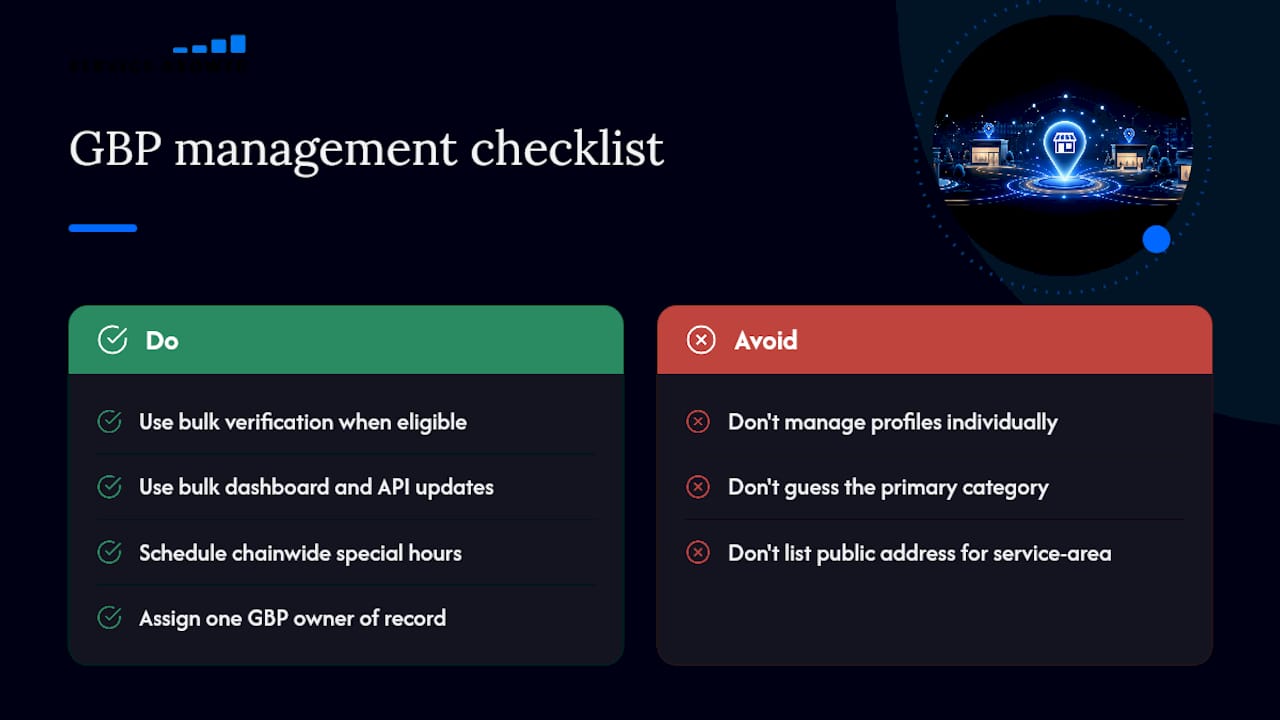
Verification gets harder as you scale. Postcard verification works fine for five locations; it becomes a logistics nightmare for 150. Chains with an established history and clean records often qualify for bulk verification through Google’s business tools, which cuts weeks off onboarding for new locations.
Once verified, resist the urge to manage each profile by hand. A bulk dashboard approach, paired with API-driven updates where your team has the technical resources, keeps hours, categories, and photos consistent without a marketing coordinator logging into 80 separate accounts every time a store extends its Sunday hours.
Category selection deserves real thought, not a default guess. Primary category should match your core revenue driver exactly; secondary categories cover the rest of what you legitimately offer. Special hours (holidays, weather closures) need updating chainwide on a schedule, not location by location whenever someone remembers.
Every GBP should link straight to its matching location page, and that page’s schema should include sameAs pointing back to the GBP listing itself. Google’s own guidelines on representing a business cover exactly how storefronts and service-area businesses should each be represented, and the distinction matters: a service-area business that lists a public address it doesn’t actually staff risks suspension.
Pro Tip: Assign one person as the GBP owner of record for your entire portfolio, even if local managers handle day-to-day posts. Split ownership across dozens of individual Google accounts is how chains lose access to their own listings during staff turnover.
Building Citations And Local Authority That Compound
Structured citations (Yelp, Apple Maps, Bing Places, and the data aggregators that feed dozens of smaller directories) function differently than unstructured mentions like a local newspaper write-up or a neighborhood blog post. Both matter, but structured citations are the foundation because they’re what data aggregators and navigation systems pull from directly.
Prioritize your citation effort this way:
- Data aggregators and Maps platforms first, since errors here cascade into dozens of smaller directories.
- Industry-specific directories second, since they carry topical trust for your category.
- General local directories last, since their SEO value is modest.
Unstructured authority takes longer to build but compounds harder. Local PR, sponsoring a youth sports team, partnering with a nearby complementary business, or contributing to a community event page all generate the kind of organic local mentions that a purchased citation never will. These are also exactly the signals research on AI-era local recommenders points to as increasingly important: AI models cite businesses that show up in genuine local context, not just directory listings.
Measuring What’s Working At Each Location
A dashboard that only shows brand-wide averages hides your best and worst performers equally. You need location-level visibility into the metrics that actually predict business outcomes.
| Metric category | What to track per location |
|---|---|
| GBP performance | Profile views, calls, direction requests, website clicks |
| Organic visibility | Location page rankings for core service terms, Map Pack presence |
| Conversion signals | Calls booked, forms submitted, appointments scheduled |
| Reputation | Review volume, review velocity, average rating, response time |
| AI visibility | Mentions or citations in AI answer sources, when tools can detect them |
Run a central dashboard for portfolio-wide trends, but build the capability to slice every metric down to a single location, because that’s where the action items actually live. A brand average of 4.3 stars can hide one location sitting at 3.1 that’s quietly losing every close call against a competitor.
Direct AI visibility measurement is still immature compared to traditional rank tracking, so most teams rely on proxy signals: whether a location’s NAP and schema are clean enough for an AI model to parse confidently, and whether the business shows up when you manually query popular AI assistants about services in that area.
Governance: Where Multi-Location Programs Actually Fail
The failure mode almost every multi-location program hits eventually isn’t a lack of strategy. It’s data drift and page bloat from having no governance model at all. Common pitfalls include doorway pages built for every nearby zip code, templated pages so thin they read as duplicate content, NAP that says one thing on the website and another on Yelp, missing schema on half the portfolio, and duplicate GBP listings nobody remembers creating.
The fix is a governance structure, not more effort:
- One single source of truth for NAP that pushes updates outward, never gets edited in five different spreadsheets.
- A clear permissions matrix: which fields corporate locks (brand name, core hours, logo) and which fields local managers can edit (staff bios, local promotions, seasonal notes).
- Template rules that define the required sections of every location page, with an approval flow before anything publishes.
Backlinko’s guidance on multi-location SEO is blunt about this: manual synchronization at scale almost always produces inconsistencies that quietly erode local visibility, even when every individual update looked correct at the time it was made.
Pro Tip: Give local managers permission to edit the things customers actually notice (photos, hours, promotions) and lock everything that affects brand consistency or legal accuracy. That split alone prevents most governance disasters.
The Rollout Sequence: Audit, Pilot, Scale
Trying to fix 200 locations simultaneously is how programs stall for a year with nothing shipped. A staged rollout gets you real data faster.
- Audit. Inventory every location’s indexation status, GBP verification state, and existing citation accuracy. Establish baseline KPIs before touching anything.
- Pilot. Choose 3 to 10 locations that represent your typical store profile, not just your best-performing ones. Build the full location-page template, launch the review program, and measure results for a full 90 days.
- Scale. Automate data sync so NAP updates push everywhere at once, roll the page template out chainwide with local variables filled in, train local managers on their piece of the governance model, and keep the monitoring dashboard running continuously.
Wix’s multi-location framework makes the same point from a different angle: working directly with location managers to collect accurate branch information up front saves far more time than retrofitting corrections after a rushed chainwide launch.
What Most Multi-Location Programs Get Wrong
The programs that actually work don’t start with the biggest ambition. They start small, prove the model works on a handful of locations, and only then scale it with confidence. The programs that fail almost always tried to roll out 150 location pages simultaneously with a template nobody stress-tested first.
The highest-ROI move in this entire playbook is unglamorous: a single, clean data repository for NAP that every platform pulls from. Teams obsess over schema markup and content strategy while their citations still show three different phone numbers for the same location. Fix the data foundation before you optimize anything sitting on top of it.
Prioritize locations by revenue opportunity and competitive pressure, not alphabetically and not by whichever regional manager complains loudest. A location in a competitive market with weak reviews deserves attention before a location with no real competitors nearby, even if the second one is easier to fix.
One tradeoff worth accepting temporarily: imperfect GBP data at low-priority locations while your team fixes the systemic sync problem, is a better use of limited time than perfecting every listing manually while the underlying data pipeline stays broken. Paralysis by analysis kills more multi-location programs than bad tactics do.
Let Service Grower Handle The Scale Problem For You
Everything above works. It also takes real hours: syncing NAP across dozens of directories by hand, writing genuinely unique location pages one at a time, chasing reviews location by location. Service Grower is built specifically to remove that manual burden instead of adding another dashboard to check.
The platform handles the parts that break most multi-location programs: AnswerReady™ generates location pages built to be found by both search engines and AI assistants, centralized NAP sync keeps your data consistent across Google, directories, and social without a spreadsheet, built-in review management collects and responds to feedback at every location, and GrowthView gives you the per-location dashboard this guide recommends without custom-building one yourself. Managed Google and Meta ad options are available too, for locations that need a paid boost while organic visibility catches up.
If your team is managing this manually across more than a handful of locations, start with a pilot on your toughest markets. Book a 15-minute call to see whether Service Grower fits your rollout, or explore the full platform to see how the pieces connect.
Sources
Before building out your own program, bookmark a few references your team will return to repeatedly:
- Multi-Location SEO: How To Win Google & AI Search Visibility At Scale
- Multi-Location SEO: How to win Google & AI search visibility at scale
- Guidelines for representing your business on Google