
 GROWTH GUIDE
Local Ad ROI: Small Businesses Must Count Offline Bookings
Measure ROI as (ad-attributed revenue minus ad cost) divided by ad cost, then adjust the revenue figure to include offline bookings and repeat-customer value, not just the first sale. Before trusting that number, confirm your conversion tags and call tracking are actually capturing the sales that happen off-screen.
TL;DR:
- Track form submissions, booking confirmations, and purchases separately; store each lead’s GCLID, enable enhanced conversions, and test the full path on a real device.
- Track calls and in person sales by campaign; without a CRM, record new customers in a spreadsheet and upload matched conversions monthly.
- Calculate customer value using average ticket, repeat visits, and gross margin; an LTV to CAC ratio below 1 means each customer relationship loses money.
- Last click can overcredit branded search and retargeting while undervaluing awareness; test incremental impact with matched locations or periods over 8 to 12 weeks.
- Allow campaigns 2 to 4 weeks and 15 to 20 conversions before judging viability; seasonal businesses should assess performance over a rolling 90 day window.
Table of Contents
- Key metrics and formulas every local business needs
- Track online conversions: tags, GCLIDs, and enhanced conversions
- Track offline conversions: calls, walk-ins, and CRM tie-ins
- Attribution and incrementality: last-click limits and smarter alternatives
- Adjust ROI for customer value: LTV, payback window, and LTV:CAC
- Channel notes and practical benchmarks for local ads
- Budget allocation and realistic timelines to evaluate performance
- Quick measurement checklist and templates to use this week
- How Service Grower helps local businesses measure and improve ad ROI
- What local advertisers get wrong most often
- A managed path to tying your ad spend to real revenue
- FAQ
- Sources
Key metrics and formulas every local business needs
ROI tells you profitability, but it only works when the inputs are right. Four numbers do most of the work:
- ROI: (Revenue − Ad Cost) ÷ Ad Cost, expressed as a percentage.
- ROAS: Revenue ÷ Ad Cost, a simpler ratio often used for quick channel comparisons.
- CPA/CAC: Ad Cost ÷ Number of Conversions, showing what each customer costs to acquire.
- LTV (simplified): Average Ticket × Expected Repeat Visits × Gross Margin.
Say a $1,000 campaign brings in 10 customers at a $150 average ticket, for $1,500 in first-visit revenue. ROAS reads 1.5, which looks mediocre. Service businesses especially need to account for margins: raw revenue overstates return when materials, labor, or booking fees eat into each sale.
Track online conversions: tags, GCLIDs, and enhanced conversions
Accurate ROI starts with capturing the right online signals. Three conversion actions matter most for local businesses: form submissions, booking confirmations, and completed purchases. Treat each as a distinct conversion action so you can see which step in the funnel is actually converting.
- Install conversion tracking tags on your confirmation pages, not just your contact forms.
- Capture the GCLID (Google Click Identifier) at the moment of lead submission and store it with the lead record, since this is what lets you later import offline sales back to the ad click that caused them.
- Set up enhanced conversions for leads, which hash and match first-party data like email or phone number to raise match rates beyond what GCLIDs alone capture.
- Test the full path from click to confirmation using a real device before trusting the data.
Pro Tip: Run a test lead through your own form weekly and confirm it shows up in your ads platform within 24 hours. Silent tracking failures are the most common reason ROI looks worse than it actually is.
Common pitfalls include tags firing on page load instead of form submit, and GCLIDs getting dropped when leads move between systems without a persistent field to hold them.

Track offline conversions: calls, walk-ins, and CRM tie-ins
Most local ad value gets lost the moment a customer picks up the phone or walks in the door instead of completing a form. Closing that gap takes a few concrete steps.
- Use call tracking numbers tied to specific campaigns, then import call conversion data into your ads platform while configuring conversion actions carefully to avoid double-counting.
- Record each booking or sale in your CRM with the GCLID or hashed contact details attached, then use offline conversion imports to match that revenue back to the original ad click.
- For very small operations without a CRM, keep a simple spreadsheet log of new customers with a “how did you hear about us” field and upload matches to your ads platform monthly.
Even a manual, once-a-month import beats no offline tie-in at all, since it is the only way to see whether ad-driven leads actually convert to paying customers.
Attribution and incrementality: last-click limits and smarter alternatives
Platform dashboards default to last-click attribution, which credits whichever ad a customer clicked last, even when they would have booked anyway. This tends to overstate the contribution of branded search and retargeting while understating awareness channels that start the journey.
- Last-click numbers are a starting point, not a verdict on what caused the sale.
- Holdout tests, where you run ads in some locations or time periods and withhold them in matched controls, show true incremental lift rather than correlation.
- A geo-test or matched-store holdout run over 8 to 12 weeks, comparing calls, direction requests, and bookings between treatment and control groups, gives a realistic read on what ads are actually adding, a method validated in a large-scale field experiment across thousands of local businesses.
A scalable alternative to running constant experiments is prediction-based incrementality, which trains models on past randomized experiments to estimate the true incremental effect of campaigns that were never run as formal tests. Research on this approach found it produces meaningfully more accurate incrementality estimates than last-click attribution alone, which matters for any owner deciding whether to renew or cut a channel.
Adjust ROI for customer value: LTV, payback window, and LTV:CAC
A customer who costs $80 to acquire looks unprofitable if you judge only the first $60 ticket. The picture changes once you factor in repeat visits.
- Estimate LTV with a simple formula: Average Ticket × (1 + Repeat Rate × 2.5) × Gross Margin, which approximates the value of future visits without needing complex modeling.
- Pick a payback window that matches your sales cycle: 30 days for impulse services, 90 days for considered purchases like home repair, or 365 days for memberships and recurring contracts.
- Divide LTV by CAC to get your LTV:CAC ratio; a ratio below 1 means you are losing money on each customer relationship, while most healthy local service businesses aim comfortably above 3.
Choosing the wrong payback window is where many owners misjudge performance, since a campaign that looks like a loss at 30 days can turn solidly profitable once repeat visits are counted at 90 or 365 days.
Channel notes and practical benchmarks for local ads
Different channels deliver different kinds of leads, and comparing them on the same yardstick without context leads to bad decisions.
- Search ads typically capture high-intent demand from people already looking to buy, making them easier to tie directly to bookings.
- Maps and local service placements tend to drive calls and direction requests more than form fills, so call tracking matters more here than elsewhere.
- Social ads generally build awareness and work best measured over longer windows rather than judged on immediate conversions.
- Local video ads lift purchase intent meaningfully: one industry study found 53% of viewers of locally targeted video were more likely to purchase, compared with 13% for national-only ads.
- Local news placements can raise trust and purchase likelihood, according to research from Reach and PA Consulting, though these gains show up mostly in offline conversion data rather than click-through metrics.
Budget allocation and realistic timelines to evaluate performance
Most ad platforms need a learning period before their algorithms optimize well, so judging performance too early produces misleading conclusions.
- Give any new campaign at least 2 to 4 weeks and roughly 15 to 20 conversions before drawing conclusions about its viability.
- Split budget by goal: lean toward search for immediate bookings, social or video for awareness, and reserve a smaller test budget for local news or niche placements.
- Seasonal businesses should evaluate performance over a rolling 90 day window rather than month to month, since a single slow month can hide an otherwise solid trend.
Pro Tip: Hold your budget steady during the first evaluation window. Changing spend mid-test makes it nearly impossible to tell whether results came from the ads or the adjustment.
For a deeper look at how much to budget by channel, our guide on Google Ads cost for local businesses breaks down typical spend ranges.
Quick measurement checklist and templates to use this week
A short setup list gets most local businesses measuring accurately within days.
- Confirm conversion tags fire on confirmation pages, not just form loads.
- Set up call tracking numbers and verify they log correctly.
- Capture and store GCLIDs with every lead record.
- Map your CRM fields so offline sales can be matched and imported monthly.
- Outline a simple 90 day holdout: pick a comparable location or period to pause ads and compare results.
| Metric | Frequency | Source |
|---|---|---|
| ROAS | Monthly | Ads platform |
| CPA | Monthly | Ads platform |
| Offline conversions imported | Monthly | CRM |
| LTV:CAC | Quarterly | CRM + ads data |
How Service Grower helps local businesses measure and improve ad ROI
We built our platform around closing the exact gaps described above. Our tools support the measurement work this guide walks through:
- AnswerReady websites that capture leads with consistent conversion tracking built in.
- GrowthView analytics for monitoring ROAS, CPA, and conversion trends in one place.
- Review and customer interaction tracking that connects booking activity back to campaign sources.
- Managed Google and Meta ad services for businesses that want offline data tied back to ad performance without building the tracking themselves.
For structuring search campaigns around measurable local intent, see our guide to search-first local advertising.
What local advertisers get wrong most often
The biggest error we see is judging a campaign by week-two ROAS while ignoring offline bookings entirely. Fix conversion capture first, run a holdout before cutting spend, and adjust every number for LTV.
— Service Grower
A managed path to tying your ad spend to real revenue
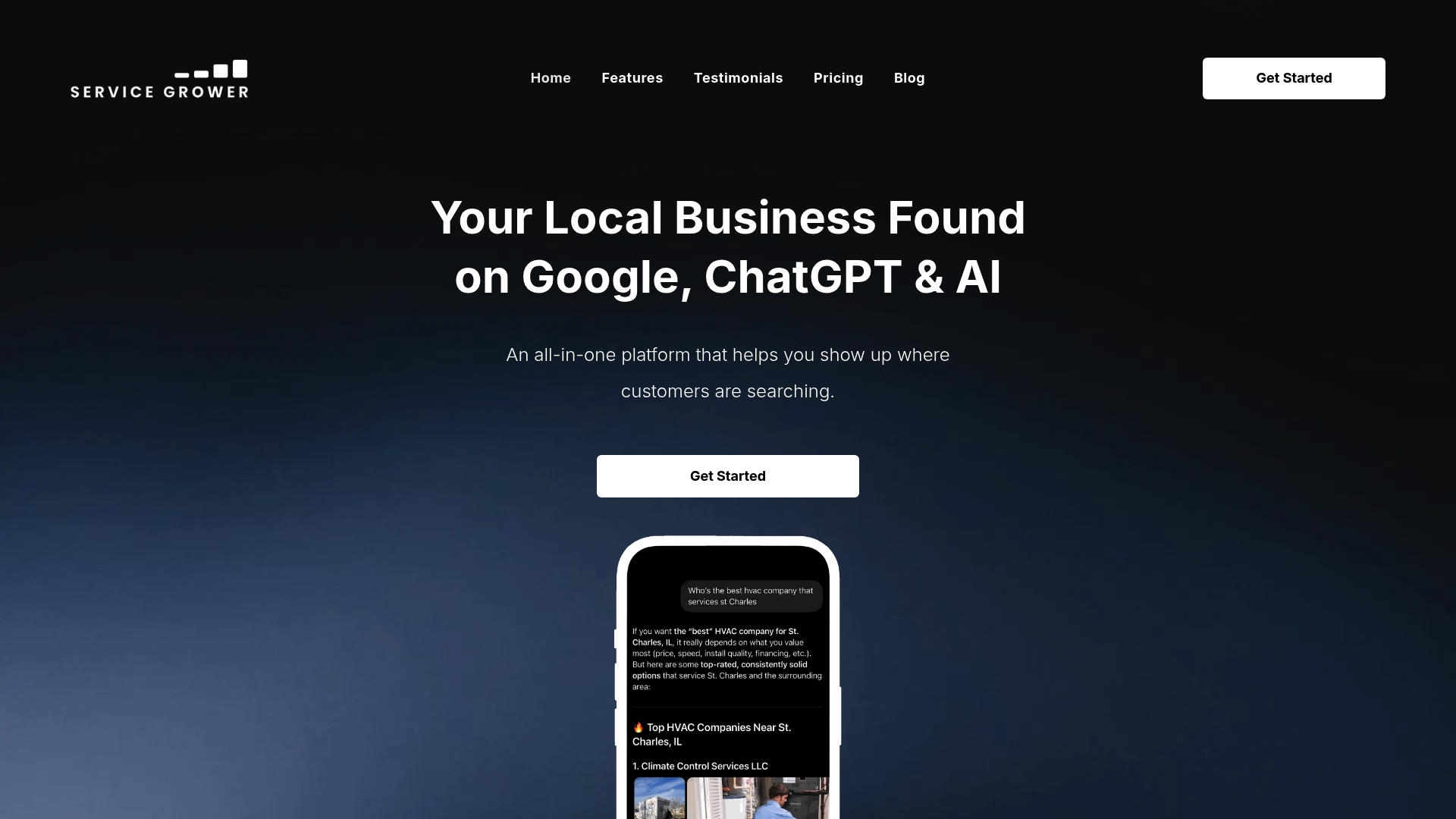
We handle the measurement groundwork directly: managed Google Ads and Meta Ads, analytics through GrowthView, and offline data tie-ins so bookings and calls get connected back to the campaigns that drove them.
- Managed ad setup paired with conversion and call tracking from day one.
- Offline conversion imports handled as part of ongoing account management.
- Monthly reporting that separates true incremental revenue from vanity clicks.
If piecing together tags, GCLIDs, and CRM imports sounds like more than your week allows, our Service Grower plan at $249 per month includes the measurement infrastructure built in. You can also start with our done-for-you local marketing setup to get tracking configured correctly from the start.
FAQ
What does the 70:20:10 rule mean in advertising?
Balancing consistent performance with ongoing discovery of new opportunities helps local businesses.
Is 4.5% a good return on local ad spend?
Compare any single figure against your own margin-adjusted ROI formula rather than a generic benchmark, since local ad performance varies widely by business type and review volume, as field experiment data shows.
What is the 3-3-3 rule for marketing?
The 3-3-3 rule is a general marketing framework suggesting content or campaigns be tested in short cycles, often interpreted as three days, three weeks, and three months, to evaluate short, medium, and longer-term results. Local advertisers can apply similar staged checkpoints when deciding whether to scale or pause a campaign.
What is the 60/40 rule in advertising?
For local businesses, balancing awareness channels like social or video against high-intent search and maps campaigns is important.
How soon should I expect to see ROI from local ads?
Most campaigns need at least 2 to 4 weeks and around 15 to 20 conversions before the data is reliable enough to judge. Seasonal or service businesses with longer sales cycles should evaluate results over a 90 day window to smooth out normal fluctuations.
Sources
- Localized video ads critical in increasing brand trust and consumer purchase intent, Locality study finds
- About offline conversion imports - Google Ads Help
- Predicted Incrementality by Experimentation (Management Science)
- Measuring the returns of advertising opportunities (Yelp field experiment) - NBER