
 GROWTH GUIDE
Local SEO for Franchises: A Franchise Owner's Playbook
The fastest way to improve local SEO for franchises is to treat each location as its own local entity inside one governed system: a verified Google Business Profile per location, a unique location page for each address, and a federated governance model that keeps brand data consistent while local teams handle the personal stuff. Skip any one of those three pillars and your locations start competing with each other instead of with actual competitors.
This week:
- Claim and verify every Google Business Profile (GBP) your franchise system owns
- Publish or repair location pages under a single subfolder structure
- Consolidate name, address, and phone (NAP) data into one master spreadsheet or system of record
This month (30/90 day):
- Assign a governance owner for data and templates at corporate
- Launch a review-request flow at the location level
- Schedule a full technical local SEO audit before quarter’s end
Pro Tip: Assign one person, even part time, to own NAP accuracy across every directory. Data drift is the single most expensive and preventable local SEO problem in franchise systems.
Key Takeaways
Franchise local SEO succeeds when every location has a verified Google Business Profile, a unique location page, and consistent NAP data governed centrally while executed locally.
| Point | Details |
|---|---|
| Claim every GBP first | A verified, complete profile per location is the highest-leverage single action available. |
| Use subfolder architecture | Host location pages at brand.com/locations for consolidated domain authority. |
| Apply the 70/30 content rule | Keep 70% brand template, 30% unique local content to avoid sibling cannibalization. |
| Centralize NAP data | One source of truth prevents the data drift that silently kills local rankings. |
| Consider an integrated platform | Service Grower combines location pages, GBP management, and review workflows into one system instead of separate tools. |
Table of Contents
- What Is Local SEO for Franchises, and How Is It Different?
- Does Local SEO Actually Move the Revenue Needle for Franchises?
- What Goes Wrong With Franchise Local SEO (and Why)
- The Core Pillars of a Franchise Local SEO Strategy
- How Do You Set Up and Manage Google Business Profiles at Scale?
- Where Should Location Pages Live: Subfolder, Subdomain, or Microsite?
- How Do You Keep NAP Data Consistent Across Hundreds of Listings?
- How Should Franchises Handle Review Generation and Response?
- How Do You Localize Content Without Creating Duplicate Pages?
- What Technical SEO Issues Are Unique to Franchise Location Pages?
- Can Local Link-Building Actually Help Franchise Locations Rank?
- What Schema Markup Do Franchise Locations Actually Need?
- What’s the Right Governance Model for Managing Hundreds of Locations?
- What KPIs Should Franchises Track, and How Often?
- What Should You Budget for Timeline and Cost?
- Your First 90 Days: The Implementation Checklist
- Lessons From Managing Local SEO Across Many Locations
- How an Integrated Platform Simplifies Franchise Local SEO
- Frequently Asked Questions
- Sources
What Is Local SEO for Franchises, and How Is It Different?
Local SEO for franchises means optimizing dozens or hundreds of individual locations for local search while protecting one shared brand identity, which is a fundamentally different problem than optimizing a single storefront. A single-location business only has to rank one page for one set of local terms. A franchise has to rank many pages for overlapping terms without those pages stealing traffic from each other.
The split comes down to intent:
- Corporate pages target brand-level searches (“[Brand Name] franchise,” “[Brand Name] services”)
- Location pages target near-me and zip-code intent (“plumber near me,” “HVAC repair 60614”)
Google’s AI Overviews and the Local Pack now pull from location-specific signals, not just domain authority, so a location with a thin or duplicated page loses visibility even if the parent brand ranks well nationally, according to Neil Patel’s franchise SEO analysis.
Does Local SEO Actually Move the Revenue Needle for Franchises?
Local Pack and GBP visibility drive foot traffic, phone calls, and bookings more directly than almost any other marketing channel a franchise location can control. When a location shows up in the three-pack for “auto repair near me,” it captures intent from someone ready to buy today, not someone researching for next quarter.
For franchise operators, that translates into concrete, trackable outcomes:
- Higher click-through rate on GBP listings with complete photos, hours, and services
- Better conversion rates from listings with active review responses versus dormant profiles
- Lower cost-per-acquisition (CPA) on paid local campaigns when organic local signals are already strong
A location that ranks in the Local Pack for its top three service categories typically pulls a disproportionate share of unit-level leads compared to sibling locations still buried on page two.
Tie every local SEO decision back to same-store revenue and unit-level lead volume. That is the only scoreboard that matters to a franchisee writing a check for marketing services.
What Goes Wrong With Franchise Local SEO (and Why)
Four failure patterns show up in nearly every multi-location system that hasn’t formalized its local SEO process:
- Sibling cannibalization, where two nearby locations compete for the same keyword instead of splitting territory
- Data drift, where a location’s phone number or suite number differs across ten directories
- Decentralized GBP misconfigurations, where a local manager changes a business category or name without approval
- Thin templated pages, where every location page is identical except for a city name swapped at the top
The fix isn’t complicated in principle: split search intent by geography, centralize the data that must stay consistent, and require at least some unique local signal on every page. The hard part is discipline at scale, not the tactics themselves.
Pro Tip: Lock GBP category and business name fields behind an approval workflow. A single franchisee adding “24/7” to a business name or switching a primary category can tank a listing’s Local Pack ranking for weeks before anyone notices.
The Core Pillars of a Franchise Local SEO Strategy
Nine pillars make up a complete franchise local SEO strategy, and they split cleanly into two tiers.
Foundational (fix first):
- GBP and listings: location-level prominence in the Local Pack
- Location pages and URL architecture: indexable, unique pages per address
- Citations and NAP: consistent data across every directory
- Governance and tooling: one system of record for brand and local data
Growth (build once foundations hold):
- Reviews and reputation: velocity and response consistency
- Local content and keywords: unique modules per location
- Schema and technical SEO: machine-readable local signals
- Links and partnerships: geographic relevance signals
- Measurement: location and brand-level KPI tracking
How Do You Set Up and Manage Google Business Profiles at Scale?
Every physical location needs a verified, complete GBP that links directly to its own location page. That single requirement solves more Local Pack problems than any other tactic on this list, according to Google’s official Business Profile guidance.
The setup checklist, in order:
- Confirm the correct primary category (this affects ranking more than almost any other field)
- Enter a consistent phone number format matching your NAP source of truth
- Match the address format exactly to your legal business listing, including suite numbers
- Set accurate hours, including holiday hours
- List services specific to that location, not a generic corporate list
- Upload at least 10 to 15 location-specific photos, not stock imagery
- Monitor and answer the Q&A section
- Post weekly updates, offers, or local news through GBP Posts
For bulk management, Google supports location groups for franchises verifying multiple addresses at once, but verification gotchas remain: changing a business name to add keywords, switching categories after the fact, or using a virtual office address can all trigger a suspension.
- Corporate typically owns category standards, verification, and bulk uploads
- Local managers typically own photos, posts, and Q&A responses
Pro Tip: Never let a local manager change the business name field without corporate sign-off. “Name stuffing” (adding a city or service to the official name) is one of the fastest ways to get a listing suspended.
Where Should Location Pages Live: Subfolder, Subdomain, or Microsite?
Host location pages on the primary domain using a clear subfolder structure, something like brand.com/locations/state/city, in most franchise systems. This keeps all domain authority consolidated on one root domain instead of splitting it across separate properties, a point echoed in Savage Global Marketing’s franchise architecture analysis.
Exceptions exist. A franchise with wildly different local branding by region, or a legal separation between entities, may need subdomains. Microsites make sense only when a location operates under a materially different brand name.
| Structure | Pros | Cons | Best for |
|---|---|---|---|
| Subfolder | Consolidates domain authority, easiest to manage | Requires disciplined URL hierarchy | Most franchise systems |
| Subdomain | Some flexibility for regional branding | Splits authority, treated as separate site by some signals | Multi-brand or acquired systems |
| Microsite | Full creative control per location | Weakest authority transfer, hardest to maintain | Rare, distinct sub-brands only |
A working location page template includes:
- Full NAP block matching your source of truth exactly
- Geo coordinates and an embedded map
- Hours of operation, including seasonal variations
- Local manager or team bio with a photo
- Services offered at that specific address
- Three to five local reviews pulled dynamically
- A short FAQ addressing local-specific questions
- 700 to 1,200 words of genuinely unique content
Use canonical tags to avoid duplicate indexing, and apply noindex to placeholder pages for locations still under construction rather than letting Google crawl an empty template.
How Do You Keep NAP Data Consistent Across Hundreds of Listings?
A single source of truth for name, address, and phone data is non-negotiable once you cross more than a handful of locations. Without it, every directory update becomes a guessing game.
Run this audit sequence quarterly:
- Scan Tier 1 directories (Google, Bing, Apple Maps, Facebook) for mismatches
- Check aggregator status on Data Axle and similar providers, since errors there propagate downstream
- Flag phone number variations, including tracking numbers that shouldn’t appear publicly
- Verify suite and unit numbers match the legal address exactly
Prioritize citation targets in this order: Google Business Profile, Apple Maps, Bing Places, Data Axle, Facebook, then relevant industry directories and local chamber of commerce listings.
- Local managers report address or hours changes to corporate within 24 hours
- Corporate pushes the update across all Tier 1 listings within one business week
- A designated owner re-checks Tier 1 accuracy every 90 days
How Should Franchises Handle Review Generation and Response?
Adopt a hybrid review model: corporate owns strategy, templates, and monitoring; individual locations own execution and personalized responses, a structure that MapLift’s franchise review management framework identifies as the most sustainable at scale.
Generate reviews systematically rather than hoping customers remember:
- Trigger an SMS or email review request within an hour of service completion
- Place QR codes at checkout counters or on receipts
- Tie review requests into loyalty program touchpoints
Aim for consistent monthly review velocity per location, with 50 or more reviews per location treated as an early aspirational benchmark rather than a hard requirement.
Response protocol by star rating:
- 1 to 3 stars: Respond within 24 to 48 hours, acknowledge the specific issue, and take the conversation offline
- 4 stars: Thank the reviewer and note any specific detail they mentioned
- 5 stars: A short, genuine thank-you referencing their specific experience
Centralize monitoring through alerts that flag any review below four stars for immediate escalation, and report review volume and sentiment trends monthly to franchise leadership.
Pro Tip: Give local managers a response framework, not a rigid script. Reviewers can tell a copy-pasted reply from a genuine one, and generic responses undercut the authenticity that makes local reviews valuable in the first place.
How Do You Localize Content Without Creating Duplicate Pages?
This ratio keeps brand consistency intact while giving Google enough unique signal to index and rank each page independently.
Localized keyword patterns to build into page content and headers:
- City plus service (“Denver appliance repair”)
- Neighborhood plus service (“Highland Park dog grooming”)
- Near-me variants embedded naturally, not stuffed
- Zip-specific phrases where local competition is dense enough to warrant it
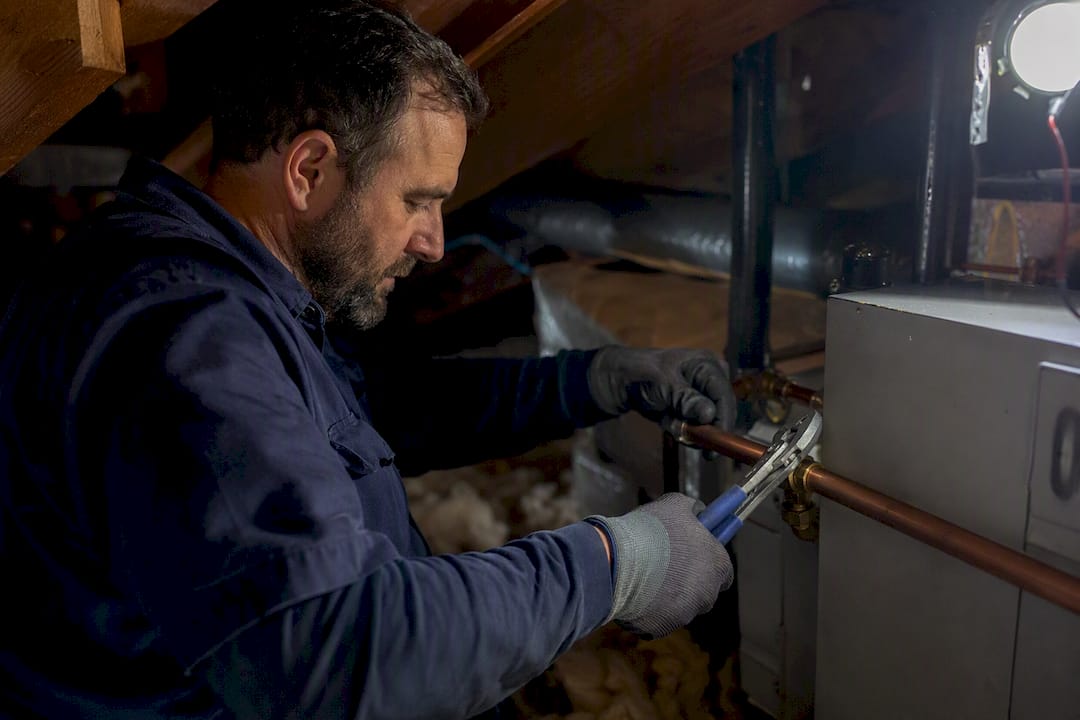
Reuse brand assets like core service descriptions and pricing structure, but layer in local modules: a recent job photo from that location, a testimonial from a local customer, or an FAQ answering a question specific to that market’s regulations or climate.
A sample local paragraph might read: “Our Highland Park team has serviced homes along Larchmont Avenue for six years, specializing in older HVAC systems common in the neighborhood’s 1920s housing stock.”
Link each location page back to relevant corporate pillar pages (main service pages, brand story) to pass authority without duplicating content.
Pro Tip: Interview one local employee per quarter for a two-sentence quote about a recent job. It’s the cheapest unique content you’ll ever produce, and it reads as authentic because it is.
What Technical SEO Issues Are Unique to Franchise Location Pages?
Every location page must be indexable, canonicalized correctly, and marked up with LocalBusiness schema. Miss any one of those three and the page either doesn’t get crawled properly or gets flagged as duplicate content against a sibling location.
Run this technical audit on every location page batch:
- Confirm the page returns a 200 status and appears in Google Search Console’s index coverage report
- Verify canonical tags point to the page itself, not a corporate hub page, unless it’s genuinely a placeholder
- Apply hreflang tags only if the franchise operates across multiple languages or countries; most single-country systems don’t need this
- Validate structured data with a schema testing tool before publishing
Performance checks that matter specifically for local pages:
- Compress and properly size local photos (oversized images are the most common speed killer on templated location pages)
- Set browser caching rules consistently across the location page template
- Test mobile rendering specifically, since most “near me” searches happen on mobile devices
Can Local Link-Building Actually Help Franchise Locations Rank?
Local links and mentions add geographic relevance that raw domain authority can’t replicate for Local Pack signals. A link from a neighborhood blog or a chamber of commerce carries more local weight than a high-authority national link that says nothing about geography.
Outreach ideas that scale across a franchise system:
- Sponsor local youth sports teams or community events
- Submit listings to local event calendars and chamber of commerce directories
- Pitch guest posts to neighborhood blogs and hyperlocal news sites
- Build supplier and vendor partnership pages that link back and forth
- Pursue local PR around community involvement stories
To scale outreach without burning out local teams:
- Build a central outreach template local managers can customize with two or three details
- Create a local press kit corporate updates quarterly
- Track link acquisition and Local Pack ranking movement together to measure real impact
What Schema Markup Do Franchise Locations Actually Need?
LocalBusiness schema with parentOrganization and AggregateRating properties is a required machine-readable signal for every franchise location page, based on Schema.
Required fields for each location’s JSON-LD:
name,address, andgeocoordinatesopeningHoursSpecificationtelephoneandurlparentOrganizationlinking to the brand entityaggregateRatingpulling from that location’s actual review dataareaServeddefining the service radius
A minimal example:
{
  "@type": "LocalBusiness",
  "name": "Brand Name - Highland Park",
  "address": {"@type": "PostalAddress", "streetAddress": "123 Main St"},
  "telephone": "+1-555-0100",
  "parentOrganization": {"@type": "Organization", "name": "Brand Name"}
}
Pro Tip: Run every location page through the Rich Results Test before publishing. A single missing comma in JSON-LD can invalidate the entire schema block without throwing an obvious error, using the process outlined in Google’s structured data codelab.
What’s the Right Governance Model for Managing Hundreds of Locations?
A federated governance model works best for most franchise systems: corporate controls data standards and page templates, while local teams execute unique content and handle GBP replies. This balances brand consistency with the local authenticity that actually drives rankings, an approach supported by BizIQ’s franchise SEO playbook.
| Model | Pros | Cons | Best for |
|---|---|---|---|
| Centralized | Maximum consistency, easiest to audit | Loses local authenticity, slow to react | Small systems under 20 locations |
| Federated | Balances brand control with local voice | Requires clear role definitions | Most franchise systems |
| Localized | Fast local response, high authenticity | Data drift risk, inconsistent quality | Highly independent franchisee models |
Define roles clearly: corporate owns NAP data, schema templates, and category standards. Local managers own GBP posts, review responses, and local content contributions. Set SLAs, like a 48 hour response window for review replies and monthly local content contributions per location.
Tooling checklist: a listings management platform, a centralized review dashboard, a CMS built for templated location pages, and schema automation so developers aren’t hand-coding JSON-LD for every new location.
Rolling this out requires real change management. Franchisees who’ve run their own marketing for years won’t automatically welcome centralized data control, so pair the rollout with training that shows them the revenue case and not just the compliance case.
What KPIs Should Franchises Track, and How Often?
Track both location-level and brand-level KPIs, reporting operational metrics weekly and strategic metrics monthly.
Core KPIs to track per location:
- Local Pack impressions and clicks
- GBP calls, direction requests, and website clicks
- Phone-call conversions (tie in call tracking where budget allows)
- Booking or lead conversions from the location page
- Review volume and sentiment trend
- Organic traffic to the location landing page
- Local keyword rankings for top service terms
Locations with complete, actively managed GBP profiles consistently pull more direction requests and calls than dormant listings, per Neil Patel’s franchise SEO framework.
Set up UTM parameters on every local campaign link and use call tracking numbers on location pages so leadership can attribute leads accurately instead of guessing which channel drove them.
What Should You Budget for Timeline and Cost?
A realistic rollout runs through five phases: discovery and audit (weeks 1 to 2), foundational fixes to NAP and GBP (weeks 3 to 6), location page buildout (weeks 6 to 12), review program and local link launch (months 3 to 4), then ongoing optimization.
Budget across these buckets:
- Listings and tooling subscriptions (scales with location count, but per-unit cost drops as volume grows)
- Content production for location pages (this cost scales linearly, since each page needs unique work)
- Developer time for schema and technical fixes (mostly a one-time template build)
- Review management tooling
- Optional managed advertising services layered on top of organic work
Tooling costs benefit from economies of scale. Content costs don’t, since every new location needs its own unique page.
Your First 90 Days: The Implementation Checklist
Days 0 to 30 (high priority):
- Audit and claim every GBP (owner: corporate)
- Consolidate NAP into one source of truth (owner: corporate)
- Fix Tier 1 directory mismatches (owner: corporate, with local verification)
- Publish or repair location pages missing basic fields (owner: dev/local)
- Set up review request flow at highest-volume locations (owner: local)
Days 31 to 60 (medium priority): 6. Add LocalBusiness schema across all location pages (owner: dev) 7. Launch localized content modules, 30% unique content per page (owner: local/corporate content team) 8. Establish review response SLA and train local managers (owner: corporate) 9. Begin local link outreach with a central template (owner: corporate/local)
Days 61 to 90 (optimization): 10. Review Local Pack ranking movement and adjust underperforming pages (owner: corporate)
Acceptance criteria: every GBP shows “verified” status, every location page passes a structured data validation check, and NAP data matches across all Tier 1 directories.
Lessons From Managing Local SEO Across Many Locations
What consistently breaks franchise local SEO isn’t a lack of tactics. It’s a lack of ownership. Someone has to be accountable for NAP accuracy, or it drifts within months no matter how good the initial setup was.
What works, every time: centralizing data governance while funding genuinely local content, measuring impact at the individual location level instead of only at the brand level, and treating GBP as a living asset that needs weekly attention, not a one-time setup task.
A common pitfall: launching identical templated pages across 50 locations and wondering why rankings stall. The fix isn’t more pages. It’s more local specificity within the pages you already have.
How an Integrated Platform Simplifies Franchise Local SEO
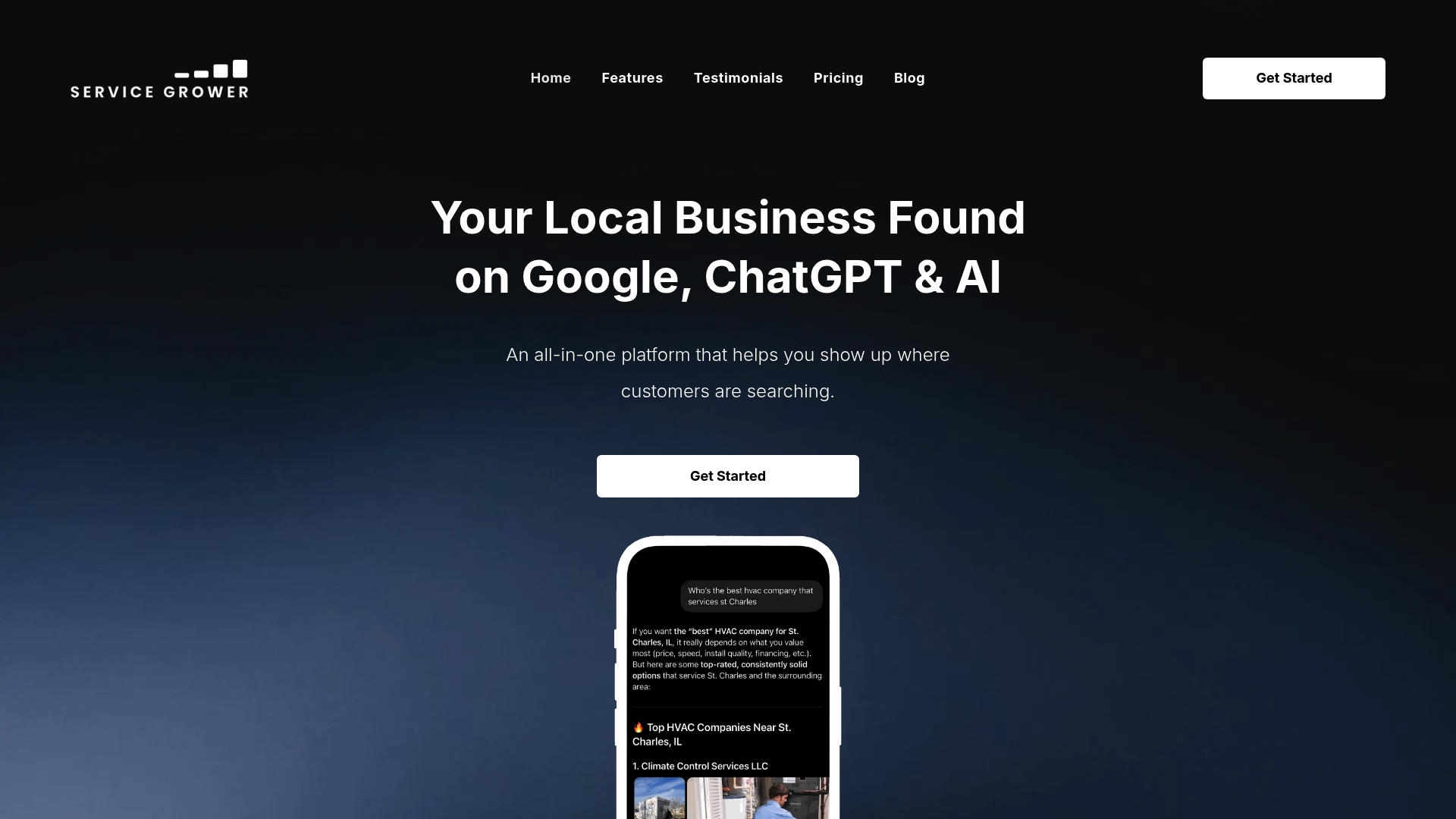
Running the playbook above manually across dozens of locations means juggling spreadsheets for NAP, a separate tool for reviews, another for analytics, and a developer queue for schema fixes. Service Grower consolidates that operating model into one system: AnswerReady websites handle location pages and schema automatically, GBP management and review workflows live in one dashboard, and GrowthView analytics reports the same KPIs discussed above without stitching together three data sources.
For a franchise team stretched thin between corporate marketing and local execution, that consolidation is the practical difference between a program that gets maintained and one that quietly decays after the initial launch. If you’re evaluating how to get found on Google and AI search across every location you operate, or want to see the platform in action, book a 15-minute call and bring your current location list. You’ll walk away with a clearer picture of what’s fixable this month versus what needs a longer runway.
Frequently Asked Questions
How is local SEO for franchises different from regular local SEO? Franchise local SEO has to manage brand consistency across many locations at once, splitting search intent between corporate brand pages and individual location pages so they don’t compete against each other.
How many Google reviews should each franchise location have? There’s no universal number, but treating 50 or more reviews per location as an early benchmark keeps review generation efforts consistent across a growing system.
Should each franchise location have its own website or a page on the main domain? A subfolder on the main domain (brand.com/locations/city) works best for most systems, consolidating domain authority rather than splitting it across separate sites.
Who should manage local SEO, corporate or the franchisee? A federated model works best: corporate manages data standards, templates, and schema, while local managers handle GBP posts, review responses, and local content details.
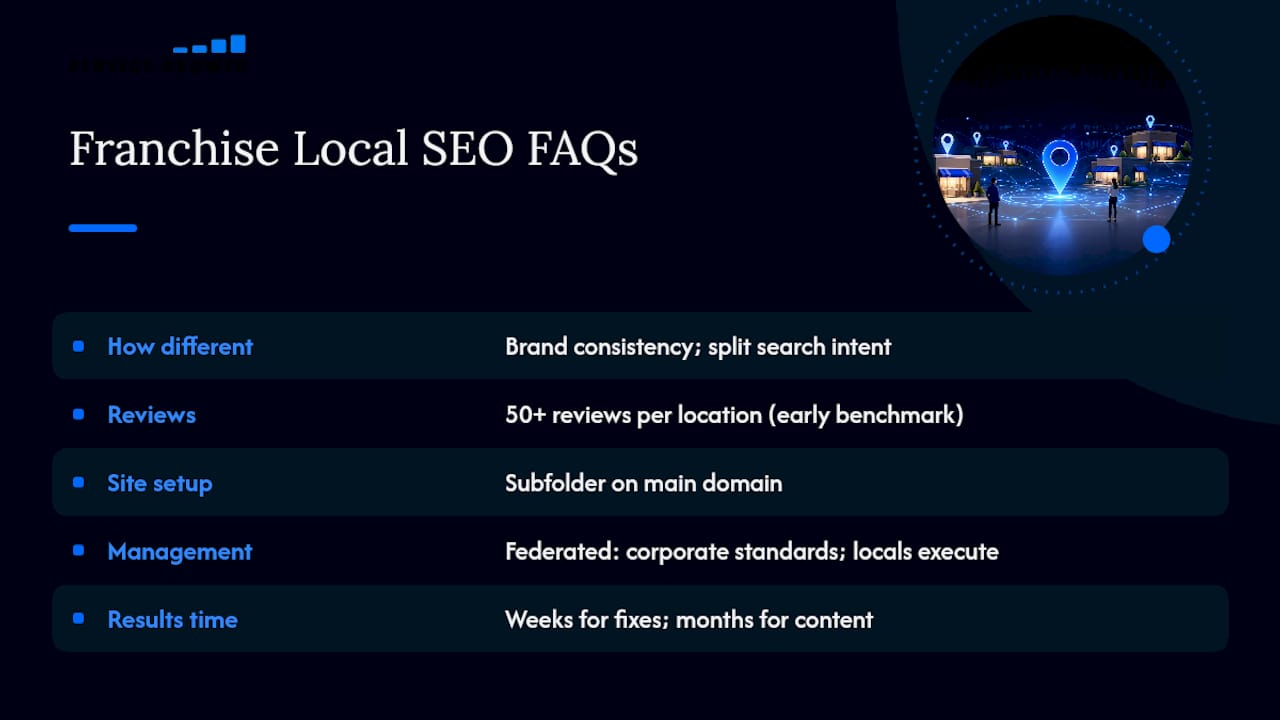
How long does it take to see results from franchise local SEO improvements? Foundational fixes like NAP cleanup and GBP completion often show movement in Local Pack visibility within weeks, while content and link-building improvements typically take a few months to compound.