
 GROWTH GUIDE
The Local SEO Checklist for Small Businesses in 2026
This 12-step local SEO checklist gives small and mid-size businesses the highest-impact tasks to improve local search visibility and map-pack rankings in 2026. Start with Google Search Console and GA4 (your measurement foundation), then move through GBP optimization, NAP consistency, on-page signals, schema, reviews, citations, local links, technical performance, multi-location management, and AI/LLM readiness. That last item is the 2026-specific addition most businesses are still ignoring.
Here are the 12 items in priority order:
- Install GSC + GA4 — High priority, 2–4 hours
- Claim and fully optimize Google Business Profile — High priority, 3–5 hours
- Fix NAP consistency across all listings — High priority, 2–8 hours
- Conduct local keyword research and map to pages — High priority, 3–6 hours
- On-page local SEO (title tags, H1s, location pages) — High priority, 4–8 hours
- Add LocalBusiness schema to key pages — High priority, 2–4 hours
- Build a review acquisition and response process — High priority, ongoing
- Audit and clean up citations and directories — Medium priority, 3–6 hours
- Local link building and PR outreach — Medium priority, ongoing
- Technical SEO and Core Web Vitals fixes — Medium priority, 4–12 hours
- Multi-location page governance — Medium priority (if applicable), 4–10 hours
- AI/LLM entity and schema readiness — High priority (2026-specific), a few hours
A complete local SEO audit covers all of these dimensions and should be repeated every 6–12 months to catch regressions before they cost you rankings.
Key Takeaways
A complete local SEO checklist for 2026 requires GBP optimization, NAP consistency, on-page schema, and AI entity signals working together — no single item alone moves the needle.
| Point | Details |
|---|---|
| GBP comes first | Claim, verify, and fully complete your Google Business Profile before any other optimization work. |
| NAP consistency is non-negotiable | Your name, address, and phone must match exactly across your site, GBP, and every directory listing. |
| Schema and AI readiness are 2026 priorities | Add LocalBusiness, Service, and FAQ schema now to be visible in LLM-driven search results. |
| Measure with GSC and GA4 | Use Google Search Console and GA4 as your authoritative sources for local ranking and conversion data. |
| Service Grower operationalizes the checklist | Service Grower’s platform handles GBP management, review automation, AI-optimized sites, and analytics in one place. |
Table of Contents
- What are the 10 fastest local SEO wins you can get in 30 days?
- How do you set up measurement for local SEO with GSC and GA4?
- How do you fully optimize your Google Business Profile in 2026?
- What on-page changes make your site rank for local searches?
- Is your site technically ready for local search in 2026?
- How do you build a review process that actually improves rankings?
- Which US directories should you prioritize for citation consistency?
- What local link building tactics still work in 2026?
- How do you manage local SEO across multiple locations?
- What KPIs should you track for local SEO, and how often?
- How do you make your business visible to AI assistants in 2026?
- Our take on what actually moves the needle first
- Service Grower gets the checklist done for you
- Sources
What are the 10 fastest local SEO wins you can get in 30 days?
Not every item on a local SEO checklist takes weeks. These 10 tasks are selected specifically because they produce measurable results fast, most within a single work session.
Task 1: Claim your GBP. Go to Google Business Profile Manager, search your business name, and claim the listing if it exists or create a new one. The single most important thing to get right here is your primary category. Choose the most specific category that describes your core service, not a broad one. A plumber should select “Plumber,” not “Contractor.”
Task 2: Fix NAP on your site. Your name, address, and phone number in the footer and on the contact page must match your GBP exactly, character for character. “St.” vs. “Street” is enough to create a mismatch that confuses citation aggregators.
Task 3: Ask for 5 reviews. Text or email your five most recent satisfied customers with a direct link to your GBP review form. Keep the message short: “Hi [Name], we’d love a quick Google review if you have 2 minutes. Here’s the link.” Timing matters more than the script.
Task 4: Add LocalBusiness schema. Paste a JSON-LD block into the <head> of your contact page with your business name, address, phone, hours, and URL. Validate it at Schema before publishing.
Task 5: Embed a Google Maps widget. Go to Google Maps, search your business, click Share, then Embed a map, and paste the iframe into your contact page. This takes under 30 minutes and reinforces your location signal.
Tasks 6–10 follow the same logic: small, discrete actions with outsized signal value. The mobile-friendly test alone can surface a rendering issue that’s been quietly killing your local pack visibility for months.
Pro Tip: Set a 30-day calendar reminder for each task. Checking off items in batches of 2–3 per week is more sustainable than trying to do everything in one sprint, and it gives Google time to process each change before you layer on the next.
How do you set up measurement for local SEO with GSC and GA4?
You can’t improve what you don’t measure. Before any other optimization work, get these two tools configured correctly.
Google Search Console setup
- Go to Google Search Console and add your site as a Domain property (not just a URL prefix) so GSC captures all subdomains and protocol variants.
- Verify ownership via DNS TXT record or Google Analytics.
- Submit your XML sitemap under Sitemaps.
- Use URL Inspection to check that your key local landing pages are indexed and rendering correctly.
- Filter the Performance report by page to isolate queries driving traffic to each location page.
GA4 setup for local tracking
- Create a GA4 property and install the Google tag on every page.
- Set up conversions for the events that matter locally: phone link clicks, direction requests, form submissions, and booking completions.
- Add a custom dimension for “location” if you have multiple service areas or pages, so you can segment traffic by city.
- Connect GA4 to your GSC property under Admin > Search Console Links.
Pro Tip: In GSC, filter the Performance report by a specific location page URL (e.g., /plumber-austin/) and look at the queries tab. You’ll see exactly which search terms are sending traffic to that page. If “emergency plumber Austin” is getting impressions but zero clicks, your title tag is the problem, not your rankings.
Statista’s data on local business search frequency in the US and Canada confirms that local search volume is substantial enough to justify this measurement investment from day one, not after you’ve already made changes.
How do you fully optimize your Google Business Profile in 2026?
GBP is the single highest-impact activity for local pack visibility, and 2026 checklists consistently rank it first for good reason. A fully completed, actively maintained profile outperforms a neglected one in every ranking study done on the local pack.
Fields that move the needle most
Primary category is the most consequential field in your entire GBP. Google uses it to decide which searches your listing is eligible to appear for. Choose the most specific category that matches your core service. If you run an HVAC company, “HVAC Contractor” beats “Contractor” by a wide margin.
Business description gets 750 characters. Use the first 250 on your core service, city, and one differentiator. Don’t stuff keywords. Write it the way you’d describe your business to a neighbor.
Services and products are underused by most small businesses. Add every service you offer with a name, description, and price (or price range). Google surfaces these in the knowledge panel and in AI-generated summaries.
Hours must be accurate, including holiday hours. An incorrect closing time is one of the fastest ways to generate a one-star review.
Attributes vary by category but can include “women-owned,” “veteran-owned,” “wheelchair accessible,” and payment methods. Fill in every attribute that applies.
Good vs. bad GBP entries
Good description: “Austin’s licensed HVAC contractor for residential and commercial heating, cooling, and air quality. Same-day service available. Serving Travis and Williamson counties since 2011.”
Bad description: “We are the best HVAC company in Austin Texas HVAC repair Austin TX HVAC installation Austin. Call us today for all your HVAC needs HVAC HVAC HVAC.”
The bad example reads like keyword stuffing because it is. Google’s spam detection flags it, and customers bounce immediately.
Pro Tip: Post to GBP at least once every two weeks. Use the “What’s New” post type for general updates and the “Offer” type for promotions. Each post stays live for seven days (offers stay until the end date), and active posting signals to Google that your listing is maintained. Add at least one new photo per week, ideally of real work, real staff, or real customers (with permission).
What on-page changes make your site rank for local searches?
Your website needs to reinforce every signal your GBP sends. That means mapping specific keyword topics to specific pages, writing metadata that matches local intent, and placing schema where search engines and LLMs can find it.
Keyword mapping to avoid cannibalization
One page per service-city combination. If you’re a plumber serving Austin, Round Rock, and Cedar Park, you need three separate location pages, not one page that mentions all three cities. Putting multiple cities on a single page splits the relevance signal and often ranks for none of them.
| Page URL | Target keyword | Title tag | H1 |
|---|---|---|---|
| /plumber-austin/ | Plumber Austin TX | Plumber in Austin, TX | Licensed Plumber in Austin, TX |
| /plumber-round-rock/ | Plumber Round Rock TX | Plumber in Round Rock, TX | Trusted Plumber in Round Rock, TX |
| /plumber-cedar-park/ | Plumber Cedar Park TX | Plumber in Cedar Park, TX | Local Plumber in Cedar Park, TX |
Metadata and microcopy that work
Title tags should follow the pattern: [Service] in [City], [State] | [Brand Name]. Keep them under 60 characters. Meta descriptions should include the city name, a specific benefit, and a call to action, all under 155 characters.
FAQ content on location pages is particularly valuable for AI visibility. Write questions the way a customer would actually ask them: “How much does a plumber cost in Austin?” or “Do you offer same-day plumbing service in Cedar Park?” Answer in 2–3 sentences with specific, factual information.
Embed a Google Maps widget on every location page, not just the contact page. This reinforces the geographic signal at the page level, not just the site level.
Is your site technically ready for local search in 2026?
Most local searches happen on mobile. If your site loads slowly or renders poorly on a phone, you’re losing customers before they ever read your content.
- Mobile-first rendering: Test every key page with Google’s Mobile-Friendly Test. Fix any viewport, font-size, or tap-target issues before anything else.
- Core Web Vitals: Run PageSpeed Insights on your homepage and top location pages. Target a Largest Contentful Paint (LCP) under 2.5 seconds, Cumulative Layout Shift (CLS) under 0.1, and Interaction to Next Paint (INP) under 200ms.
- Image compression: Oversized images are the most common LCP killer. Use WebP format and compress every image below 150KB where possible. Tools like Squoosh or ShortPixel handle this in bulk.
- Unused JavaScript and CSS: Use the Coverage tab in Chrome DevTools to identify unused code. Defer non-critical JS and remove unused CSS rules. This alone can cut 0.5–1.5 seconds off load time.
- Render-blocking resources: Move critical CSS inline and defer third-party scripts (chat widgets, analytics) that block the initial render.
- XML sitemap: Submit a current sitemap in GSC. Confirm all location pages are included and that no important pages are blocked in robots.txt.
- Canonical tags: Every location page needs a self-referencing canonical tag. If you have near-duplicate pages (e.g., a city page and a neighborhood page with similar content), canonicalize the weaker one to the stronger.
- Index coverage: Check GSC’s Coverage report monthly. Any “Excluded” or “Error” status on a location page needs immediate attention.
Run Lighthouse in Chrome DevTools for a combined performance, accessibility, and SEO score. Aim for 90+ on mobile for every location page. A score below 70 on mobile is a ranking liability in 2026.
How do you build a review process that actually improves rankings?
Reviews affect both your local pack ranking and your conversion rate once someone finds you. The process needs to be repeatable, compliant with Google’s guidelines, and fast enough that customers respond before the memory of your service fades.
Review request templates and timing
Ask within 24–48 hours of service completion. That’s when satisfaction is highest and the experience is fresh. Use SMS for the fastest response rate.
| Channel | Template | Best timing |
|---|---|---|
| SMS | “Hi [Name], thanks for choosing us! If you have 2 minutes, a Google review helps us a lot: [link]” | Within 24 hours |
| “Hi [Name], we hope everything went well. We’d love your feedback on Google: [link]. It only takes a minute.” | Within 48 hours | |
| In-person | “If you’re happy with the work, a quick Google review would mean a lot to us. Here’s a card with the link.” | At job completion |
Responding to reviews
Respond to every review, positive or negative, within 48 hours. For positive reviews, thank the customer by name and mention the specific service. For negative reviews, acknowledge the issue, apologize without admitting fault, and offer to resolve it offline.
On review gating: Google’s guidelines explicitly prohibit asking customers to leave a review only if they had a positive experience. Never filter who receives a review request based on their anticipated rating. Send the same request to every customer. Violating this policy risks having your reviews removed or your GBP suspended.
Review structured data (using itemReviewed and reviewRating in your schema) can be added to service pages, but only for reviews you actually collected and display on your own site. Never add review schema to pages that don’t visibly show those reviews. Validate your markup with Google’s Rich Results Test before publishing.
Which US directories should you prioritize for citation consistency?
NAP consistency across the web is a foundational ranking signal. A mismatch between your GBP address and your Yelp listing is enough to suppress your local pack visibility. The 2026 local SEO checklist consensus is clear: fix citations before you build new ones.
Citation audit checklist
- Search your business name in Google and note every listing that appears.
- Check the four major US data aggregators: Data Axle, Neustar Localeze, Foursquare, and Acxiom. Corrections here propagate to hundreds of downstream directories.
- Search “[business name] [city]” and “[phone number]” to find unlisted duplicates.
- Flag any listing with a wrong address format, old phone number, or outdated business name.
- Submit corrections directly on each platform or use a citation management tool to push updates in bulk.
High-value US directories to prioritize
Focus first on the directories that carry the most authority and the widest distribution: Google Business Profile, Apple Maps, Bing Places, Yelp, Facebook, the Better Business Bureau, and your industry-specific directories (Houzz for contractors, Healthgrades for medical, Avvo for legal, and so on). After those, work through the major data aggregators.
Run a citation audit quarterly. Directories merge, close, or change their data formats, and a listing that was correct six months ago may have drifted. Set a calendar reminder for January, April, July, and October.
What local link building tactics still work in 2026?
Links from locally relevant, authoritative sites carry more weight for local rankings than generic directory links. The goal is to earn mentions and links from sources that a local customer would actually trust.
| Opportunity type | What to offer | Where to track the gain |
|---|---|---|
| Local news features | Data, a story angle, or a community initiative | GSC referral traffic, GBP mentions |
| Chamber of commerce membership | Membership fee, participation | GSC links report |
| Sponsor a local event or team | Sponsorship fee | Referral traffic from event site |
| Community partnerships | Cross-promotion, co-authored content | GSC links report |
| Local business associations | Membership, expertise contribution | Domain authority signals in GSC |
For outreach, lead with what you’re offering, not what you want. A pitch that says “I’d love a link” goes nowhere. A pitch that says “I have data on [local topic] that your readers would find useful, and I’d be happy to write it up for you” gets responses.
Track your link-building progress in GSC under Links > Top linking sites. Watch for new referring domains appearing after outreach campaigns. Referral traffic in GA4 from local news or association sites is a strong signal that the link is passing real value, not just sitting in a footer.
How do you manage local SEO across multiple locations?
Multi-location businesses face a specific problem: how do you create unique, rankable location pages at scale without producing thin duplicate content?
Location page template
Each location page needs these elements to be both unique and rankable:
- A unique H1 that names the city and service (not just swapped from a template).
- 300–500 words of genuinely location-specific content: local landmarks, service area neighborhoods, staff names, or location-specific FAQs.
- LocalBusiness schema with the specific address, phone, and hours for that location.
- An embedded Google Maps widget for that location’s address.
- A unique meta title and description.
- At least 3 location-specific customer reviews displayed on the page.
The content length guidance matters. A 150-word page with swapped city names is thin content. Google has seen that pattern millions of times and ranks it accordingly.
Bulk GBP management
- Use GBP’s Location Groups feature to organize locations by region or brand.
- For 10+ locations, use the bulk upload spreadsheet in GBP to update hours, attributes, and descriptions at scale.
- Assign location managers for each physical location but restrict their permissions to hours and photos only. Keep category and description edits centralized to prevent drift.
- Run a monthly GBP audit across all locations using the GBP API or a management tool to catch unauthorized edits, suspended listings, or missing fields.
Governance rule of thumb: local managers handle what changes locally (hours, photos, event posts). Central marketing controls what must stay consistent (category, description, service list, NAP). Document this in a one-page policy and share it with every location manager.
What KPIs should you track for local SEO, and how often?
Tracking the wrong metrics wastes time. These are the signals that actually tell you whether your local SEO is working.
| KPI | Tool | Frequency | What a change means |
|---|---|---|---|
| Local pack impressions | GSC + GBP Insights | Weekly | Rising = better category/keyword fit |
| GBP clicks (calls, directions, website) | GBP Insights | Weekly | Drop = listing issue or competitor surge |
| Organic clicks to location pages | GSC Performance | Monthly | Flat = content or title tag problem |
| Review count and velocity | GBP Insights | Weekly | Slowing = request process broke down |
| Local landing page conversions | GA4 Events | Monthly | Low = UX or offer problem, not SEO |
| New referring domains | GSC Links | Monthly | Rising = link building working |
| Core Web Vitals scores | PageSpeed Insights | Monthly | Drop = new code or image added |
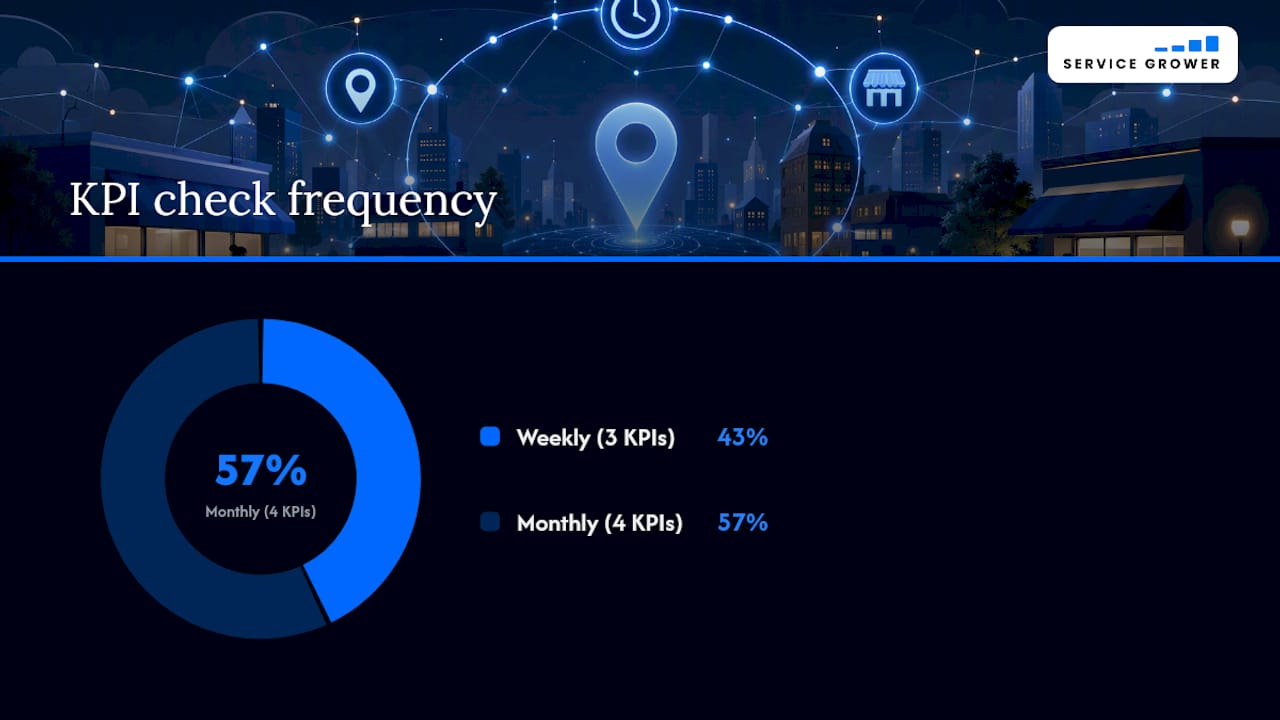
Weekly checks take 15 minutes if you build a simple dashboard in GA4 or a spreadsheet that pulls GBP data. Monthly checks are deeper: look at trends over 90 days, not just week-over-week, because local SEO moves slowly and short-term noise can mislead you.
GSC and GA4 are your authoritative sources. GBP Insights is useful for engagement signals but doesn’t replace GSC for search performance data. Use both together for a complete picture.
How do you make your business visible to AI assistants in 2026?
This is the item most local businesses are skipping, and it’s the one that will separate the visible from the invisible over the next two years. AI visibility requires explicit, consistent entity signals across your GBP, website, and citation sources so that LLMs can confidently identify your business and its services.
AI readiness checklist
- Add LocalBusiness structured data to your homepage and contact page with
name,address,telephone,openingHours,geo,url, andsameAs(linking to your GBP, Yelp, and Facebook profiles). - Add
Serviceschema to each service page withname,description,provider, andareaServed. - Add
FAQPageschema to any page with FAQ content. Write questions the way a customer would ask a voice assistant. - Use the same business name, address, and phone number everywhere, with zero variation. LLMs cross-reference sources; inconsistency creates ambiguity that gets resolved against you.
- Make sure your GBP description, website About page, and top citation listings all describe your business using the same core phrases and service names.
Schema snippet example (LocalBusiness, JSON-LD)
{
  "@context": "https://schema.org",
  "@type": "LocalBusiness",
  "name": "Austin Plumbing Co.",
  "address": {
    "@type": "PostalAddress",
    "streetAddress": "123 Main St",
    "addressLocality": "Austin",
    "addressRegion": "TX",
    "postalCode": "78701"
  },
  "telephone": "+15125550100",
  "openingHours": "Mo-Fr 08:00-18:00",
  "url": "https://austinplumbingco.com",
  "sameAs": [
    "https://www.google.com/maps/place/...",
    "https://www.yelp.com/biz/..."
  ]
}
Validate every schema block with Google’s Rich Results Test before publishing. Errors in your schema don’t just block rich results — they send a confusing signal to LLMs trying to parse your entity.
Pro Tip: Test whether an LLM is citing your business by running prompts like “Who are the best plumbers in Austin, TX?” or “Which HVAC companies in [your city] offer same-day service?” in ChatGPT, Perplexity, and Google’s AI Overview. If you’re not appearing, check whether your schema is valid, your GBP description matches your site’s service descriptions, and your citations are consistent. Run this test monthly and track changes.
Our take on what actually moves the needle first
The prioritization framework in this checklist is deliberate, and it’s worth explaining why GBP comes before everything else. Your Google Business Profile is the one asset Google controls the display of, but you control the content of. It’s the fastest path to local pack visibility because Google already trusts it as a primary data source. On-page SEO and schema matter enormously, but they take longer to process and rank. Reviews and citations amplify a GBP that’s already complete; they don’t substitute for one that isn’t.
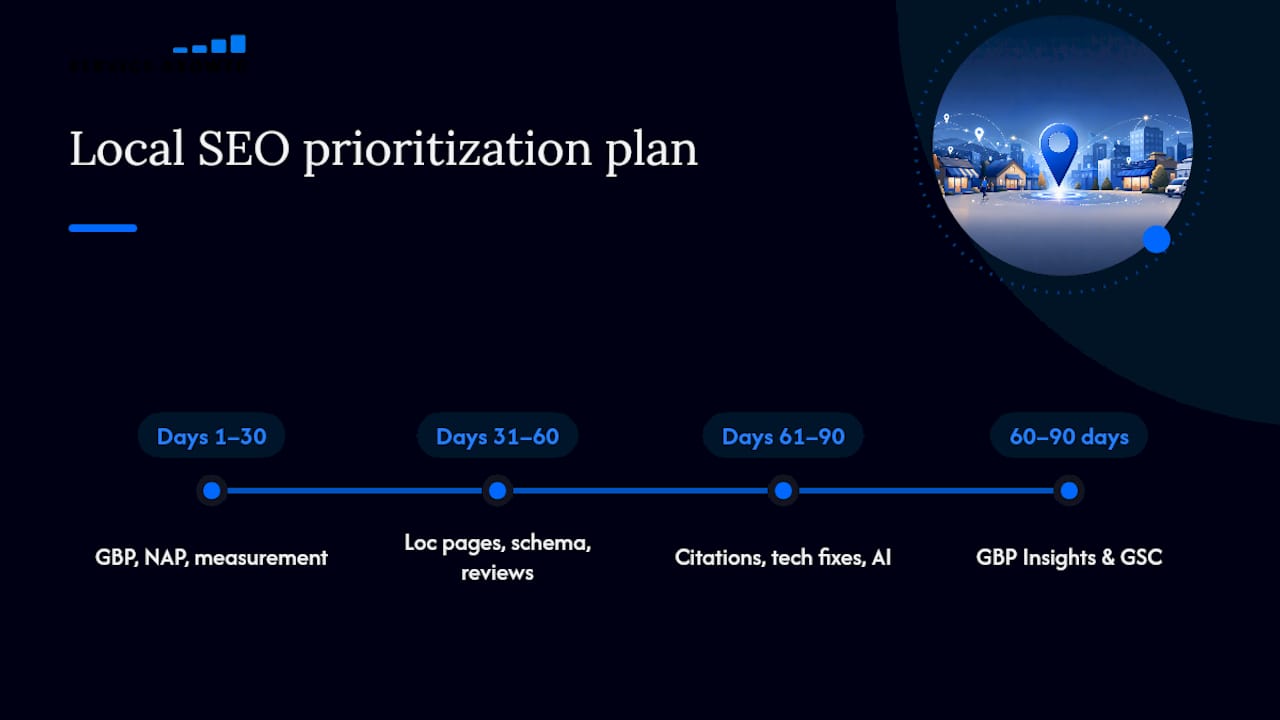
For a single-location small business with limited time, a realistic 90-day plan looks like this: spend the first 30 days on GBP, NAP, and measurement setup. Spend days 31–60 on location page content, schema, and review acquisition. Spend days 61–90 on citations, technical fixes, and the AI readiness checklist. That sequence produces visible results in GBP Insights and GSC within 60–90 days for most businesses.
The resource question comes up constantly. If you have 5–10 hours per month to spend on local SEO yourself, focus that time on GBP maintenance, review responses, and content updates. Outsource the technical work (schema, Core Web Vitals fixes, citation cleanup) to a specialist or a platform that handles it for you. The math on DIY vs. managed usually favors managed once you account for the opportunity cost of your own time.
One thing most checklists understate: the AI readiness work is not optional in 2026. Businesses that establish clear entity signals now will have a compounding advantage as LLM-driven search grows. The businesses waiting to see how it plays out are already behind.
Service Grower gets the checklist done for you
Working through a 12-step local SEO checklist takes real time, and for most small business owners, that time is the scarcest resource. Service Grower is built specifically for local businesses that want the checklist implemented without hiring an agency or managing five separate tools.
The platform combines AnswerReady websites optimized for both Google and AI assistants, built-in review management that automates request timing and response tracking, GrowthView analytics that surfaces the KPIs from this checklist in one dashboard, and SmartRequest booking forms that convert local traffic into actual customers. It’s the difference between knowing what to do and having it running.
Service Grower fits best for single-location and multi-location local businesses in service industries — HVAC, plumbing, fitness, healthcare, travel, restaurants — that want a managed or semi-managed approach rather than a DIY stack. If you’d rather spend your time running your business than auditing citations, book a 15-minute call to see exactly how the platform maps to your situation. The call is a working session, not a sales pitch.
Sources
- The Complete Local SEO Checklist for 2026 (GBP, Citations, Reviews & More)
- The Local SEO Checklist for 2026 (Download PDF + Excel)
- Schema