
 GROWTH GUIDE
6 Local Business Marketing Tasks to Do This Month for Busy Owners
For most local businesses, the fastest path to more calls and foot traffic runs through four things: a fully optimized Google Business Profile, a steady stream of new reviews, one paid channel run consistently, and a website that converts a search into a phone call. Together, proximity signals and trust signals decide who shows up first, and who gets picked once they do. Stay consistent for 30 to 90 days and you’ll typically see the shift in call volume and foot traffic before you see it in a spreadsheet.
TL;DR:
- Claim and fully optimize your Google Business Profile within days, ensuring all fields are filled and primary categories are carefully chosen.
- Implement a review request flow immediately after each service to generate recent reviews and respond to all reviews within 48 hours for maximum trust.
- Launch a geo-targeted paid search campaign with clear action-oriented ad copy, testing variations over at least two weeks before adjusting budgets.
- Post weekly updates with real photos and engage with local social groups using location hashtags to improve visibility and reputation signals.
- Focus on offline tactics like direct mail and local sponsorships in neighborhoods under 10 miles, tracking response with unique codes or dedicated phone numbers.
Table of Contents
- Quick Shortlist: What To Do This Month
- Google Business Profile and Local SEO: How Do You Get on the Map?
- How Do You Get More Reviews Without It Feeling Pushy?
- Which Paid Ads Actually Work for a Local Budget?
- Social Content and Local Engagement: What Actually Gets Seen?
- Referral Partnerships, Events, and Sponsorships That Bring Customers In
- Owned Media: Local Pages, Emails, and Content That Convert
- Offline Tactics: When Direct Mail, Print, and Radio Still Win
- Measure and Optimize: KPIs, Timelines, and Reporting
- Applied Example: How Service Grower Executes This Playbook in One Flow
- Mobile Marketing: SMS Campaigns and Location Alerts
- Service Grower’s Take: Priorities for an Owner With 8 to 12 Hours a Week
- How Service Grower Can Help You Execute This Plan
- Sources
Quick Shortlist: What To Do This Month
You don’t need twelve marketing projects running at once. You need six, done in order, with someone accountable for each one.
- Claim and complete your Google Business Profile. Owner task, one afternoon. Fill every field, pick the right primary category, and add real photos.
- Turn on a review request flow. Front desk or field staff sends a link after every job. Takes a week to build the habit.
- Fix your website’s phone-first experience. A click-to-call button above the fold and a simple booking form. A freelance developer or an in-house update can knock this out in days.
- Launch one paid search campaign. Start with Google Search or Local Services Ads, geo-fenced to your service radius. Budget owner time to check it weekly.
- Post to your listing weekly. Photos, offers, and updates. Five minutes, once a week, owner or a part-time staffer.
- Set up one referral or partner relationship. Pick a complementary local business and agree on a simple incentive.
Expect early movement, like more profile views and a few extra calls, within two to four weeks. Booked jobs and steady review growth usually take a full quarter to show a clear trend.
Pro Tip: Assign each of these six tasks to one specific person, even if that person is you. Tasks with no owner are the ones that quietly stop happening after week two.
Google Business Profile and Local SEO: How Do You Get on the Map?
Your Google Business Profile is very likely the single highest-leverage free asset you own, and it works alongside a wider mix of online and offline signals that shape local discovery, including how AI tools now surface local businesses in conversational search results.
Start with the basics most owners skip. Claim and verify the listing if you haven’t, then fill in every available field, not just the required ones. Choose your primary category carefully. “HVAC contractor” pulls different search traffic than “Air conditioning repair service,” even though both sound close enough.
Beyond the profile itself, your website needs to carry the same local signals. Build a dedicated service page for each location or service area you cover, with the city or neighborhood name in the heading and body copy, not stuffed into a footer. Add LocalBusiness schema markup so search engines and AI crawlers can parse your address, hours, and service area without guessing.
A few habits keep the listing working for you instead of against you:
- Post weekly with real photos of jobs, staff, or your storefront, not stock images.
- Answer every question in the Q&A section yourself before a competitor or a confused customer does.
- Keep your name, address, and phone number identical across your website, GBP, and every directory listing.
- Update attributes (wheelchair accessible, appointment required, women-owned) as they change.
Duplicate listings and inconsistent NAP data are the two most common reasons a business shows up inconsistently on the map. If you’ve moved, rebranded, or opened a second location, search your business name on Google to catch stray duplicates before they confuse the algorithm.
| Action | Time to first result |
|---|---|
| GBP claim and completion | Days |
| Weekly GBP posts and photos | 2 to 4 weeks for engagement lift |
| Localized service pages with schema | 2 to 4 months for organic ranking movement |
| Duplicate listing cleanup | 1 to 6 weeks depending on Google’s review queue |
For a deeper walkthrough of category selection, attributes, and posting cadence, the Google Business Profile optimization playbook covers the field-by-field detail this section can’t. A complementary outside take on ranking factors is worth a look in this local SEO strategy guide.
How Do You Get More Reviews Without It Feeling Pushy?
Review volume is one of the clearest trust signals a searcher uses to pick between three nearly identical businesses on a map. More reviews, and more recent reviews, tend to correlate with more clicks and more calls.
Timing matters more than most owners realize. Ask right after the moment of satisfaction, not days later when the memory has faded. For a service call, that’s the minute the technician wraps up. For a retail purchase, it’s the follow-up text that afternoon.
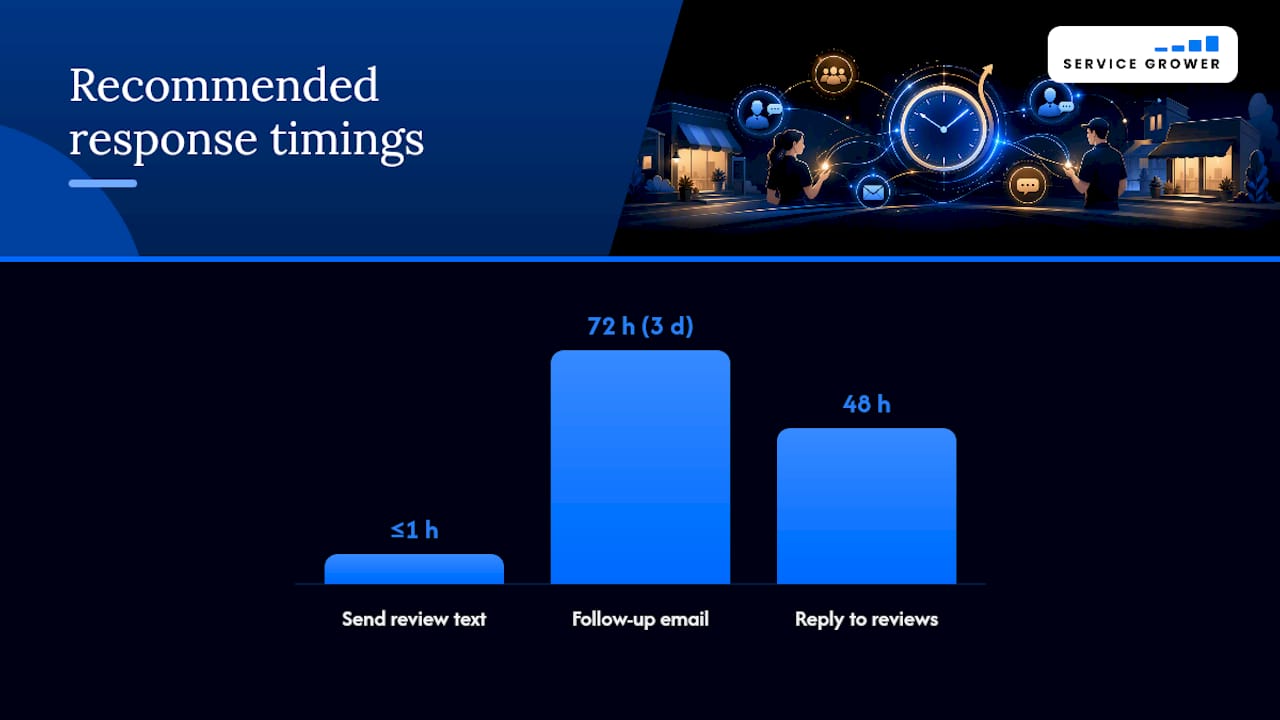
- Send a one-click review link by text within an hour of service completion.
- Follow up once by email three days later if the text goes unanswered.
- Keep the ask short: name, thank you, and a direct link. No guilt trips, no bribes.
- Respond to every review within 48 hours, positive or negative.
- Never offer a discount or payment in exchange for a positive review. That crosses an ethical line and violates most platforms’ terms.
For negative reviews, resist the urge to argue in public. Acknowledge the specific complaint, state what you did or will do about it, and invite the person to continue the conversation offline. For positive reviews, a personal reply that references something specific from their comment reads far better than a copy-pasted “Thank you for your feedback.”
Pro Tip: Automate the ask, never the response. A templated follow-up text is fine. A templated reply to an angry review reads as exactly what it is and makes things worse.
A consistent, automated request-and-reply system is one of the areas where a reputation management playbook pays off, since most owners lose momentum on manual follow-up within a month.
Which Paid Ads Actually Work for a Local Budget?
Start with search intent, not reach. Someone typing “emergency plumber near me” is closer to booking than someone scrolling a social feed, so your first paid dollars should go toward Google Search or Local Services Ads before anything else.
A small local campaign can run effectively on a moderate monthly budget, geo-targeted to a radius that matches your actual service area rather than an entire metro. Local Services Ads and geo-targeted Google Ads campaigns let you set that radius directly, which keeps spend from leaking into zip codes you’ll never actually serve.
- Write ad copy around the action, not the brand: “Same-day AC repair, call now” beats a generic tagline.
- Use call extensions and a phone-first landing page so mobile searchers can reach you in one tap.
- Test two headlines and one call-to-action variation at a time, never more, or you won’t know what moved the needle.
- Let each test run at least two to three weeks before judging it, longer if your sales cycle involves quotes or scheduling.
- Track cost-per-lead weekly, but only make budget decisions monthly.
A geo-targeted Meta campaign is worth adding once search ads are stable, particularly for businesses with a visual product like a salon, restaurant, or retail storefront. For a full campaign build, the search-first Google Ads guide for local business walks through bid strategy and negative keywords in more depth.
Social Content and Local Engagement: What Actually Gets Seen?
Pick the platform where your customers already spend time, not the one that’s trending. A barbershop or restaurant usually does better on Instagram and TikTok. A B2B service contractor often gets more traction on Facebook groups and LinkedIn.
Content doesn’t need to be elaborate to work. A weekly rotation of a behind-the-scenes job photo, a customer shoutout, a quick tip related to your service, and a repost of your best recent review covers most of what a local audience wants to see. Repurpose the same photo across your GBP post, Instagram, and Facebook page instead of creating three separate assets.
Micro-influencer partnerships work well at the local level precisely because they’re low-cost. Reach out to a local creator with a few thousand followers, offer a free service or product in exchange for an honest post, and set clear expectations upfront about what you’re hoping they’ll cover.
- Join local Facebook groups and neighborhood forums where your customers already ask for recommendations.
- Use location-based hashtags on Instagram and TikTok so nearby users can find you organically.
- Trade a service or product for a genuine post from a local micro-influencer rather than paying cash upfront.
- Cross-post GBP updates to social so the same content works twice.
- Screenshot and share standout reviews as social proof content, with the customer’s permission.
Consistent posting also feeds back into your GBP visibility and review volume, since engaged followers are the same people most likely to leave a review after a good experience.
Referral Partnerships, Events, and Sponsorships That Bring Customers In
Referral relationships tend to produce leads with higher lifetime value than most paid channels, largely because the referring partner already vetted you before the introduction ever happened.
- Identify complementary, non-competing businesses. A landscaper and a pool cleaner. A barbershop and a coffee shop next door.
- Draft a simple referral incentive. A flat dollar amount, a percentage of the first job, or a reciprocal discount both sides can track.
- Set up basic tracking. A unique promo code or a shared spreadsheet is enough at this scale. Don’t overbuild it.
- Choose an event format that fits your business. A workshop for a home services business, a pop-up for retail, a sponsorship of a local youth league or farmers market.
- Promote the event everywhere at once. GBP post, an email to your list, and a social announcement the same week, not staggered over a month.
Sponsorships work best when the audience overlap is obvious. Sponsoring a Little League team makes sense for a family dentist. It makes far less sense for a B2B accounting firm.
Owned Media: Local Pages, Emails, and Content That Convert
Your website and email list are the only channels you fully control. Everything else runs on rules set by Google, Meta, or a review platform that can change overnight.
A landing page that converts local search traffic needs local language in the headline, not just the body copy. It needs trust signals above the fold: review count, years in business, or a licensing credential. And it needs exactly one clear action, a phone number or a booking form, not three competing buttons.
- Build a welcome email for new customers with your hours, service area, and a direct booking link.
- Send a post-service follow-up email that doubles as a review request.
- Run a seasonal re-engagement email for past customers who haven’t booked in six months.
- Write blog posts that answer the exact questions customers ask before booking, like “How much does an AC tune-up cost.”
- Reuse each blog post as a GBP update and a social caption instead of writing three separate pieces.
The local SEO checklist for small businesses covers the page-by-page detail for structuring these local landing pages if you want a template to start from.
Offline Tactics: When Direct Mail, Print, and Radio Still Win
Digital dominates the conversation, but offline channels still outperform digital in specific situations, particularly for a service business with a tight radius under 10 miles and an older or less digitally native customer base.
Every Door Direct Mail through USPS can cost under $0.30 per piece depending on volume and zip code targeting, which makes it one of the more affordable ways to blanket a specific neighborhood. Local print placements in a community newsletter or a radio spot on a local station can work well for a business with strong name recognition to build, like a new restaurant or a family dental practice.
- Use a dedicated tracking phone number on mailers and print ads so you know exactly what drove the call.
- Add a unique coupon code to each offline piece to separate that channel’s results from everything else.
- Point offline ads to a specific landing page, not your homepage, so you can measure conversion cleanly.
- Time direct mail drops to coincide with a seasonal service push, like furnace tune-ups before winter.
Tie every offline dollar back to a trackable number or code. Without that link, you’re guessing.
Measure and Optimize: KPIs, Timelines, and Reporting
The KPIs that actually matter for a local business are narrower than most marketing dashboards suggest: GBP profile views and calls, phone leads by source, booked jobs, and cost-per-lead by channel.
Resist the urge to pivot after three weeks. Many local marketing gains only become measurable after a longer stretch of consistent activity, and switching channels too early is one of the most common ways owners sabotage their own results before a campaign has a chance to stabilize.
| Metric | Check frequency | What it tells you |
|---|---|---|
| GBP profile views and calls | Weekly | Whether visibility is improving |
| Phone leads by source | Weekly | Which channel is actually working |
| Booked jobs | Monthly | Whether leads convert to revenue |
| Cost-per-lead by channel | Monthly | Where to shift budget next |
If one channel is underperforming, run a quick diagnostic before cutting it: check your ad’s landing page load speed, confirm your phone number is correctly tracked, and read your last ten reviews for recurring complaints that might be quietly costing you conversions.
Applied Example: How Service Grower Executes This Playbook in One Flow
The six systems above (listings, reviews, content, email, ads, and visibility) usually live in five different tools when businesses build this stack piece by piece. Service Grower consolidates them into one platform, which matters because managing listings, reviews, content, email, and targeted ads as a single connected system tends to outperform juggling disconnected tools that don’t talk to each other.
In practice, that looks like:
- AnswerReady™ websites built with the phone-first, geo-signal structure this article covers under local SEO.
- Review management that automates the text-and-email ask flow described in the reviews section, with response templates built in.
- SmartRequest booking forms that turn a landing page visit into a scheduled job without a phone tag.
- GrowthView analytics that track the same KPIs outlined above (calls, leads, booked jobs) in one dashboard instead of five.
- Optional managed Google and Meta ads for owners who want the paid channel run without pulling staff off other work.
Actual outcomes vary by industry, market, and starting point, and specific case results depend on details this article cannot generalize.
Mobile Marketing: SMS Campaigns and Location Alerts
Text messages get opened faster than almost any other channel, which makes SMS a strong fit for time-sensitive local offers like a same-day appointment opening or a limited-run seasonal promotion. Keep the list opt-in only, and keep the message short: an offer, a link, and a clear deadline.
Location-based notifications work differently. These trigger when a customer’s phone enters a geofenced radius around your business, typically through an app or a platform that supports proximity alerts. A coffee shop might trigger a notification for a loyalty member walking past at 7 a.m. A retail store might send one when a past customer is in the mall.
A few rules keep mobile marketing effective instead of annoying:
- Send SMS only to customers who’ve explicitly opted in, and make opting out a one-word reply.
- Cap frequency at once or twice a month unless there’s a genuine, time-sensitive reason to send more.
- Use geofenced alerts sparingly. Overuse trains customers to ignore or mute them entirely.
- Pair every mobile message with a clear, single call to action, like “Reply YES to book” or a direct link.
Mobile campaigns work best layered on top of the systems already covered here, not as a standalone strategy. A geofenced alert means little if the landing page it links to isn’t built to convert on a phone screen in the first place.
Service Grower’s Take: Priorities for an Owner With 8 to 12 Hours a Week
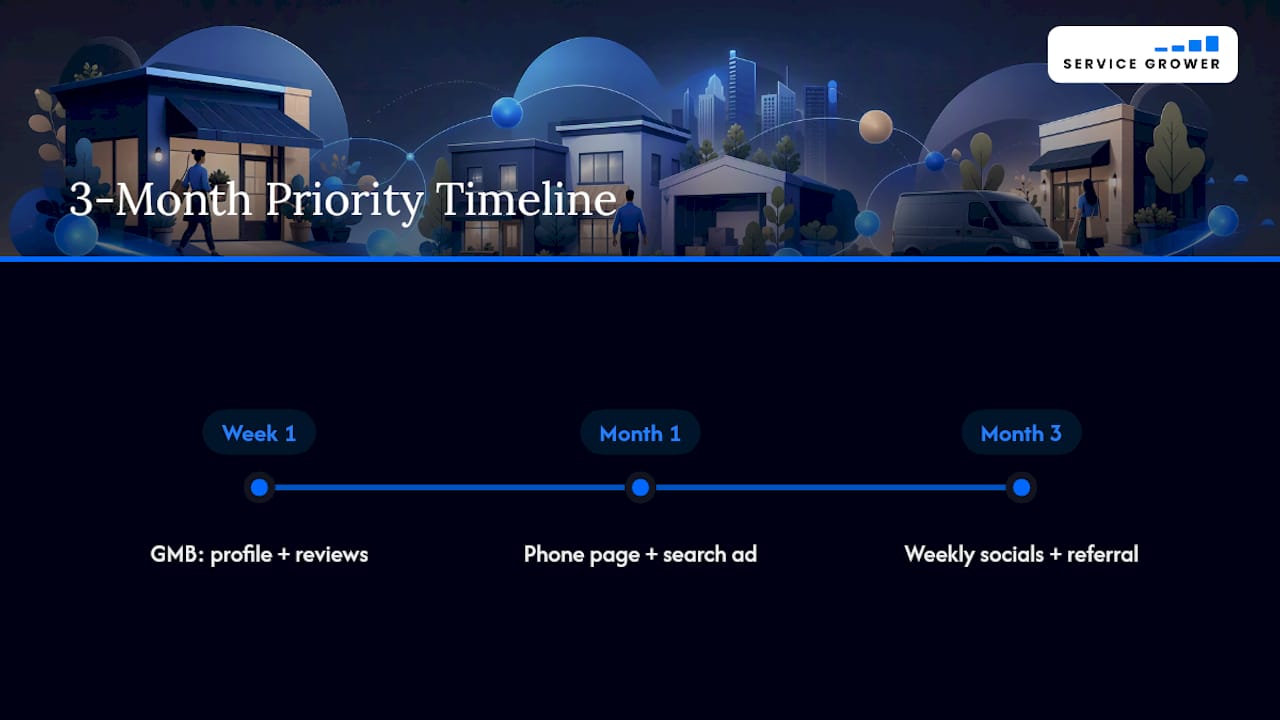
Most owners try to do everything at once and end up doing nothing well. Week one, fix your Google Business Profile and turn on review requests. That’s it. Month one, add a phone-first landing page and launch one modest search ad campaign. Month three, layer in weekly social posts and your first referral partnership.
The most common mistake isn’t picking the wrong tactic. It’s abandoning a good one after three weeks because the phone didn’t ring yet. Building a local brand earns trust and loyalty that a discount code never will, but trust compounds slowly.
If you only have a handful of hours a week, spend them on listings, reviews, and one paid channel. Everything else is optimization on top of a foundation that isn’t built yet.
— Service Grower
How Service Grower Can Help You Execute This Plan
There is an alternative to juggling multiple disconnected tools for local marketing: one platform that handles your website, listings, reviews, and booking flow, so nothing falls through the cracks between a review request and a follow-up email.
If you’ve read this far and recognized your own to-do list in it, the honest next step is figuring out where your business currently stands. Fit depends on your budget, how much you want handled for you versus in-house, and how quickly you want to move. A restaurant chasing weekend reservations has different priorities than an HVAC company fielding emergency calls, and Service Grower’s vertical-specific solutions are built around those differences rather than a one-size-fits-all dashboard.
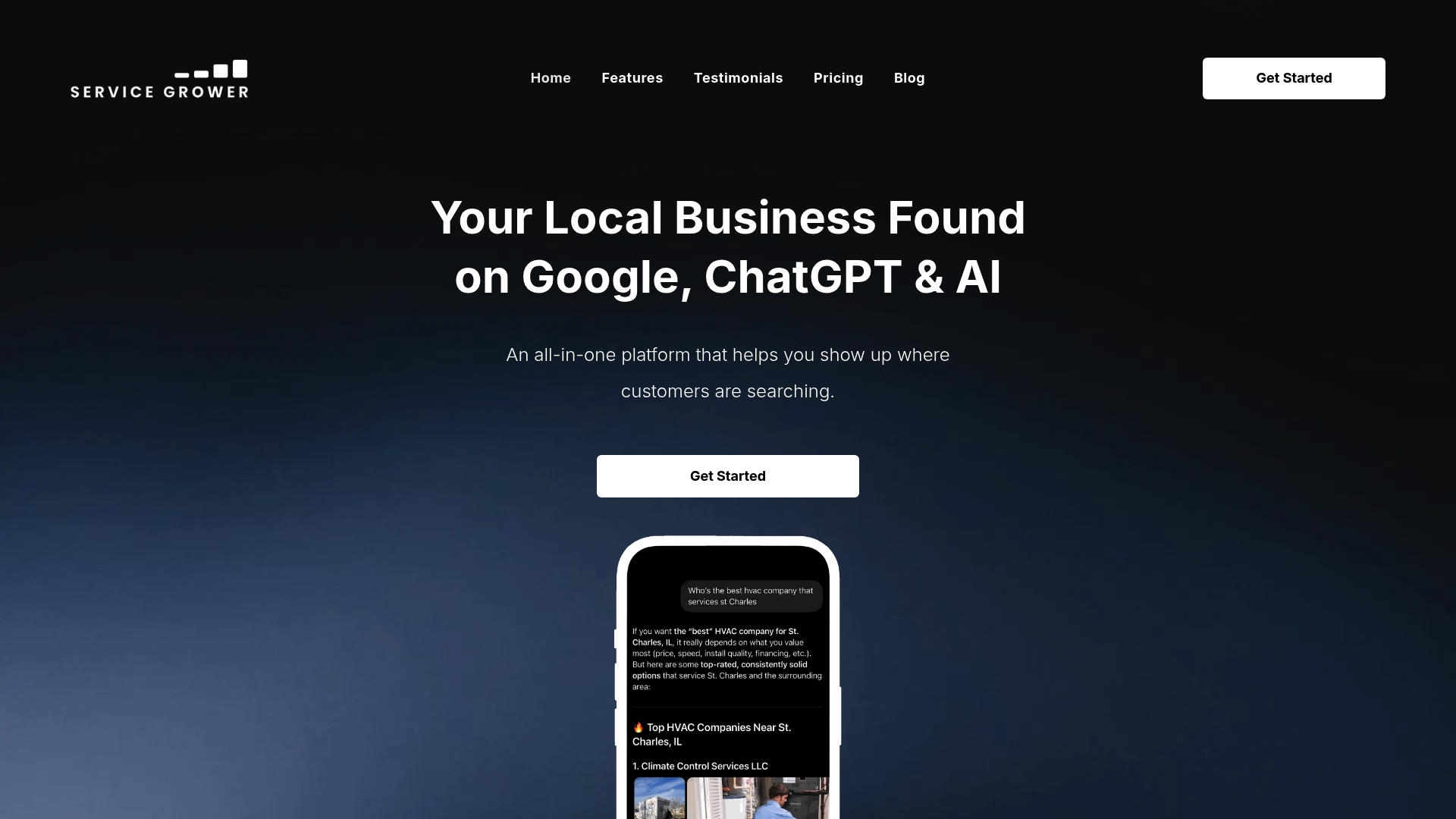
The fastest way to see where you stand is a free AI visibility check, which shows you exactly how your business currently appears across Google and AI search tools before you decide what to fix first.
Sources
For owners who want to go deeper on any single piece of this playbook, a few sources are worth bookmarking. The Search Engine Land local marketing guide covers how AI-driven discovery is reshaping local visibility beyond traditional search. The SBA’s list of local marketing strategies is a solid primer on referral programs and community tactics straight from a government small-business resource. Salesforce’s guide to local marketing digs into why community-focused branding lowers acquisition costs over time. And for a practical look at affordable advertising options and channel prioritization, Ueni’s small business advertising roundup is worth the ten-minute read.
- Local Marketing Guide: Win More Customers Nearby
- AI Marketing for Local Businesses | Syxo
- How to promote your business locally: 10 simple tactics
- Local Marketing: A Complete Guide | Salesforce