
 GROWTH GUIDE
Google Ads for Local Business: Search-First 2026 Guide
For a single-location local business, yes — run Google Ads, but start with Search campaigns and Local Services Ads (LSA) if your category qualifies. Add AI Max only after you have a stable conversion baseline, and hold off on Performance Max until you have a stable conversion baseline. That sequencing matters more than budget size.
Two quick decision points before you spend a dollar:
- Run LSAs now if you’re in an urgent, reactive category (HVAC, plumbing, legal, cleaning) and your Google Business Profile is verified. LSAs use a pay-per-lead model and carry the Google Guarantee badge, which visibly builds trust with first-time customers.
- Start with Search only if your conversion volume is low or your tracking isn’t set up yet. AI Max and Performance Max need to signal to work; without it, they burn budget.
Your first 72 hours: verify your Google Business Profile, create a single Search campaign with 8–12 local-intent keywords, and set up call tracking with a unique forwarding number.
Stat to know: Local ads on Google Search, Maps, and Waze can surface your business above organic results when customers are actively searching nearby — but only if your location assets and conversion tracking are properly configured first.
Table of Contents
- Is now the right time to run Google Ads for your business?
- Which Google Ads campaign types should you run?
- What ad creative actually works for local services?
- How do you measure conversions for a local business?
- How much should you budget, and when will you see results?
- Why pairing ads with an AI-driven local presence improves your ROI
- Your practical 30-day setup plan
- Key Takeaways
- The case for building presence before scaling spend
- Servicegrower handles the parts most local owners skip
- Useful sources and further reading
Is now the right time to run Google Ads for your business?
Work through this before you open Google Ads.
- Demand type: Do customers search for your service when they urgently need it (plumber, emergency locksmith, urgent care)? Search and LSA are ideal. If your sales cycle is weeks long (custom remodeling, wedding photography), organic SEO and nurture sequences may deliver better ROI first.
- Tracking readiness: Do you have GA4 installed, a call-tracking number, and at least one online conversion event (booking, form, deposit)? If not, fix tracking before spending on ads — you’ll be flying blind.
- Review volume: LSA eligibility requires a verified Google Business Profile and a minimum number of reviews. Check your category’s threshold in the LSA signup flow.
- Budget floor: Plan for at least $500–$1,000/month to generate enough data for meaningful optimization. Below that, the learning phase drags on and results are noisy.
- Conversion volume: If your conversion volume is low, skip Performance Max entirely for now. Search campaigns build the signal PMax needs to learn.
Pro Tip: If you’re torn between Search and PMax, run Search exclusively for the first 60 days. Advertisers who launch PMax without prior conversion history typically see higher cost-per-lead than pure Search during that window. Build your conversion history with Search before adding PMax to ensure more efficient spending.
Which Google Ads campaign types should you run?
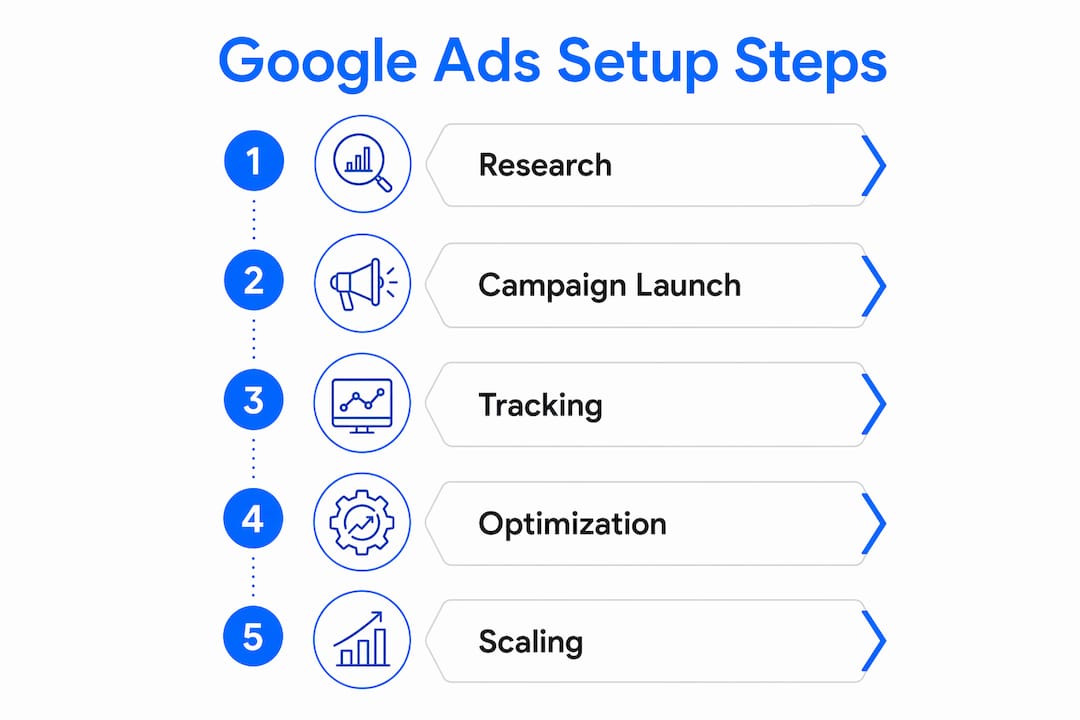
| Campaign Type | Best For | Pay Model | When to Add |
|---|---|---|---|
| Search | Any local service with keyword demand | CPC | Day 1 |
| Local Services Ads | Urgent/reactive categories (HVAC, legal, cleaning) | Pay-per-lead | Day 1 if eligible |
| AI Max for Search | Expanding reach after stable baseline | CPC | After 60+ days of Search data |
| Performance Max | Multi-channel reach, store goals | CPC/CPM | After ~30 conversions/month |
Search campaign setup checklist:
- Geo setting: “People in or regularly in this location” — not “interested in”
- Keywords: long-tail local phrases (“emergency AC repair Austin TX”), not broad match alone
- Negative keywords from day one: “DIY,” “how to,” “free,” competitor names
- Ad assets: phone number, location, sitelinks to booking page
LSAs sit above standard Search results for intent-driven queries and require a verified Google Business Profile since November 2024. Your reviews feed directly into LSA visibility, so reputation management isn’t optional — it’s a ranking factor.
AI Max tests reported an average ~14% increase in conversions at the same CPA, and when combined with Smart Bidding Exploration, lifts can reach approximately 19%, but these numbers are directional, not guaranteed, and they assume a stable baseline already exists.
What ad creative actually works for local services?
Polished studio ads rarely win for local service businesses. UGC-style assets — screenshots of real Google Business Profile reviews, short staff walk-throughs filmed on a phone, before-and-after photos — consistently outperform higher-production creative in local service categories. They’re also free to produce.
A practical creative system: build one polished hero asset (your best photo or a 15-second brand video), then create four UGC variants. Rotate them weekly and pause the lowest click-through-rate variant after 10–14 days.
- Pull review screenshots that mention a neighborhood name (“Fixed our furnace in Midtown in under two hours”)
- Write ad copy that names the area: “Serving Oak Park and River Forest since 2018”
- Use landmarks in headlines when space allows: “Near Wicker Park? Same-day service available”
- Radius targeting is a soft signal on modern platforms; creative that calls out neighborhoods filters high-intent leads more reliably than geo settings alone
Servicegrower’s AnswerReady™ websites are built to surface your existing reviews and location-specific content as structured assets, which means the raw material for this creative system is already organized and ready to pull from.
Pro Tip: Screenshot a 5-star review that names your neighborhood, add your phone number in the image, and use it as a responsive search ad image asset. Takes 10 minutes and often beats anything your designer produces.
How do you measure conversions for a local business?
Track bookings or require a small deposit — that single change converts an offline action into a digital conversion event your campaigns can learn from.
- GA4 setup: Install GA4, configure goals for form submissions, booking confirmations, and phone call clicks.
- Google Ads conversion actions: Import GA4 goals into Google Ads; set primary conversion action as “booking” or “lead form submit.”
- Call tracking: Use a dynamic call-tracking number (Google’s forwarding number or a third-party service) so calls from ads are attributed correctly.
- Deposit or booking fee: Requiring a small refundable deposit fires a purchase event and works well for salons, studios, and appointment-based services. This is the highest-impact tracking fix most local businesses skip.
- Offline conversion upload: For walk-in businesses, upload a weekly CSV of closed jobs matched to Google Click IDs to close the attribution loop.
Primary KPIs: paid leads, cost per lead, booking rate. Secondary: click-to-call rate, store visits (where available). Default click metrics tell you almost nothing about whether ads are generating real customers.
Note: Google is deprecating Call-Only ads in February 2027. If you’re running them now, migrate to responsive search ads with call assets before that deadline.
How much should you budget, and when will you see results?
Expect a 4–12 week window before results stabilize. Here’s how that breaks down:
| Week | Focus | What to Measure |
|---|---|---|
| 1–2 | Campaign setup, tracking verification | Impressions, click-through rate, call volume |
| 3–4 | Creative testing, negative keyword pruning | Cost per lead, conversion rate |
| 5–8 | Bid adjustments, peak-hour scheduling | Lead quality, booking rate |
| 9–12 | Evaluate PMax/AI Max readiness | Conversions/month vs. 30-conversion threshold |
Budget guidance for single-location service businesses: a testing floor of a few hundred dollars per month generates enough data to optimize; a higher budget is a realistic scaling range for most markets. Competitive categories (legal, HVAC, dental) in major metros will sit at the higher end.
Optimization cadence: add negatives weekly for the first month, adjust bids for peak hours (typically 7–9 AM and 5–7 PM for service businesses) by week three, and rotate creative assets every two weeks.
Why pairing ads with an AI-driven local presence improves your ROI
Ads drive clicks. What happens after the click determines whether you get a customer or a bounce. An AI-optimized local presence closes that gap.
Servicegrower addresses the three places local ad spend leaks:
- AnswerReady™ websites are built for local search and AI engine visibility, so the landing page a searcher hits after clicking your ad is already structured to convert and to surface in AI-driven results like ChatGPT and Google’s AI Overviews.
- SmartRequest gives you trackable booking forms and online request flows, which means every ad click that turns into a booking fires a real conversion event. No more guessing whether the ad worked.
- GrowthView consolidates your analytics and review data in one dashboard, so you can see cost per lead alongside review volume and booking trends without toggling between five tools.
Clients using Servicegrower’s integrated platform report meaningful increases in both bookings and reviews, which feeds back into LSA visibility and organic rankings. When to choose managed services vs. DIY: if you’re spending more than $1,500/month on ads and don’t have 3–5 hours per week to monitor and optimize, the managed route pays for itself in recovered waste.
Your practical 30-day setup plan
- Week 1: Verify your Google Business Profile, install GA4, set up a unique call-tracking number, and build a Search campaign skeleton (1 ad group, 8–12 keywords, 3 responsive search ads, negative keyword list).
- Week 2: Launch creative tests (1 hero asset + 4 UGC variants), start the LSA signup process if your category qualifies, and activate a trackable booking flow using SmartRequest or a deposit-required booking page.
- Week 3: Review search term reports and add negatives, pause the lowest-performing creative variant, and set bid adjustments for your peak service hours.
- Week 4: Count your conversions. If you’re on pace for 30+ per month, plan an AI Max or PMax test for month two. If not, keep iterating Search and creative before adding complexity.
Key Takeaways
Google Ads for local business works best when Search campaigns build conversion signal first, offline actions are made trackable, and ads are paired with an AI-optimized local presence.
| Point | Details |
|---|---|
| Start with Search and LSA | Launch Search campaigns on day one; add LSA if your category qualifies and your GBP is verified. |
| Build signal before PMax | Wait until you reach roughly 30 conversions per month before trusting Performance Max with your budget. |
| Make offline conversions trackable | Require a small deposit or route bookings through an online form to fire real conversion events. |
| Use UGC and neighborhood copy | Review screenshots naming your area and local copy filter high-intent leads better than geo settings alone. |
| Servicegrower integrates the full stack | AnswerReady™, SmartRequest, and GrowthView connect ad performance to presence, bookings, and reviews in one place. |
The case for building presence before scaling spend
Most local business owners treat Google Ads as a standalone lever. Run the campaign, watch the clicks, wonder why the phone isn’t ringing more. The problem is usually upstream: the landing page doesn’t convert, the reviews are thin, or the booking flow is broken. Ads amplify whatever is already there — good or bad.
The integrated approach Servicegrower was built around starts from a different premise. AnswerReady™, SmartRequest, and GrowthView exist because the attribution gap between “someone clicked my ad” and “someone booked a job” is where most local ad budgets quietly disappear. Closing that gap with trackable booking flows and structured review management isn’t a nice add-on. It’s what makes the ad spend defensible.
If you have the time and technical comfort to manage campaigns yourself, the 30-day plan above gives you a solid foundation. If you’d rather hand it off, the managed route makes more sense once you’re past the $1,500/month threshold. Either way, start with the tracking and presence work first.
Servicegrower handles the parts most local owners skip
Most local businesses that struggle with paid search aren’t losing on keywords or bids. They’re losing because their booking flow leaks, their reviews are stale, and their landing page wasn’t built for local intent. Servicegrower fixes all three in one subscription.
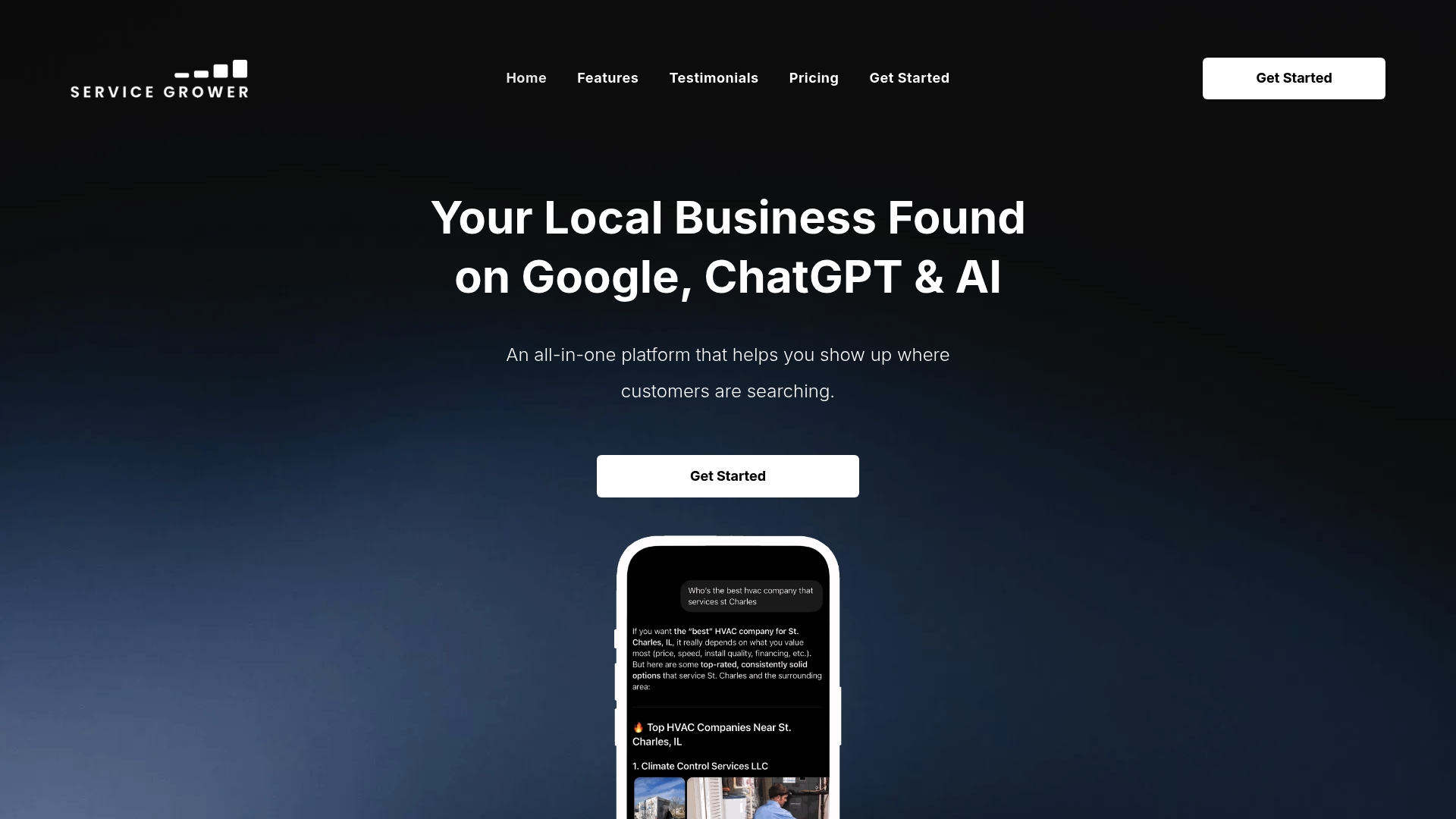
AnswerReady™ gives you a local-presence website structured for Google and AI search engines. SmartRequest turns ad clicks into trackable bookings with no manual follow-up. GrowthView shows you exactly which campaigns are driving real revenue, not just clicks. And if you’d rather not manage bids yourself, Servicegrower’s optional managed ads service handles Google and Meta campaigns for you, with full attribution back to bookings and reviews.
Owners using the platform report more bookings, stronger review volume, and clearer attribution than they had running ads alone. Book a 15-minute discovery call to see whether the managed plan or the self-serve platform fits your situation better.
Useful sources and further reading
- Local Services Ads overview — Google Ads: Start here for LSA eligibility, verification requirements, and the Google Guarantee badge. Check this page for your specific category before signing up.
- Lead generation for local businesses — Google Ads: Google’s own guidance on pay-per-lead benefits and LSA trust signals.
- About Local Ads — Google Ads Help: Technical reference for Local Ads on Search, Maps, and Waze, including billing models and asset requirements.
- Growing your business with Local Services Ads — Google: Covers the November 2024 GBP verification requirement and how reviews feed LSA visibility.
- Google Ads for Local Businesses 2026: Strategy Guide — Lionelz: Practitioner-level breakdown of Search-first sequencing, AI Max lift data, and PMax conversion thresholds.
- Facebook Ads for Local Businesses 2026 — Alenich: Source for the deposit-as-conversion-event strategy; directly applicable to Google Ads tracking setup.
- Facebook Ads Local Business Playbook 2026 — AdLibrary: UGC creative benchmarks and the neighborhood-copy-over-radius-targeting insight used throughout this guide.
For specific tasks: Use the Lionelz strategy guide for AI Max and PMax timing decisions. Use the Google Help page for call-tracking configuration and Local Ads asset setup. Check the LSA overview page for the February 2027 Call-Only deprecation timeline and current LSA verification requirements before launching.