
 GROWTH GUIDE
Google Ads Cost for Local Businesses: Budget Guide
For most U.S. local businesses, Google Ads runs within a range of monthly spend that varies with industry and competition. A plumber in a mid-size city typically spends in the lower thousands of dollars per month. A personal injury attorney in a major metro area may spend several thousands of dollars within the first half of a month.
Before you spend a dollar, do this: verify your Google tag is firing and conversions are flowing into Google Analytics 4 (GA4). Without that, you’re flying blind. Automated bidding cannot learn, and you’ll have no idea whether your spend is working. Service Grower’s managed ad packages include a tracking audit as the first step, which is exactly the right order of operations.
Quick budget benchmarks:
-
Most local service businesses: $1,000–$3,000/month
-
High-competition categories (legal, medical, finance): $3,000–$10,000+/month
-
Minimum to generate learning data: $500/month
Backlinko’s 2025 data puts the average Google Search CPC at $8.34 across all industries, with legal averaging around $22.75 and e-commerce as low as $0.82. WordStream reports a 2026 Search average of $5.42 and an average cost per lead of $66.69. AdPredictor offers a lower cross-industry CPC benchmark at $2.69 (Search), and Display ads averaging $0.63. Most local service businesses will see CPCs between $2.50 and $8.50, depending on competition, but legal and finance categories can average over $20 per click.
Table of Contents
What actually determines your Google Ads cost
Your cost isn’t set by Google’s rate card. It’s set by a real-time auction that runs every time someone searches. Three inputs decide your price: your maximum bid, your ad’s Quality Score (relevance + expected click-through rate + landing page experience), and the predicted likelihood that the click converts.

Ad rank = bid × quality and expected impact. The advertiser with the highest ad rank wins the top slot, but they don’t necessarily pay the most. A high Quality Score can let you outrank a competitor who bids more, and pay less per click doing it. Quality Score improvements can cut your CPC by as much as 50% compared to a low-quality account. That’s not a marginal difference.
Beyond quality, several other factors shift your cost. Industry competition is the biggest one: legal and financial keywords cost far more than home services or retail. Geographic targeting matters too — a keyword in Manhattan costs more than the same keyword in Tulsa. Campaign type also changes the math: Search ads carry the highest intent and the highest CPC, while Display ads average under $1 per click but convert at much lower rates. Long-tail keywords (“emergency HVAC repair Denver”) typically cost less and convert better than broad terms (“HVAC”).
Spending more alone doesn’t lower your CPC. Relevance does.
What do typical CPCs and CPAs look like for local businesses?
Backlinko’s 2025 data puts the average Google Search CPC at $8.34 across all industries, with legal averaging around $22.75 and e-commerce as low as $0.82. WordStream reports a 2026 Search average of $5.42 and an average cost per lead of $66.69. These figures are benchmarks, not your invoice. Your actual CPC depends on your market, your quality, and your targeting.
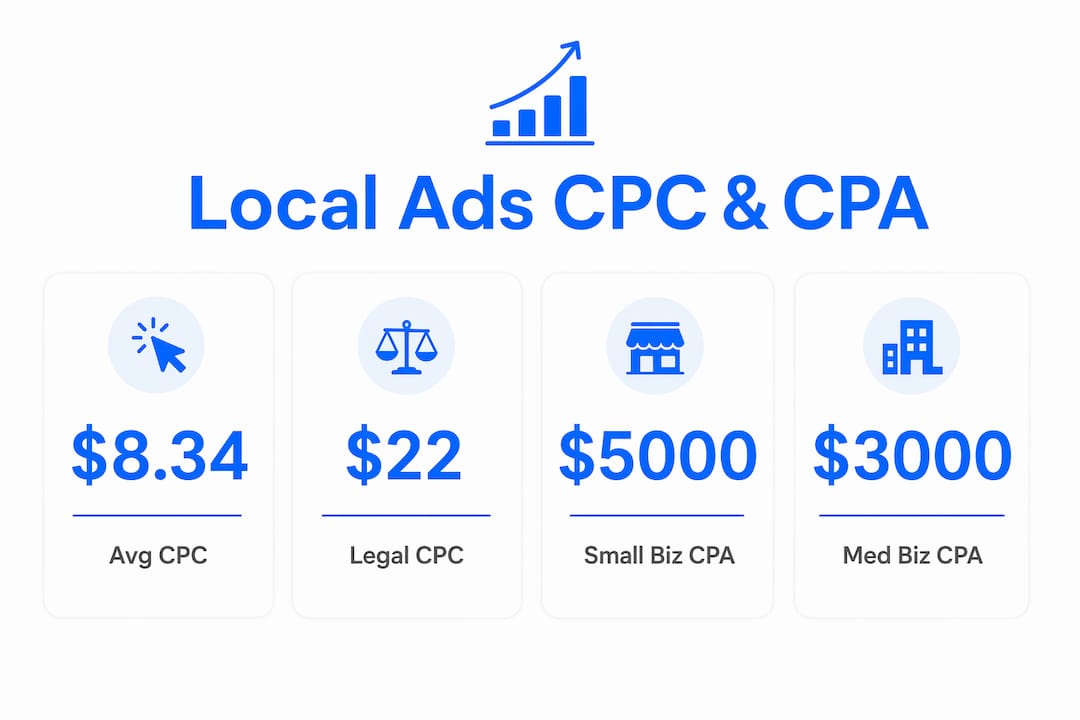
Industry categories show illustrative average CPC and CPA ranges that reflect planning estimates; actual costs vary based on location, competition, and campaign quality.
Three quick scenarios: A local restaurant running a lunch promotion might pay $2.50–$4/click and close a reservation spending about $20 in ads. A plumbing company targeting “burst pipe repair” might pay $8/click and land a booked job for $90 in spend. A family law firm could pay $22–$25/click and need $400 in spend to sign a new client — but that client is worth thousands. High CPC doesn’t mean bad ROI. It means you need to know your numbers.
How to set a realistic monthly budget and forecast leads
The core formula is simple: Monthly budget = target conversions × target CPA.
A basic budgeting formula involves multiplying your target number of leads by your target CPA to estimate a monthly budget. Daily budget follows from there: divide monthly by 30.4 (Google’s standard monthly divisor). Google’s own documentation confirms that your campaign may spend up to 2× the daily budget on high-traffic days but won’t exceed your monthly cap.
Inputs to nail down before you build the budget:
-
Target CPA — what you can afford to pay per lead or sale, based on your margin
-
Target conversion volume — how many leads or sales you need monthly
-
Estimated CPC — use industry benchmarks as a starting point, then adjust
-
Expected conversion rate — industry average for local lead gen is roughly 3–5%
-
Minimum tracking validation — confirm your Google tag fires on the thank-you page or call event
AdsGo recommends a practical minimum monthly budget sufficient to generate enough conversions for Google’s automation; too low a budget may prevent exiting the learning phase. The minimum daily budget rule of thumb: set it at least 5× your average CPC. If your average CPC is around $5.40 (WordStream benchmark), your daily budget floor is about $27, for a monthly minimum close to $820. If your actual CPC is higher, increase the minimum accordingly.
What should you expect in the first 90 days?
The first three months are data collection, not profit maximization. Set that expectation now and you’ll avoid the most common mistake: pausing a campaign that was actually working.
Launch week: Monitor for tag errors, disapproved ads, and zero-conversion days. Don’t touch bids yet.
Weeks 2–4: Watch click-through rate, conversion rate, and cost per conversion. The campaign is in learning phase. Automated bidding needs 15–30 conversions per campaign per month to stabilize. If you’re getting fewer, your budget may be too low or your targeting too narrow.
Month 2: Check impression share lost to budget. If it’s above 20%, you’re leaving clicks on the table. Review search term reports and add negatives weekly.
Month 3: If CPA has been stable for 14+ days and is at or below your target, you’re ready to scale. When you do, increase the daily budget by no more than 10% at a time. Larger jumps restart the learning phase.
The trigger to shift from learning to growth: consistent CPA below target with at least 30 conversions in the past 30 days.
Practical ways to lower your cost per click and per lead
The fastest cost reductions come from improving relevance and conversion rate, not from raising bids.
-
Use long-tail keywords. “Emergency furnace repair Chicago” costs less and converts better than “HVAC.”
-
Add negative keywords weekly. Block irrelevant searches (“DIY,” “free,” “how to”) that eat budget without converting.
-
Tighten match types. Broad match without negatives is a budget leak. Start with phrase or exact match.
-
Improve your landing page. A page that loads in under 3 seconds and matches the ad’s promise directly raises Quality Score and conversion rate.
-
Use local extensions. Location extensions, call extensions, and review extensions improve CTR and ad rank at no extra cost.
-
Adjust bids by device and time. If your data shows mobile converts at half the rate of desktop, reduce mobile bids by 20–30%.
-
Test two ad variations at a time. Change one element (headline, CTA, offer) and let each run for at least 100 clicks before judging.
Pro Tip: Before switching to automated bidding strategies like Target CPA or Maximize Conversions, confirm you have at least 30 conversions in the past 30 days. Without that data, automated bidding often overspends in the early weeks.
Tracking and measurement: the non-negotiable setup
Don’t judge campaign performance until conversion tracking is verified and GA4 is reporting accurately. This sounds obvious. Most local business campaigns skip it.
Minimum setup before launch: Google tag live on every page, conversion events firing on form submissions and phone calls, and GA4 linked to your Google Ads account. If you take offline leads (someone calls, then books in person), reconcile those in your CRM and import them as offline conversions when possible.
On attribution: Google Ads defaults to last-click, which gives all credit to the final ad click. Data-driven attribution distributes credit across the full path and tends to give a more accurate picture once you have enough conversion volume (roughly 300+ conversions in 30 days). For most local businesses starting out, last-click is fine. Just know what you’re looking at.
Reporting rhythm: check weekly for the first month (clicks, conversions, CPA, search terms). After month one, biweekly reviews with a focus on cost per conversion and impression share lost to budget are enough.
When does a managed service make sense for your business?
Self-managing Google Ads is viable if you have time, patience for a 90-day learning curve, and someone who can verify tracking. Most local business owners don’t have all three.
Consider a managed platform when: you can’t verify your own conversion tracking, you’re running ads across multiple services or locations, or you need your ads integrated with lead management and review generation rather than operating as a standalone channel.
Service Grower is built for exactly this situation. The platform combines AnswerReady websites (optimized for Google and AI search), SmartRequest lead capture forms, GrowthView reporting, and optional managed Google Ads. Tracking verification is built into onboarding, not bolted on after the fact. That matters because campaigns with verified tracking from day one collect usable conversion data faster and exit the learning phase sooner.
Questions to ask any managed provider before signing: How do you verify conversion tracking? What’s your recommended minimum monthly ad spend? How often do you report, and what metrics? Is your fee a flat rate or a percentage of spend?
Key Takeaways
For U.S. local businesses, a realistic Google Ads budget starts at $500/month and typically runs $1,000–$3,000/month for most service categories, with verified conversion tracking as the mandatory first step.
| Point | Details |
|---|---|
| Starting budget range | Most local businesses need $1,000–$3,000/month; minimum $500/month to generate learning data. |
| Mandatory first step | Verify Google tag and GA4 conversion tracking before spending a dollar on ads. |
| First 90 days focus | Collect conversion data, not profit. Aim for 15–30 conversions per campaign per month. |
| Cost reduction lever | Improve Quality Score and landing page relevance before raising bids. |
| Service Grower | Offers integrated tracking, lead management, and managed ads to shorten the path to stable CPA. |
The trade-off most local owners don’t see coming
The hardest part of Google Ads isn’t the budget. It’s the patience. Local business owners are used to seeing results fast — a new sign goes up, foot traffic changes. Google Ads doesn’t work that way. The first 60 days often look like waste because the system is learning, not performing. Owners who pause campaigns at day 45 because “it’s not working” are cutting off the data collection that would have made month three profitable.
The other trade-off: self-managing saves the management fee but costs time and often costs more in wasted spend from poor tracking or broad targeting. A managed platform with integrated presence, lead tracking, and verified conversion setup typically shortens the path to a stable, profitable CPA. The fee pays for itself when it prevents the common mistakes — especially the tracking errors that make automated bidding useless.
Ready to stop guessing at your ad budget?
Running Google Ads without verified tracking and an integrated lead system is like running a restaurant without a POS — you’re busy, but you don’t know what’s working.
Service Grower’s managed ad service starts with a tracking audit. Before recommending a monthly spend, the team verifies your Google tag, confirms GA4 is attributing correctly, and establishes a baseline CPA for your category. From there, managed campaigns run alongside your AnswerReady website and SmartRequest lead forms, so every click, call, and booking is captured in one place.
The first step costs you 15 minutes. Book a discovery call and find out what a realistic budget looks like for your specific business, location, and goals. No commitment, no minimum spend required to start the conversation.