
 GROWTH GUIDE
GoHighLevel vs HubSpot: Which CRM Wins in 2026?
GoHighLevel is the right call for agencies and multi-client operators. HubSpot is the right call for inbound-focused B2B companies that need deep attribution and a unified data model. If you run a local service business and neither platform fits your actual workflow, Service Grower is the managed alternative built specifically for that situation.
Two factors drive that verdict:
-
Architecture and pricing shape. GoHighLevel charges a flat monthly fee regardless of contact count, with sub-accounts designed to isolate each client’s CRM and automations. For active agencies, real-world monthly spend is typically $400–$600 when SMS, calling, and AI usage are included. HubSpot charges per seat and scales by contact tier, with a unified object layer that connects every record across marketing, sales, and service. Equivalent Marketing plus Sales Professional combinations cost several thousand dollars per month.
-
Business motion. Multiple comparative analyses frame this choice as motion-driven, not feature-driven: agency/multi-client operators versus single-company inbound sales teams.
One caveat: if your team needs multi-touch revenue attribution, custom objects, or real-time API integrations with analytics platforms, HubSpot’s premium pays for itself even at higher contact volumes.
Table of Contents
-
How does pricing actually compare between the two platforms?
-
How does platform architecture affect your data and reporting?
-
Service Grower is the visibility-first alternative for local businesses
GoHighLevel vs HubSpot: Side-by-Side Comparison
The table below maps both platforms and Service Grower across the dimensions that actually move purchase decisions. Read the pricing row as a shape comparison, not a list price. The SMS row reflects a meaningful technical difference: GoHighLevel supports native two-way SMS; HubSpot handles SMS via third-party add-ons.
| Dimension | GoHighLevel | HubSpot | Service Grower |
|---|---|---|---|
| Best for / buyer profile | Agencies and multi-location operators needing per-client isolation | Inbound B2B teams needing unified CRM and deep attribution | U.S. local businesses wanting managed visibility and booking |
| Pricing model & example TCO | Flat $97–$497/month + usage fees; actual agency spend for active use is typically $400–$600/month | Free tier; Pro/Enterprise plans typically run several thousand dollars per month by seat and contacts | Subscription SaaS; tiered plans not publicly listed |
| CRM depth | Pipeline management, contacts, deals; limited custom objects | Full object layer: contacts, companies, deals, tickets, custom objects | Lead tracking and booking portal; not a full CRM |
| Marketing automation | Native workflows, email, 2-way SMS, voicemail drops | Workflows, email sequences, 1-way SMS via add-on | Managed campaigns; not a self-serve automation builder |
| Funnel/landing-page builder | Native drag-and-drop funnels and websites | Landing pages in Marketing Hub; no native funnel builder | AnswerReady™ AI-optimized websites |
| Appointment scheduling | Native calendar and booking system | Meetings tool (HubSpot Meetings); limited native scheduling | SmartRequest booking and request forms |
| Agency & white-label | Full SaaS Mode white-label reseller; Snapshot cloning | No white-label capability | Not applicable |
| Reporting & analytics | Standard pipeline and campaign reports | Multi-touch attribution, revenue forecasting, custom dashboards | GrowthView analytics for local visibility and bookings |
| Integrations & API | Built-in features + Zapier for gaps; limited native ecosystem | 1,400+ native integrations; Webhooks v3 API | Platform integrations not publicly listed |
| Scalability | Strong for agency scale; cross-client analytics limited | Mid-market to enterprise; strong governance and data integrity | Local business scale; not built for enterprise |
| Migration complexity | Moderate; Snapshot cloning speeds onboarding | High; custom objects and attribution require careful mapping | Low; managed onboarding |
Note on SMS: GoHighLevel’s native two-way SMS is a genuine operational differentiator for agencies running conversational campaigns. HubSpot’s SMS capability requires a third-party integration and does not offer the same conversational threading natively.
How does pricing actually compare between the two platforms?
Advertised prices rarely tell the full story. Here is how each platform charges and what real-world spend looks like across three buyer profiles.
GoHighLevel’s pricing model
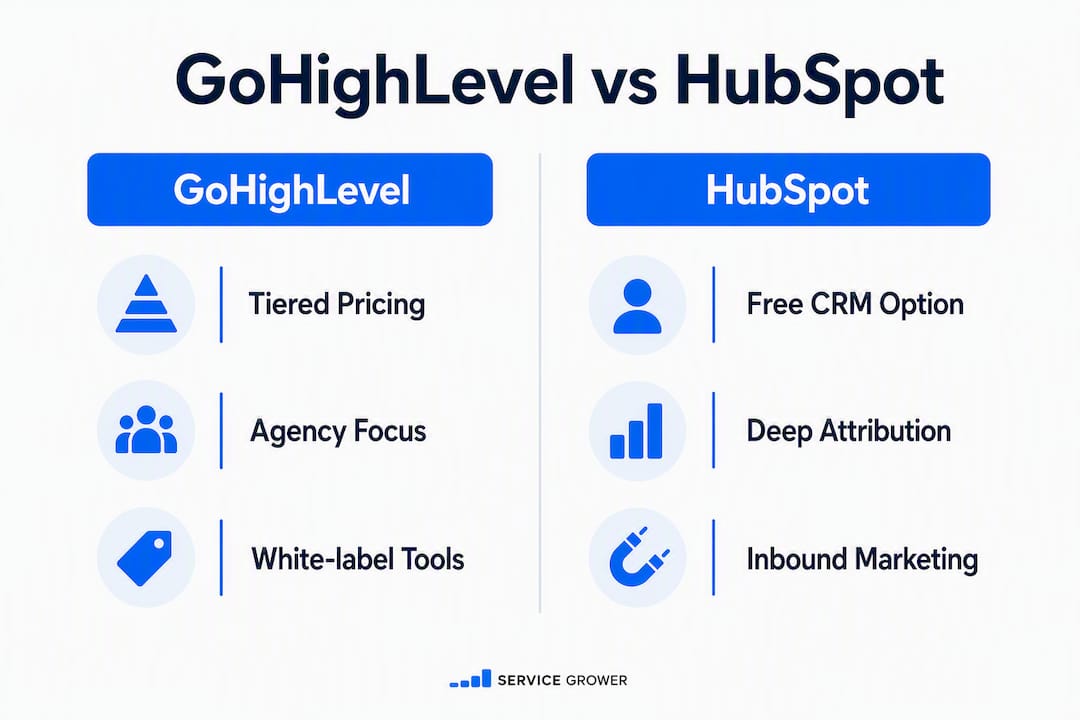
GoHighLevel offers tiered pricing plans starting under a few hundred dollars per month, but practitioners report that active agencies often incur total monthly costs in the $400–$600 range with SMS, calling, and AI usage included. The $97 entry price is essentially a floor, not a budget.

HubSpot’s pricing model
HubSpot’s free CRM is real and genuinely useful for small teams. The cost jumps fast once you need Marketing Hub Professional ($800/month) or Sales Hub Professional ($450/month per seat). An equivalent Marketing plus Sales Professional combination runs several thousand dollars per month, with enterprise tiers costing significantly more. Contact-tier overages add another variable to forecast.
Three TCO scenarios
Scenario A: Agency with 10 retainer clients
-
GoHighLevel Unlimited plan: base monthly fee under few hundred dollars
-
SMS and calling usage for 10 active client campaigns: ~$150–$200/month estimated
-
Total: approximately several hundred dollars per month
-
Equivalent HubSpot stack (Marketing Pro + Sales Pro for 2 reps) costs several thousand dollars per month
-
Difference: significant annual cost savings for small agencies using GoHighLevel
Scenario B: Single-location local business using scheduling and SMS
-
GoHighLevel Starter plan has a low base fee plus additional SMS usage costs
-
HubSpot Starter CRM plus Marketing Starter tier charges a modest monthly fee, with SMS requiring an additional add-on
-
Service Grower: subscription pricing not publicly listed; contact for a quote
-
For a local business that primarily needs booking, reviews, and visibility, neither GoHighLevel nor HubSpot is purpose-built for that workflow
Scenario C: B2B company with 5 sales reps needing advanced reporting
-
HubSpot Sales Hub Professional charges per seat, resulting in several thousand dollars per month for a typical sales team
-
Marketing Hub Professional adds significant monthly cost
-
Total: several thousand dollars per month
-
GoHighLevel equivalent costs a few hundred dollars per month, with limited advanced reporting capabilities
-
For this profile, HubSpot’s reporting depth justifies the premium
Pro Tip: Before signing any contract, export a 90-day sample of your SMS and email send volume. Both platforms charge for outbound messaging, and underestimating that number by 30% can flip a budget comparison entirely.
What are the real feature differences that matter?
CRM and data objects
GoHighLevel handles contacts, pipelines, and deals competently for agency use. Custom objects are limited, which matters when you need to track non-standard data relationships. HubSpot’s unified CRM object layer connects contacts, companies, deals, tickets, and custom objects on a single record, giving every team a shared source of truth. That architecture is what makes HubSpot’s lifecycle reporting actually work.
Marketing automation
Both platforms support visual workflow builders. GoHighLevel’s automation covers email, SMS, voicemail drops, and conditional branching. HubSpot’s workflows are deeper on the B2B side: lead scoring, deal-stage triggers, and enrollment criteria tied to custom properties. For agencies running similar campaigns across many clients, GoHighLevel’s Snapshot cloning copies an entire client configuration (CRM, automations, funnels, calendar) to a new sub-account in one click, which is a genuine time saver at scale.

SMS and telephony
GoHighLevel supports native two-way SMS and calling. That means a client can reply to a campaign message and the conversation threads inside the platform. HubSpot’s SMS is add-on territory. One technical limitation worth knowing: GoHighLevel’s call tracking uses number-pool rotation rather than session-level dynamic number insertion (DNI). That limits the ability to tie a call back to a specific ad keyword or visitor session, which matters if you need granular paid-search attribution.
Funnel and landing-page builder
GoHighLevel includes a drag-and-drop funnel builder with templates. HubSpot has landing pages inside Marketing Hub but no native funnel builder in the traditional sense. For agencies building lead-gen funnels for clients, GoHighLevel’s native tooling removes a dependency on ClickFunnels or Unbounce.
Reporting and analytics
HubSpot’s multi-touch attribution and revenue forecasting are materially deeper than GoHighLevel’s. Custom dashboards, deal-stage velocity, and campaign-to-revenue attribution are built into Marketing Hub Pro and Enterprise. GoHighLevel’s reporting covers pipeline and campaign basics well but does not match HubSpot at the attribution layer.
White-label and agency tools
GoHighLevel’s SaaS Mode lets agencies rebrand the entire platform and resell it as their own product. Combined with sub-account isolation, this is the feature that makes GoHighLevel genuinely agency-first. HubSpot has no equivalent white-label capability.
Pro Tip: Flat-tier bundles create a false sense of savings when messaging volume is high. An agency sending 50,000 SMS messages per month will pay usage fees that can exceed the base plan cost. Model your actual send volume before comparing sticker prices.
How does platform architecture affect your data and reporting?
The single biggest structural difference between these two platforms is not a feature. It is a design philosophy.
GoHighLevel uses a sub-account architecture where each client lives in its own isolated environment. One agency dashboard manages many accounts, and data does not bleed between clients. That isolation is exactly what agencies need. The trade-off is that cross-client analytics require manual aggregation or third-party tooling.
HubSpot uses a unified data model. Every contact, company, deal, and ticket lives in one connected record. When a contact moves from a marketing campaign to a sales deal to a support ticket, the history follows them. That continuity is what powers multi-touch attribution and lifecycle reporting. HubSpot’s Webhooks v3 API also supports event-driven architectures, making real-time integrations with analytics platforms like Amplitude and Mixpanel practical in a way GoHighLevel’s API currently does not match.
Practitioners note that bolting a post-sale service motion onto an agency-first platform often fragments data and complicates retention tracking. If post-sale workflow matters to your business, a unified model is the right foundation.
Migration checklist before you switch
-
Data exportability. Can you export contacts, deals, and custom fields in a format the destination platform can import cleanly?
-
Custom object parity. Does the destination platform support the same non-standard data relationships you rely on today?
-
API maturity. Does your current tech stack depend on webhooks or real-time event triggers that require a mature API?
-
SMS opt-in records. TCPA compliance requires that opt-in records transfer with contacts. Confirm the export includes consent timestamps.
-
Attribution history. Multi-touch attribution data rarely migrates cleanly. Decide whether you need historical attribution or can start fresh.
-
Call tracking setup. If you use session-level DNI today, verify the destination platform supports it natively or plan for a CallRail integration.
Which platform should you actually choose?
The answer depends almost entirely on your business model, not your feature wishlist.
| Buyer profile | Recommended platform | Why |
|---|---|---|
| Marketing agency, 1–20 clients | GoHighLevel | Sub-account isolation, white-label SaaS Mode, flat pricing, Snapshot cloning |
| Multi-location operator | GoHighLevel | Per-location sub-accounts, unified agency dashboard, native SMS |
| B2B company, 5+ sales reps | HubSpot | Unified CRM, multi-touch attribution, Sales Hub pipeline depth |
| Inbound-led SaaS or mid-market | HubSpot | Custom objects, revenue forecasting, 1,400+ integrations |
| U.S. local service business | Service Grower | Managed visibility, AnswerReady™ websites, booking, reputation management |
Six questions to ask before you decide
- Is multi-touch attribution required? — If your CFO asks for campaign-to-revenue reporting, HubSpot is the answer.
For agencies with fewer than 20 clients, GoHighLevel typically delivers annual savings exceeding $6,000 compared to an equivalent HubSpot stack. For mid-market and enterprise buyers focused on forecasting and attribution, HubSpot’s premium tends to pay for itself.
What does migration actually look like?
Most migrations take longer than expected. Here is a realistic phased timeline.
-
Discovery (1–2 weeks). Audit your current data: contact count, custom fields, active automations, integrations, and SMS opt-in records. Document every workflow that touches revenue.
-
Data mapping and cleanup (2–3 weeks). Map source fields to destination fields. Remove duplicate contacts. Confirm custom object parity. Flag any attribution history you need to preserve.
-
Pilot (2–4 weeks). Migrate a single team or client sub-account. Test every automation end-to-end. Verify SMS opt-ins transferred with consent timestamps.
-
Parallel run (2–4 weeks). Run both platforms simultaneously. Compare outputs. Identify discrepancies in reporting before cutting over.
-
Cutover (1 week). Redirect integrations, update DNS for email sending domains, and decommission the old platform. Confirm deliverability is stable.
Common friction points
-
Custom objects that have no equivalent in the destination platform
-
Multi-touch attribution history that does not export in a usable format
-
Call tracking numbers that need to be ported or replaced
-
SMS opt-in records missing consent timestamps (a TCPA compliance risk)
-
Knowledge base articles and service tickets that live outside the CRM export
Pro Tip: Run a parallel period of at least two weeks before full cutover. Reporting discrepancies that look like platform bugs are often data-mapping errors that surface only when you compare live outputs side by side.
Use a migration partner when your stack includes custom objects, complex attribution, or more than 50,000 contacts. In-house migrations work well for simpler setups with clean data and no custom object dependencies. Always keep a rollback plan: keep the old platform active and paid through the parallel run period.
How we evaluated this comparison
This comparison draws on the following sources and methods:
- Vendor documentation — GoHighLevel’s feature list and HubSpot’s official comparison page were used for architecture and feature claims.
Pros and cons of each platform
GoHighLevel
Pros:
-
Flat monthly pricing with unlimited contacts removes a major scaling cost
-
Sub-account architecture isolates client data cleanly
-
Native two-way SMS and voicemail drops included
-
SaaS Mode white-label reseller capability
-
Snapshot cloning speeds multi-client onboarding significantly
-
Native funnel builder removes dependency on third-party tools
Cons:
-
Usage fees for SMS, calls, and AI can push real costs to $400–$600/month for active agencies
-
Call tracking uses number-pool rotation, not session-level DNI, limiting paid-search attribution
-
Limited custom objects and cross-client analytics
-
Integration ecosystem relies heavily on Zapier for gaps
-
Reporting depth does not match HubSpot for attribution-heavy teams
Best for: agencies and multi-location operators managing multiple client environments at a predictable cost.
HubSpot
Pros:
-
Unified CRM object layer connects every record across marketing, sales, and service
-
Multi-touch attribution and revenue forecasting built into Pro and Enterprise tiers
-
1,400+ native integrations and a mature Webhooks v3 API
-
Strong governance and data integrity for mid-market and enterprise teams
-
Free tier is genuinely functional for small teams starting out
Cons:
-
Per-seat and contact-tier pricing scales fast; equivalent feature sets cost $1,600–$2,400/month
-
No white-label or sub-account reseller capability
-
SMS requires third-party add-ons; no native two-way conversational SMS
-
High migration complexity for teams with custom objects and attribution history
-
Onboarding fees can add significant upfront cost
Best for: inbound-focused B2B companies and mid-market teams that need deep attribution and a unified data model.
Service Grower
Pros:
-
Purpose-built for U.S. local service businesses, not adapted from an agency or enterprise tool
-
AnswerReady™ websites optimized for AI and local search visibility
-
SmartRequest booking and request forms integrated with the platform
-
GrowthView analytics focused on bookings and local visibility, not generic pipeline metrics
-
Managed onboarding removes the DIY implementation burden
-
Optional managed Google and Meta ads as an add-on
Cons:
-
Not a full CRM; does not replace GoHighLevel or HubSpot for sales pipeline management
-
Subscription pricing not publicly listed
-
Not suited for agencies managing multiple client accounts
-
No white-label or reseller capability
Best for: U.S. local businesses (HVAC, barbers, restaurants, fitness, healthcare) that need managed visibility, bookings, and reputation management rather than a self-managed CRM stack.
Why Service Grower works for many U.S. local businesses
GoHighLevel and HubSpot are both built around a core assumption: the user is managing their own platform. Someone on your team sets up the automations, builds the funnels, maps the integrations, and monitors the reports. For an agency or a B2B sales team, that assumption is reasonable. For a local HVAC operator or a barber shop owner, it is not.
Service Grower is built around a different assumption: the business owner wants customers to find them and book, not a new software project to manage.
The platform’s core capabilities address the specific problems local businesses actually face:
-
AnswerReady™ websites are optimized for both traditional search and AI-driven discovery (Google, ChatGPT), so the business shows up when a nearby customer searches for a specific service.
-
SmartRequest forms handle online booking and service requests without requiring the owner to configure a CRM pipeline.
-
GrowthView analytics report on what matters locally: booking volume, review growth, and search visibility, not deal-stage velocity.
-
Reputation management tools track and respond to reviews across platforms, which directly affects local search ranking.
-
Optional managed Google and Meta ads mean the business can run paid campaigns without hiring an agency or learning a platform.
For a local business, the question is not “which CRM has better attribution?” It is “are new customers finding me, and are they booking?” Those are different questions that need different tools.
The managed delivery model is the real differentiator. Service Grower handles setup, optimization, and ongoing management. A local business owner does not need to become a marketing technologist to get results.
What is the final recommendation?
Choose GoHighLevel if you run a marketing agency or manage multiple client accounts. The sub-account architecture, white-label SaaS Mode, and flat pricing make it the most cost-effective option for that specific business model. For agencies with fewer than 20 clients, documented savings are typically over $6,000 annually compared to an equivalent HubSpot stack.
Choose HubSpot if you run an inbound-focused B2B company with a dedicated sales team and real attribution requirements. The unified data model, multi-touch attribution, and 1,400+ integrations justify the higher cost when your business depends on connecting marketing spend to closed revenue.
Choose Service Grower if you run a U.S. local service business and your primary need is getting found online, generating bookings, and managing your reputation. Neither GoHighLevel nor HubSpot is purpose-built for that workflow.
Three-item buyer checklist
- Count your client accounts or sales reps — More than five clients points to GoHighLevel. Five or more sales reps needing attribution points to HubSpot.
Pro Tip: Start any platform evaluation with a 30-day pilot on a single use case, not a full migration. Agencies should pilot one client sub-account. B2B teams should pilot one sales pipeline. Local businesses should pilot booking and review management. A narrow pilot surfaces real friction before you are committed.
Key Takeaways
GoHighLevel wins on agency economics and white-label capability; HubSpot wins on data integrity and attribution depth; Service Grower is the purpose-built alternative for U.S. local businesses that need managed visibility and bookings rather than a self-managed CRM.
| Point | Details |
|---|---|
| Agency economics favor GoHighLevel | Agencies with fewer than 20 clients consistently save over $6,000 annually compared to an equivalent HubSpot stack. |
| HubSpot leads on attribution | Multi-touch revenue attribution and custom objects are built into HubSpot Pro/Enterprise and are not matched by GoHighLevel natively. |
| Real GoHighLevel costs are higher than advertised | Active agency spend typically runs $400–$600/month once SMS, calling, and AI usage fees are included. |
| Architecture drives the decision | The agency sub-account model versus the unified CRM object layer is a structural choice, not a feature preference. |
| Service Grower serves a different buyer | Local service businesses needing managed visibility, booking, and reputation management are better served by Service Grower than by either CRM platform. |
The part most comparisons get wrong
Most GoHighLevel vs HubSpot write-ups treat this as a feature race. They count integrations, compare workflow builders, and score each platform on a rubric. That framing misses the actual decision.
The real question is not which platform has more features. It is which platform was designed for your business motion. GoHighLevel was built for operators who manage other people’s marketing. HubSpot was built for companies that do their own inbound marketing and need every team aligned on the same data. Those are fundamentally different jobs.
The mistake most buyers make is choosing a platform based on a feature they need today without accounting for the operational overhead of running it. An agency owner who buys HubSpot because it has better attribution will spend months configuring a platform that was never designed for multi-client management. A B2B sales leader who buys GoHighLevel because it is cheaper will hit a wall the first time the CFO asks for campaign-to-revenue reporting.
The second common mistake is assuming that a cheaper platform is a better deal. For an agency with 10 clients, GoHighLevel’s flat pricing is genuinely better economics. For a B2B company with a five-person sales team and a demand-gen budget, HubSpot’s attribution tools can identify which campaigns are actually driving revenue, and that information is worth the premium.
One more thing: if you are a local service business reading this comparison, both platforms are probably more than you need and less than you want. Neither was designed to help a plumber show up first when someone in their zip code searches for emergency pipe repair on ChatGPT. That is a different problem, and it needs a different tool.
Service Grower is the visibility-first alternative for local businesses
GoHighLevel and HubSpot are strong platforms for the buyers they were designed for. But if you run a local service business in the U.S., what you actually need is not a CRM. You need customers to find you when they search, a simple way for them to book, and a steady stream of reviews that build trust.
Service Grower delivers exactly that: AnswerReady™ websites built for AI and local search visibility, SmartRequest booking forms, GrowthView analytics that track what matters locally, and optional managed Google and Meta ads when you are ready to grow faster. The platform is managed, so you do not need a marketing team or a software background to get results. Local businesses using Service Grower report measurable increases in bookings and reviews without the DIY overhead of a self-managed CRM stack.
Book a 15-minute call to see how Service Grower fits your business.
Useful sources
-
GoHighLevel vs HubSpot (2026 Comparison) | The GTM Directory — Practitioner-level comparison covering architecture, pricing, and agency economics with real-world cost estimates.
-
HubSpot vs HighLevel | HubSpot Official Comparison — HubSpot’s own comparison page covering unified CRM architecture and feature differences.
-
GoHighLevel vs HubSpot (2026): Agency All-in-One vs Enterprise CRM | Velocity AI Insights — Detailed TCO analysis documenting annual savings for small agencies on GoHighLevel.
-
GoHighLevel vs HubSpot (2026): Agency Bundle vs Enterprise CRM | StackSwap — Integration ecosystem comparison; documents HubSpot’s 1,400+ native integrations versus GoHighLevel’s middleware dependency.
-
GoHighLevel Review | CallRail Blog — Technical review covering call-tracking architecture and the number-pool rotation limitation.
-
HubSpot vs GoHighLevel 2026: CRM Depth vs Agency Automation | IntegrateIQ — Analysis of HubSpot’s reporting and attribution depth relative to GoHighLevel.
-
GoHighLevel vs HubSpot 2026: Which CRM Is Actually Worth Your Money? | Simular AI — Broad comparison covering pricing tiers, feature sets, and buyer profiles.
-
Roadbase vs ClickUp: Agency Ops and Quoting Workflows | Roadbase Blog — Agency-focused analysis of operational tooling relevant to teams evaluating CRM and delivery platform combinations.