
 GROWTH GUIDE
8 Week Playbook to Get Cited in AI Answers for Local Firms
Put a self-contained answer capsule at the top of a crawlable page, publish a number nobody else has, and get named on Reddit, review sites, and industry roundups. Those three moves account for most of the variance in citation rates across engines. Everything else, from schema markup to redirect hygiene, decides whether the systems can even see what you’ve built. Citation is probabilistic, not guaranteed, so watch manual prompt checks and referral traffic in your analytics as your earliest signal that something is working.
TL;DR:
- Citation rates are highest for pages with answer capsules placed immediately below the main header, especially within the top third of the page, containing specific data or standards.
- Query type heavily influences citation likelihood, with comparison and buying-guidance searches being twice as likely to generate citations as definitional queries.
- Building a strong independent presence on social media, review platforms, and niche forums significantly enhances AI recognition through unlinked mentions.
- Regularly monitor AI citation metrics across multiple engines using a fixed prompt set to differentiate between quick retrieval updates and longer-term mention growth.
- Implement schema markup such as FAQPage, Article, and Organization to improve machine readability, helping retrieval systems extract and cite your content more effectively.
Table of Contents
- What AI Engines Actually Cite and Why: The Signal Hierarchy
- Structure and Content Patterns That Make a Passage Quotable
- Technical Checklist: Making Your Pages Reachable and Machine-Readable
- Off-Page Signals and Distribution: Earning the Mentions AI Systems Trust
- Measure and Monitor AI Citations: A Repeatable Tracking Framework
- An 8-Week Prioritized Action Plan
- How AI Training Data Cycles Affect Your Citation Window
- Best Practices for Ethical and Accurate Citation
- Open vs. Closed Models: Why Your Approach Has to Split
- Do Images and Videos Help You Get Cited?
- Where Service Grower Fits in the Citation Equation
- Get Your Business Cited, Not Just Ranked
- Sources
- FAQ
What AI Engines Actually Cite and Why: The Signal Hierarchy
Not all queries get treated the same way, and that single fact should reorder your entire content calendar. Cross-engine analysis shows query type moves citation rates roughly twice as much as topic does, with “best X” and buying-guidance searches pulling citations far more often than plain definitional ones. If you’re writing “what is invoice factoring,” you’re competing for scraps. If you’re writing “best invoice factoring companies for trucking,” you’re in the zone where AI systems actively hunt for a source to name.
The engines themselves don’t behave identically, either. Perplexity and similar live-retrieval tools will pull in a page within days if it’s crawlable and well-structured, since they’re querying the live web rather than a frozen snapshot. Closed models leaning on older training data behave differently. They tend to favor sources with a track record, meaning historical presence in authoritative publications matters more for a model like that than a page you published last week, no matter how well it’s built.
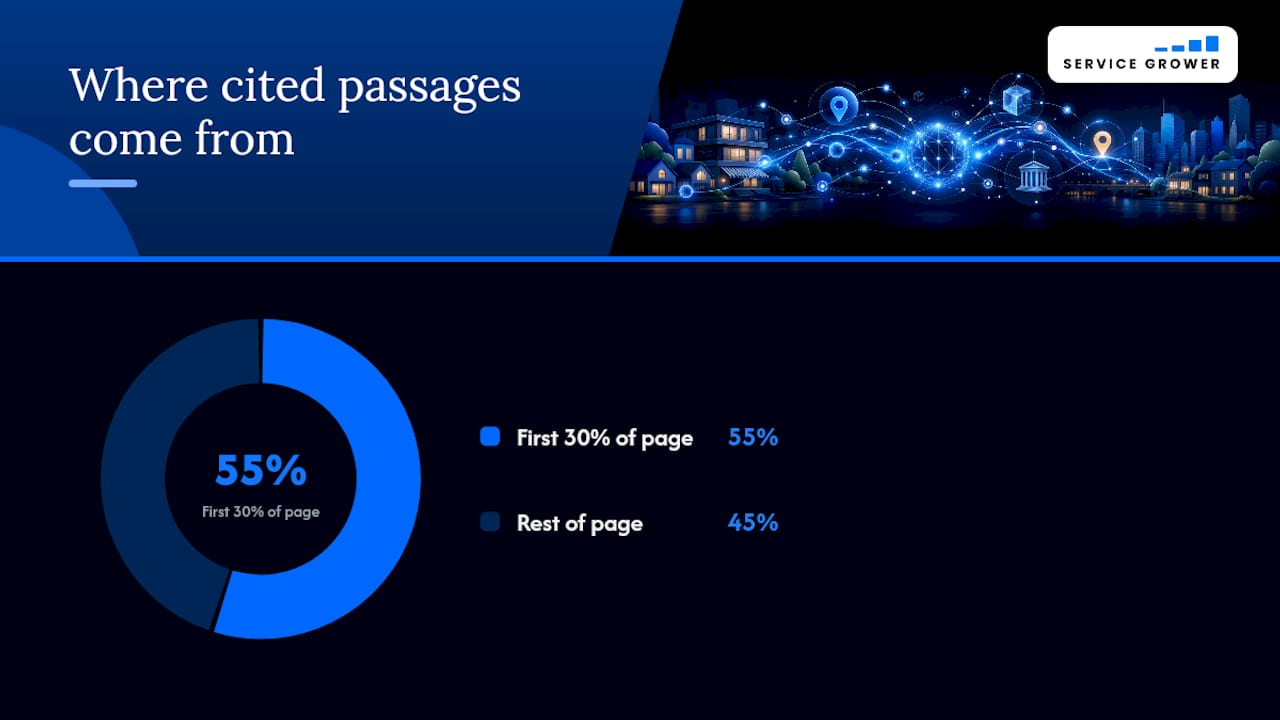
Where the citation comes from on the page matters just as much as the query type. A large-scale audit of AI Overview sourcing found that roughly 55% of cited passages come from the first 30% of a page’s content. That’s not a soft trend. It’s a structural bias in how these systems scan and extract text.
A few source types dominate what gets pulled into answers:
- Reference and comparison sites built around structured, scannable data
- Editorial roundups that already do the comparison work for the reader
- Community threads, especially Reddit, which functions as a trust signal for commercial queries
- Original research or benchmark pages with a number nobody else has published
Move your best material up, not down.
Structure and Content Patterns That Make a Passage Quotable
An answer capsule is a short, self-contained passage, usually two to four sentences, that fully answers a specific question without requiring the reader to scroll further. It states the claim, gives the key number or standard, and (where relevant) names the date or source behind it. Think of it as writing the pull-quote a journalist would lift, except you’re writing it for a language model instead of a human editor.
Here’s a simple template you can adapt to almost any page:
- Open with the direct answer to the question implied by your H1 or H2 (“The average cost of X is $Y, based on Z data from [year]”).
- Add one sentence of context or scope (who this applies to, what it excludes).
- Close with a specific detail: a number, a named standard, or a comparison point that makes the passage impossible to paraphrase without losing precision.
Placement is not negotiable. Given that most citations come from the top third of a page, your capsule belongs immediately under the H1 or the first H2, not buried after three paragraphs of throat-clearing about industry trends. One audit of frequently quoted pages found answer capsules were present in a large majority of cited passages, and the highest citation share went to pages combining a capsule with original data.
Formatting decisions compound this effect. Descriptive H2s that mirror real questions, short paragraphs instead of dense blocks, labeled lists instead of run-on prose, and a dedicated FAQ block near the top all make a page easier for a retrieval system to parse into discrete, quotable units.
Pro Tip: Write your answer capsule last, after you’ve drafted the whole page. It’s far easier to compress a fully formed argument into three sentences than to write a tight summary before you know what you’re summarizing.
Technical Checklist: Making Your Pages Reachable and Machine-Readable
None of the structural work above matters if the crawlers can’t reach your content in the first place. Start with the basics: check your robots.txt file and server logs for whether you’re allowing or blocking the specific bots these engines use, including GPTBot, ClaudeBot, PerplexityBot, and Google’s various AI crawler variants like Google-Extended. It’s a common and entirely avoidable mistake to block one of these while assuming your standard Googlebot allowance covers everything.
Rendering matters just as much as access. If your answer capsule loads via JavaScript after the initial page render, many crawlers will simply miss it. Server-render the essential text, especially anything in your top 30%, so it’s present in the raw HTML a crawler receives on first request.
Schema markup gives these systems a machine-readable shortcut to your content’s structure. FAQPage schema helps retrieval systems identify clean question-and-answer pairs, Article schema signals publication and authorship metadata, and Organization or Person schema ties content to a named, identifiable source. None of these guarantee a citation, but they remove friction from the extraction process, which is exactly the kind of low-effort, high-leverage fix marketers tend to skip.
A short checklist worth running quarterly:
- Confirm named AI crawlers aren’t blocked in
robots.txtor at the server/firewall level - Test that your answer capsule appears in a “view source” check, not just the rendered page
- Add FAQPage, Article, and Organization/Person schema to pages targeting buying-intent queries
- Display visible author names, publisher identity, and publish or update timestamps
- Eliminate redirect chains and confirm canonical URLs are stable, not shifting between www and non-www versions
Fast fact: schema.org’s own documentation frames these types as a “clarity aid” for machines, not a ranking lever. Treat schema as the difference between handing a crawler a labeled filing cabinet versus a shoebox of receipts. It doesn’t create the content’s value, but it makes that value legible fast, which is exactly what a structured GEO approach depends on.
Off-Page Signals and Distribution: Earning the Mentions AI Systems Trust
Citation inside your own content only gets you halfway there. AI systems weigh corroboration, meaning independent confirmation that other sources treat you as credible on the topic. That’s why brand mentions across third-party surfaces correlate so strongly with actually getting named in an answer. Ahrefs’ research on brand-mention patterns found Reddit functioning as the single most-cited domain for ChatGPT across a large sample of tracked queries, and even unlinked mentions on forums or review sites still feed entity-recognition signals that models use to decide who’s worth naming.
A practical playbook for building that corroboration:
- Search for existing “best X” and comparison roundups in your category and identify which ones exclude you.
- Pitch inclusion with one specific detail an editor can drop straight into their existing comparison table, since editors move faster on submissions that require no extra research on their end.
- Refresh and complete your review profiles on the platforms your buyers actually check, not just the ones easiest to set up.
- Publish one original data point, survey, or benchmark, then proactively send it to publications already covering your space.
- Participate genuinely in relevant Reddit threads and niche forums where your category gets discussed, since these communities carry outsized weight for commercial and buying-intent queries.
Unlinked mentions matter more here than in traditional SEO, where a link was historically the only currency that counted. Large language models build entity associations from co-occurrence and context, not just hyperlink graphs. A brand name that shows up repeatedly next to relevant keywords across independent sources builds a recognition pattern even without a single backlink attached.
That said, converting a bare mention into a stronger signal, an actual linked citation or a quoted line in an editorial piece, compounds the effect. If a reporter already mentioned you once, follow up with an offer of a fresh statistic or a direct quote for their next piece on the topic. Reach out through a three-lever approach that pairs capsule content with active mention-building, rather than treating them as separate workstreams.
Measure and Monitor AI Citations: A Repeatable Tracking Framework
You can’t manage what you don’t measure, and most teams are flying blind on this because the analytics aren’t as mature as traditional search reporting. Build a fixed basket of 15 to 25 prompts that mirror your buyers’ actual questions, then run that identical prompt set weekly across ChatGPT, Perplexity, Gemini, and Google AI Overviews.
Track a consistent set of fields for each run:
- Mention rate: how often your brand name appears at all, linked or not
- Citation rate: how often you’re specifically named as a source for a claim
- Linked-citation rate: how often that citation includes an actual clickable link
- Cited URL: which specific page got pulled, so you know what’s working
- Sentiment: whether the mention is neutral, favorable, or unfavorable
- AI referral traffic: check your analytics platform for referral sources tagged from chat.openai.com, perplexity.ai, or similar domains
Expect different timelines depending on the engine. Live-retrieval tools can reflect a technical fix or a new capsule within a week or two, since they’re pulling fresh content on each query. Corroboration-driven visibility in closed models moves slower, often taking a full quarter or more to show up, because it depends on accumulated mentions rather than a single crawl. Keeping the prompt set frozen matters more than any single week’s result. A consistent monitoring cadence is what separates a real trend from ordinary week-to-week sampling noise.
An 8-Week Prioritized Action Plan
Spreading this work over eight weeks keeps it manageable, while front-loading the changes with the highest citation impact.
Weeks 3 and 4: Original data and outreach. Publish one proprietary data point, survey result, or benchmark tied to your core service. Identify five roundups missing your brand and pitch inclusion using a template like: subject line naming the roundup directly, one sentence establishing relevance, one data point formatted for their existing table, and a direct link to your capsule page.
Weeks 5 through 8: Distribution, monitoring, and iteration. Expand outreach to review platforms and relevant community threads, launch your weekly prompt-tracking routine, and revise any capsule that isn’t getting picked up after four weeks of stable crawlability.
- Build a monitoring sheet with columns for prompt text, engine, date, mention (yes/no), citation (yes/no), linked (yes/no), cited URL, and sentiment.
- Run the same prompt basket every week, same time, same order, to control for variance.
- Flag any page with zero citations after eight weeks for a structural rewrite, not just a content refresh.
Pro Tip: Don’t rewrite ten pages at once in week one. Pick your five highest-traffic, highest-intent pages first, so you can actually attribute any citation change to a specific edit rather than guessing which of ten changes moved the needle.
How AI Training Data Cycles Affect Your Citation Window
Closed models like the ones behind ChatGPT’s default responses train on data collected up to a cutoff date, then get periodically updated or supplemented with retrieval layers. Content published after a model’s last training cutoff won’t influence its baseline knowledge until the next update cycle, which can take months.
This is exactly why the split between live-retrieval and closed-training behavior matters for your planning. If you’re optimizing for Perplexity or a search engine’s AI Overview, a technical fix or new capsule can show results within days because those systems query the live web on each request. If you’re trying to influence ChatGPT’s baseline responses without a live browsing plugin active, you’re waiting on the next training cycle and, more importantly, on whether your brand has accumulated enough independent mentions by that point to be included.
The practical takeaway: don’t judge a content change by checking ChatGPT once and concluding it failed. Check live-retrieval engines first for fast feedback, and treat closed-model citation as a longer-term outcome that depends on sustained mention-building rather than a single optimized page.
Best Practices for Ethical and Accurate Citation
Getting cited is worthless if the citation is wrong, and inaccurate AI summaries of your content create a reputational problem that’s harder to fix than earning the citation in the first place. Keep every factual claim on your pages current, dated, and sourced, since a stale statistic that gets pulled into an AI answer months later can misrepresent your business.
Attribute your own data honestly. If you’re citing a third-party statistic, link to the original source rather than a secondary blog that repeated it, since accuracy at the source level reduces the odds of a distorted claim propagating into an AI-generated summary. When you publish original research, state your sample size, date, and methodology plainly rather than implying more authority than the data supports.
Avoid keyword-stuffing your capsules with your brand name in ways that read as manipulative rather than informative. Systems designed to extract trustworthy answers are also designed to downweight content that reads like it’s gaming the format. Write the capsule to genuinely answer the question first. The citation follows from usefulness, not from engineering a passage to look citable.
Open vs. Closed Models: Why Your Approach Has to Split
Open-weight models and closed, proprietary systems don’t source citations the same way, and treating them identically wastes effort. Closed models like the ones powering ChatGPT’s core responses depend heavily on training-data presence, meaning brands with a long history of authoritative coverage have a structural advantage that’s hard for a new site to close quickly.
Open models and retrieval-augmented systems, including most implementations built on open frameworks, tend to lean harder on live web retrieval and are less dependent on baked-in training presence. That means a technically sound, well-structured page can compete faster in those environments regardless of how new your domain is.
The practical adaptation: if your brand is new or your domain authority is thin, prioritize the engines and query types where live retrieval dominates, since that’s where technical execution can outpace historical reputation. Simultaneously, keep building the third-party mention volume that eventually earns you a place in closed-model training presence down the line. Running both tracks in parallel, rather than betting everything on one engine type, protects you against any single platform’s update cycle.
Do Images and Videos Help You Get Cited?
Multimedia doesn’t get cited directly the way text passages do, but it plays a supporting role that’s easy to underrate. Descriptive alt text and captions give crawlers additional context about what a page covers, which can reinforce topical relevance signals even when the image itself isn’t the cited element.
Video transcripts matter more than the video file. A well-structured transcript, especially one with timestamped sections and clear headers, gives retrieval systems the same extractable text advantage as a well-formatted article. If you’re producing video content, publish the full transcript on the page rather than relying on an embedded player alone.
Original charts, graphs, or infographics built from your own data can function similarly to a written statistic. If the visual represents a number nobody else has published, it strengthens the same “citation gravity” effect that a standout data point creates in prose. Just make sure the underlying number also appears as text on the page, since most current retrieval systems still extract from text far more reliably than from image content directly.
Where Service Grower Fits in the Citation Equation
Local businesses face a compressed version of this whole problem: limited time, no in-house schema expertise, and dozens of directories and review sites to maintain. Service Grower’s AnswerReady™ Websites build the answer-capsule structure and schema markup into the page from the start, while the AI Presence tools track and strengthen the brand mentions that corroboration depends on. For most local operators, the highest-leverage split is owned-page fixes first, third-party mention campaigns second, since a technically sound page is what makes those earned mentions actually convertible into citations.
— Service Grower
Get Your Business Cited, Not Just Ranked
This platform offers an integrated solution combining website, review, and local search functionalities for local businesses seeking to be the answer AI provides customers, not just another link in a list.
The AnswerReady™ Website product structures your pages with the capsule format and schema markup this article describes, built in rather than bolted on. Pair that with AI Presence monitoring to see where you’re mentioned and where you’re missing, and Reputation tools to keep your review profiles current across the platforms buyers actually check. If you run a local service business and want to see where you currently stand, visit Service Grower’s local business page to check your options and get started.
Sources
- What Gets Cited in AI Answers? Query Type Beats Topic
- Where Google AI Overviews Cite From: A 100-Page Study
- Schema
FAQ
What Is the 30% Rule in AI Citations?
It refers to the finding that roughly 55% of passages cited by AI Overviews and similar engines come from the first 30% of a source page. Placing your clearest answer, statistic, or comparison near the top of the page matters more than burying it after lengthy context.
Can AI-Generated Content Be Cited by Other AI Systems?
Yes, if it’s factually accurate, clearly structured, and hosted on a crawlable page with proper schema. AI systems don’t distinguish citation eligibility by whether a human or a tool wrote the draft. They evaluate structure, clarity, and corroboration from other sources.
Can AI Help Me Find Citations for My Content?
AI tools can help you locate existing brand mentions, track competitor citation patterns, and identify roundups missing your business, but they can’t fabricate legitimate third-party corroboration. Tools like Ahrefs’ brand-mention research help surface where you’re already mentioned so you can strengthen those placements.
How Do I Add Citations Using Schema Markup?
Add FAQPage schema to structured question-and-answer sections, Article schema for authorship and publish dates, and Organization or Person schema to identify who published the content. These give retrieval systems a machine-readable map of your page’s content and credibility signals.
Does Service Grower Help With AI Citation Specifically?
Service Grower’s AnswerReady™ Websites build answer-capsule formatting and schema markup into local business sites, while its AI Presence tools track brand mentions across the surfaces that feed AI citation decisions. Current pricing and plan details are available directly on the Service Grower site.