
 GROWTH GUIDE
Generative Engine Optimization: A Practical 2026 Guide
Generative engine optimization (GEO) is the practice of structuring and signaling your content so AI-powered answer engines reliably cite it in their responses. Three things to do first:
- Audit your top pages for crawlability, clear H1/H2 structure, and whether key answers appear in plain HTML (not buried in JavaScript).
- Make content snippable by writing one clear idea per paragraph and adding direct Q&A blocks that AI can lift verbatim.
- Build earned mentions through third-party press, directories, and reviews, since AI systems show a measurable bias toward authoritative external sources over brand-owned pages.
Pro Tip: If you run a local service business, reviews and directory listings often move the needle faster than on-page edits. Earned signals are the shortest path to AI citation for place-based services.
Key Takeaways
Generative engine optimization requires snippable content, citable evidence, earned third-party mentions, and clean technical structure to produce consistent AI citation across Google, Bing, and LLM-based platforms.
| Point | Details |
|---|---|
| Snippability drives citation | Write one direct answer per section; AI systems lift self-contained statements, not dense paragraphs. |
| Citations and stats move the needle | Adding sourced quotes and statistics produced roughly 30% relative visibility gains in GEO-bench experiments. |
| Earned media outranks owned content | AI engines show a systematic bias toward third-party authoritative sources; PR and reviews are GEO tactics. |
| Measure with the right tools | Use Google Search Console generative reports, Bing Webmaster AI metrics, and Semrush AI Visibility weekly. |
| Service Grower for local businesses | Service Grower’s AnswerReady™ Websites, schema automation, and review management implement the full GEO stack for place-based businesses. |
Table of Contents
- What is generative engine optimization, and how do practitioners use the term?
- How does GEO differ from traditional SEO in practice?
- Why does GEO matter for your business and marketing KPIs?
- What are the core GEO strategies every marketer should implement?
- How do you perform GEO step by step?
- How do you measure GEO performance?
- What are the risks and best practices in GEO?
- A GEO checklist for local businesses and service providers
- How Service Grower implements GEO for local businesses
- What marketers should stop doing and start testing now
- Local businesses get found faster with Service Grower
- Sources
What is generative engine optimization, and how do practitioners use the term?
Generative engine optimization is the discipline of making your content the source AI answer engines draw from when they synthesize a response. Where traditional SEO targets a ranked list of blue links, GEO targets the synthesized paragraph, the cited source block, or the named business in an AI-generated answer. The goal is not position one on a results page. The goal is being the content the engine quotes.
A few terms you will encounter, and what they actually mean:
- AEO (Answer Engine Optimization): Optimizing for direct-answer features, including featured snippets and voice results. GEO is the generative-AI extension of this idea.
- AIO (AI Overview Optimization): Specifically targeting Google’s AI Overviews, the synthesized answer blocks appearing above traditional results.
- LLMO (Large Language Model Optimization): A broader term covering optimization for any LLM-based system, including ChatGPT, Perplexity, and Claude.
- Snippability: The quality of a content block that makes it easy for an AI to extract and reuse as a standalone answer.
- RAG (Retrieval-Augmented Generation): The technical process by which AI systems retrieve external content at query time and weave it into a generated answer. Your content is the retrieval target.
Definitions vary across vendors and academics, but they converge on the same practical signals: structure, authority, and crawlability. Google’s official guidance frames generative AI features as an extension of core Search systems, which means the practices that have always mattered for SEO still apply. The difference is the output format and the signals that tip the balance toward citation.
How does GEO differ from traditional SEO in practice?
The overlap is real. Both disciplines depend on crawlable pages, authoritative content, and clear structure. Where they diverge is in what “winning” looks like and which signals carry the most weight.
| Dimension | Traditional SEO | Generative Engine Optimization |
|---|---|---|
| Primary objective | Rank in a list of links | Be cited in a synthesized answer |
| Key content signal | Topical depth, keyword relevance | Snippability, direct answers, cited evidence |
| Authority signal | Backlinks, domain authority | Earned media, third-party mentions, reviews |
| Technical priority | Crawlability, page speed, Core Web Vitals | Server-side rendering, clean HTML, structured data |
| Measurement | Rankings, organic traffic, CTR | AI mentions, share of voice, brand citations |
Consider a single page about HVAC maintenance. For SEO, you might build a 2,500-word pillar covering every subtopic, optimized for a cluster of keywords. For GEO, you would add a Q&A section at the top with direct one-sentence answers, embed a relevant statistic with a citation, and make sure the page renders in plain HTML so AI crawlers can read it. Neither approach cancels the other. The GEO layer sits on top.
The proportions shift for newer sites with thin authority, where earned media deserves more weight.
Microsoft’s guidance specifically recommends structuring content into modular, clearly headed sections with concise answers, which maps directly to the snippability priority above.
Why does GEO matter for your business and marketing KPIs?
The shift to AI-generated answers changes where demand gets captured. When a user asks ChatGPT or Perplexity which HVAC company to call in their city, the answer is synthesized from sources the engine trusts, not from a ranked list the user scrolls. If your business is not in those sources, you are invisible at the moment of highest intent.
Three concrete business benefits:
- Capture demand before the click. AI answers often resolve queries without a click to any site. Being cited means your brand name, service, or recommendation appears in the answer itself.
- Increase qualified lead quality. Users who arrive after an AI cites you have already received a pre-qualified recommendation. Conversion rates on that traffic tend to run higher than cold organic traffic.
- Reduce paid dependency for discovery. Consistent AI citation builds brand presence in channels where paid ads currently have limited reach, creating an organic discovery layer that does not require a cost-per-click.
Statistic callout: GEO-bench experiments found that adding citations, quotations, and statistics to pages produced noticeable relative visibility gains on position-adjusted metrics, with measurable improvements on subjective impression scores as well.
GEO delivers the highest ROI in three scenarios: local service businesses (where AI answers frequently name specific providers), high-consideration purchase categories (where users research before buying), and support or FAQ content (where AI engines regularly pull direct answers from help documentation).
A separate large-scale analysis found that AI engines show a systematic bias toward earned media over brand-owned content when selecting sources for synthesized answers. For businesses that have invested in PR, local press, and directory presence, that is a structural advantage worth protecting and expanding.
What are the core GEO strategies every marketer should implement?
These seven tactics cover the full stack: content, technical, and off-site. Work through them in order for the fastest compounding effect.
-
Write snippable answers. Every key question your audience asks should have a one-sentence direct answer at the top of its section. One idea per paragraph. Short, self-contained statements that can be lifted verbatim. Example of a liftable answer: “Generative engine optimization is the practice of structuring content so AI-powered answer engines cite it in synthesized responses.” That sentence stands alone. Write more of them.
-
Add citable evidence. Quotes from named experts, statistics with source attributions, and cited data points all increase citation likelihood. The GEO-bench research showed these additions drove the largest measurable visibility gains of any single tactic. Format quotes with attribution inline: “According to [Source], X.” AI systems can then attribute the quote correctly when they reuse it.
-
Implement structured data and schema. FAQ schema, HowTo schema, and LocalBusiness schema give AI systems machine-readable signals about what your content answers and who you are. Schema does not guarantee citation, but it reduces ambiguity about your content’s purpose.
-
Fix server-side rendering. AI crawlers have reduced ability to process JavaScript-rendered content. If your key answers live inside a React or Vue component that requires client-side execution, many AI systems will never read them. Serve critical content as plain HTML. Google’s documentation confirms that crawlability remains a foundational requirement for generative AI features.
-
Earn third-party mentions. PR placements, local press coverage, industry directory listings, and co-citations from authoritative sites all feed the earned-media signal that AI systems weight heavily. A large-scale analysis confirmed AI engines favor third-party authoritative sources over brand-owned content. Treat PR as a GEO tactic rather than just a brand exercise.
-
Build multi-platform presence. User-generated content (reviews, forum mentions, video transcripts) and presence across platforms like YouTube, Reddit, and Yelp creates a distributed citation footprint. AI systems draw from a wide corpus. Practitioner guidance from Walker Sands recommends combining earned media, structured on-page content, and multi-platform presence as a mixed strategy for AI visibility.
-
Refresh content regularly. AI systems prefer current information. Date-stamp your facts, update statistics annually, and add a “last reviewed” note to high-value pages. Stale content gets deprioritized in favor of fresher sources.
How do you perform GEO step by step?
Turn the playbook above into an operational workflow your team can assign, track, and iterate.
-
Audit your current state. Check every priority page for: indexability (confirm in Google Search Console), server-side rendering (view source and verify key text appears in raw HTML), H1/H2 clarity (each heading should answer a specific question), presence of at least one quote or statistic with attribution, and whether the page appears on high-impact third-party sites (directories, press, review platforms).
-
Prioritize pages by intent and traffic. Start with pages that answer high-intent questions your audience already searches. FAQ pages, service pages, and “how to” content are the fastest wins. Pillar pages with broad keyword coverage are secondary.
-
Implement formatting and schema changes. Rewrite section openings as direct answers. Add FAQ schema to Q&A sections. Add LocalBusiness or Service schema where applicable. Confirm changes render in plain HTML before publishing.
-
Run outreach for earned mentions. Identify five to ten authoritative local or industry publications and pitch a data-backed story or expert quote. Each earned placement is a citation signal. Track placements in a simple spreadsheet with date, domain authority, and anchor context.
-
Deploy technical fixes. Address any server-side rendering gaps, fix crawl errors flagged in Google Search Console, and confirm your XML sitemap is current. Bing Webmaster Tools provides a parallel set of AI-specific performance reports worth checking alongside GSC.
-
Test and iterate. Run A/B experiments on snippability by publishing two versions of a section (one with a direct one-sentence answer at the top, one without) and tracking AI citation frequency over 30 days. Sample prompts in ChatGPT, Perplexity, and Google AI Overviews weekly to check whether your content appears.
Pro Tip: Build a prompt library of 10–15 questions your customers actually ask, then run them weekly in two or three AI platforms. When your brand or content appears in an answer, note the source page. When it does not, that page is your next GEO priority.
Audit template checklist:
- Page indexed and crawlable (confirmed in GSC)
- Key content visible in raw HTML source
- H1 and H2 headings phrased as questions or direct claims
- At least one quote with named attribution
- At least one statistic with a linked source
- Page listed on at least two authoritative third-party sites
- Schema markup present and validated
How do you measure GEO performance?
Measurement for GEO requires a different dashboard than traditional SEO. Rankings tell you little. What you need is citation frequency, share of voice in AI answers, and downstream conversion signals.
Core metrics to track:
- AI visibility / citation frequency: How often your brand or content appears in AI-generated answers for target queries. Track by sampling prompts weekly.
- AI share of voice: Your citation count relative to competitors across a defined query set. Semrush’s AI Visibility toolkit tracks this automatically.
- Position-adjusted word count: A proxy metric from GEO research measuring how prominently your content appears in a generated answer (early citation vs. buried reference).
- Brand mention volume: Total third-party mentions across the web, tracked via Google Alerts, Semrush Brand Monitoring, or similar tools.
- Downstream KPIs: Organic traffic from AI-referred sessions, lead form completions, and phone calls attributable to AI-surface discovery.
Tools and usage notes:
| Tool | What to use it for |
|---|---|
| Google Search Console (Generative AI reports) | Track impressions and clicks from AI Overview appearances; monitor crawl coverage |
| Bing Webmaster Tools (AI performance reports) | Monitor Copilot and Bing AI citation signals; check indexing health |
| Semrush AI Visibility toolkit | Track AI mention frequency, share of voice, and competitor citation gaps |
| Google Alerts / brand monitoring | Catch new third-party mentions as they appear; feed earned-media tracking |
Semrush’s GEO guidance positions AI Visibility tracking as a practical extension of existing SEO measurement, which means you can layer it onto a reporting stack you already use rather than building a new one from scratch.
Recommended cadence: Weekly prompt sampling and citation checks during active experiments; monthly trend reporting for AI share of voice and brand mention volume. A minimal dashboard for a local business should include: citation frequency (weekly), new third-party mentions (weekly), organic traffic from AI surfaces (monthly), and lead volume (monthly).
What are the risks and best practices in GEO?
GEO done wrong creates problems that are harder to fix than a rankings drop. AI systems can amplify misinformation, and content optimized purely for machine extraction often degrades the human reading experience.
Do not do these:
- Prompt-only hacks. Tactics that try to inject your brand into AI outputs through prompt manipulation rather than genuine content quality do not scale and often violate platform policies.
- Mass-generated micro-pages. Creating hundreds of thin location or topic pages to capture AI citations is the GEO equivalent of keyword stuffing. Google’s guidance explicitly warns that scaled content abuse violates quality policies.
- Fabricated citations. Never invent statistics, quotes, or source attributions to make content look more citable. AI systems that surface fabricated data cause real harm to users, and the reputational damage when it surfaces is severe.
Ethical guardrails:
- Verify every statistic before publishing and link to its primary source.
- Date-stamp facts that change over time (pricing, regulations, research findings).
- Add author credentials and an editorial review date to high-stakes content (health, legal, financial).
- Disclose when AI tools assisted in content creation, particularly in regulated industries.
Pro Tip: Set a quarterly content audit on your calendar specifically to check whether cited statistics are still current. A single outdated figure that AI surfaces as current advice can undermine trust faster than any ranking loss.
A GEO checklist for local businesses and service providers
Local businesses have a structural advantage in GEO: AI systems regularly name specific providers for local-service queries, and the signals that drive those citations are achievable without a large content team.
Priority checklist:
- Claim and fully complete your Google Business Profile and Bing Places listing (name, address, phone, hours, services, photos).
- Actively acquire and respond to reviews on Google, Yelp, and industry-specific platforms. Research confirms that review signals and third-party mentions are decisive for local AI visibility.
- Maintain consistent NAP (name, address, phone) across every directory and platform listing.
- Add LocalBusiness schema to your homepage and location pages.
- Build service pages with snippable Q&A sections answering the questions your customers actually ask.
- Earn mentions in local press, neighborhood blogs, and industry directories.
Example LocalBusiness JSON-LD block (adapt for your business):
{
  "@context": "https://schema.org",
  "@type": "LocalBusiness",
  "name": "Your Business Name",
  "address": {
    "@type": "PostalAddress",
    "streetAddress": "123 Main St",
    "addressLocality": "Your City",
    "addressRegion": "ST",
    "postalCode": "00000"
  },
  "telephone": "+1-555-000-0000",
  "url": "https://yourbusiness.com",
  "openingHours": "Mo-Fr 08:00-18:00"
}
Quick wins by effort and time-to-impact:
For local businesses investing in Google Ads alongside GEO, the review and citation signals built for AI visibility also strengthen Quality Score and local ad relevance, so the two efforts compound.
How Service Grower implements GEO for local businesses
Service Grower maps its platform capabilities directly to the GEO tasks that matter most for place-based businesses.
Platform capabilities and their GEO function:
- AnswerReady™ Websites: Built for AI crawlability with server-side rendering, clean HTML structure, and pre-formatted Q&A sections. Pages are designed to be snippable from day one.
- Review management: Automated review requests and a centralized response portal build the review volume and recency signals that AI systems weight for local queries.
- Schema automation: LocalBusiness, Service, and FAQ schema are generated and maintained automatically, removing a common technical gap for businesses without in-house developers.
- GrowthView analytics: Tracks AI visibility signals alongside traditional traffic and lead metrics, giving local business owners a single dashboard for measuring GEO progress.
- SmartRequest forms: Captures leads from AI-referred traffic with booking and inquiry forms embedded directly in service pages.
Evaluation questions to ask before buying any GEO platform:
- Does the platform provide direct access to raw citation data, or only a proprietary score?
- How quickly does the team address technical crawlability issues (SLA for fixes)?
- Can you export your schema and content if you leave the platform?
- Does the reporting connect AI visibility to actual leads and bookings, or only to impressions?
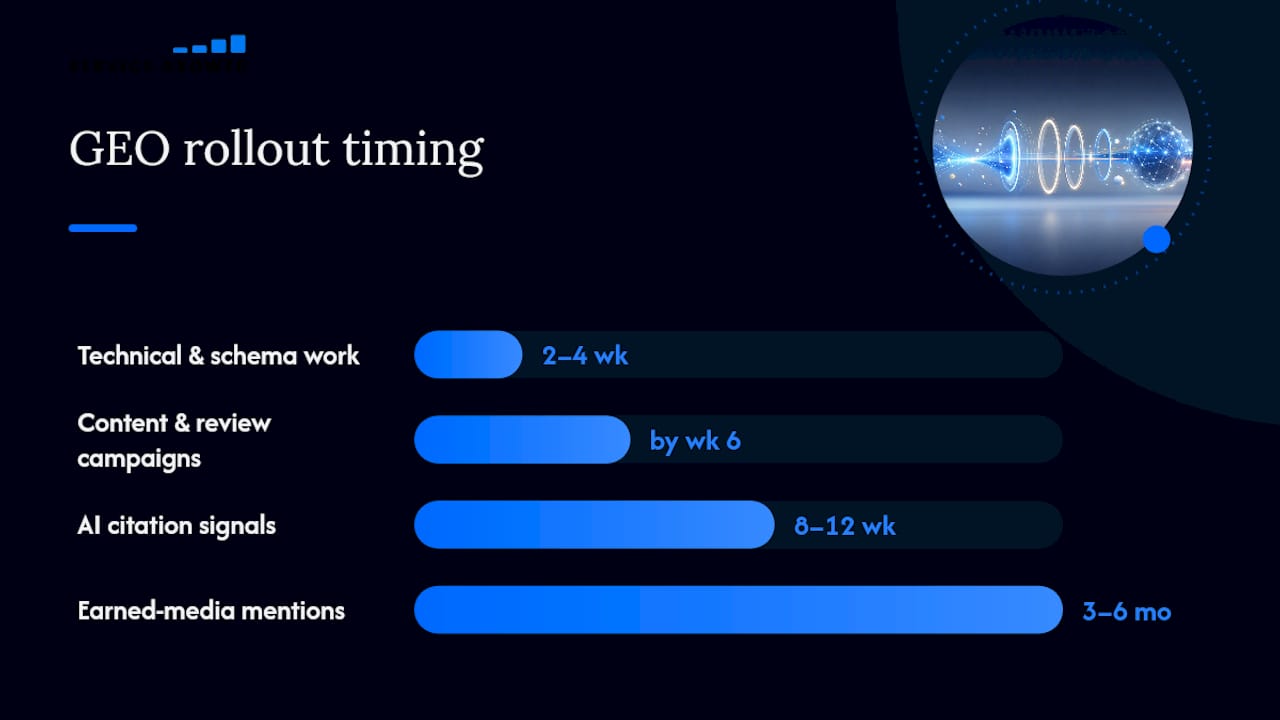
For a managed GEO rollout with Service Grower, local businesses typically see initial technical and schema work completed within the first two to four weeks, content reformatting and review campaigns active by week six, and measurable AI citation signals appearing in prompt sampling within eight to twelve weeks. Earned-media results take longer, typically three to six months for consistent third-party mention volume. The Service Grower platform is built to handle the full stack without requiring a separate agency for each layer.
What marketers should stop doing and start testing now
The most common GEO mistake is treating it as a separate discipline requiring a separate content factory. It is not. The businesses gaining AI citation share right now are mostly doing three things: writing cleaner answers, citing their sources, and showing up in more places off their own site.
Stop overproducing low-quality micro-pages. A hundred thin location pages with near-identical content do not multiply your citation chances. They dilute your authority signal and risk triggering quality filters. One well-structured service page with a real Q&A section and a cited statistic outperforms twenty thin variants.
Stop chasing ephemeral AI hacks. Every few months a new tactic circulates promising to “trick” AI systems into citing your content. These tactics have a short half-life and often conflict with the foundational practices that produce durable results. The GEO-bench research and Google’s documentation both point to the same durable signals: structure, evidence, and earned authority.
Start these experiments in the next 30–90 days:
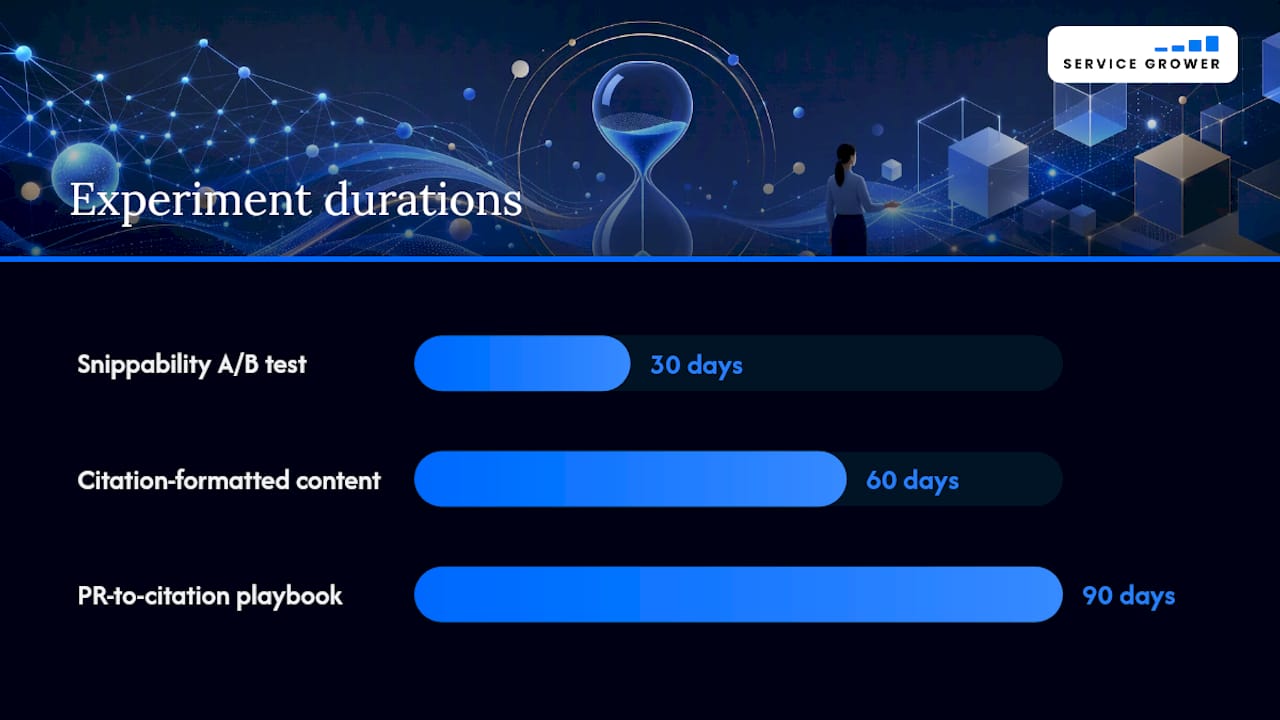
- Snippability A/B test (30 days): Take one high-traffic page and add a direct one-sentence answer to the top of each major section. Sample the same prompts weekly before and after. Track whether your content appears more frequently in AI answers.
- Citation-formatted content (60 days): Add one sourced statistic and one attributed quote to your five most important service pages. Monitor AI citation frequency and brand mention volume.
- PR-to-citation playbook (90 days): Pitch three local or industry publications with a data-backed story. Track each earned placement and note whether it appears as a source in AI answers within 60 days of publication.
When an experiment shows a consistent citation lift over four or more weekly samples, that is the signal to scale it into a program. Measure success by citation frequency first, then downstream leads. Scale what moves both.
Local businesses get found faster with Service Grower
Most local businesses have the same GEO gap: technically sound enough for traditional search, but invisible to AI answer engines because their pages are not snippable, their schema is missing, and their review volume is thin. Service Grower closes all three gaps in one platform.
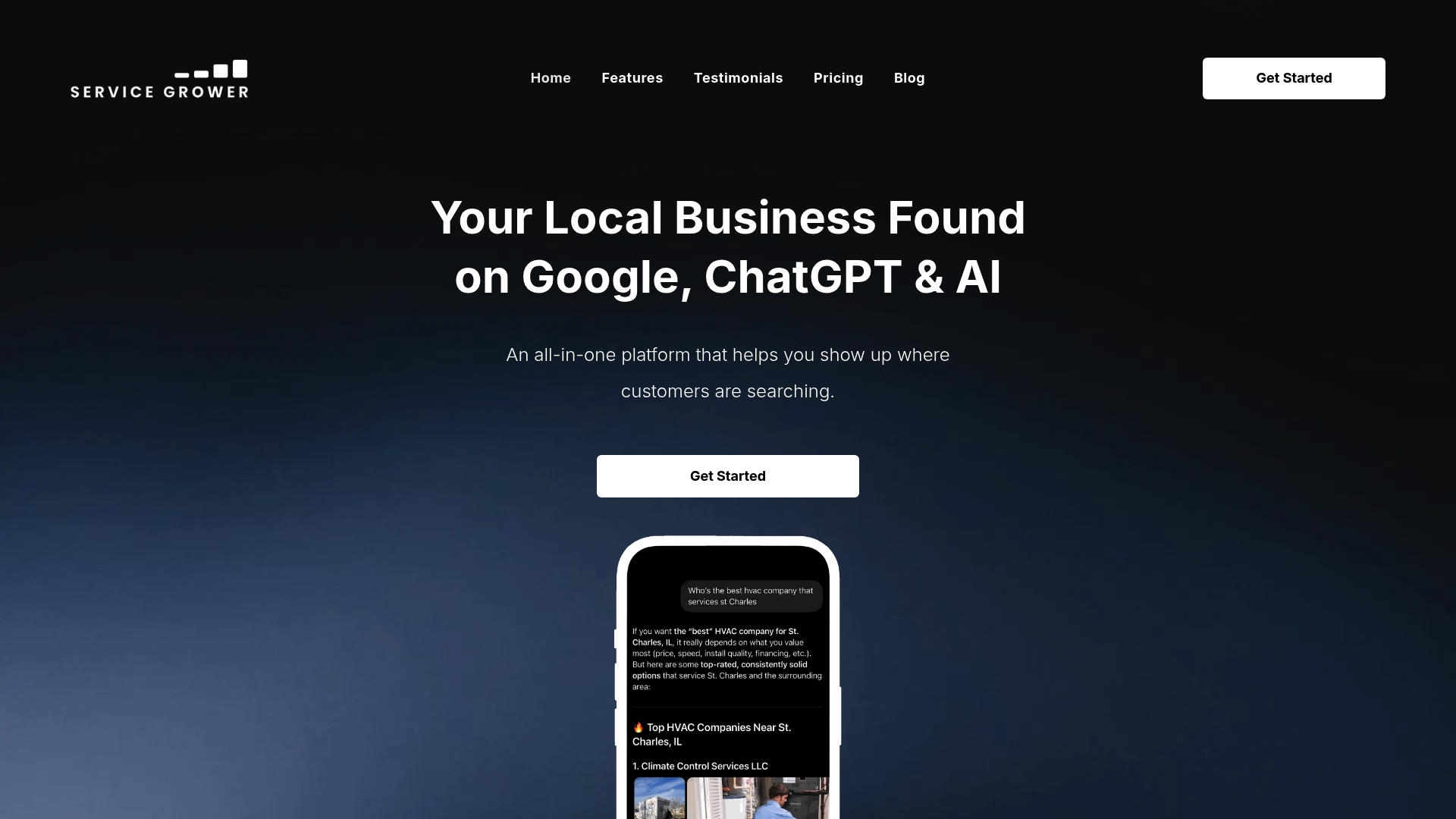
AnswerReady™ Websites are built for AI crawlability from the start, not retrofitted. Review management runs automatically, building the earned-signal volume that AI systems weight for local queries. Schema is generated and maintained without a developer. GrowthView ties AI visibility directly to bookings and leads, so you see what is actually working, not just impressions.
Local businesses using Service Grower skip the six-month agency onboarding cycle and the patchwork of disconnected tools. The platform handles technical GEO, content structure, and reputation signals in one subscription.
Book a 15-minute call to see how Service Grower can build your AI citation presence, or explore the platform to see the full feature set.
Sources
- Optimizing your website for generative AI features on Google Search
- Generative Engine Optimization: How to Dominate AI Search
- Optimizing your content for inclusion in AI search answers | Microsoft Advertising