
 GROWTH GUIDE
Best Facebook Ads Agencies for Local Businesses in 2026
For most local businesses, the strongest Meta ads partner isn’t a standalone agency at all. An integrated SaaS platform that pairs managed Meta ads with built-in landing pages, booking forms, and analytics gives you a shorter path from ad click to paying customer than any agency working in isolation. Service Grower combines exactly that: AnswerReady websites, GrowthView analytics, and SmartRequest booking in one subscription, with optional managed Meta ad campaigns layered on top.
Before you read further, here’s what matters most:
- An integrated conversion path (ad → landing page → booking) consistently outperforms ads that drop traffic on a generic homepage
- Meta Business Partner designation is the minimum credential to verify before signing any contract
- Expect a creative runway of several weeks before campaigns reach a stable cost per acquisition
- Transparent, dashboard-level reporting is non-negotiable; vanity metrics are a warning sign
- A 15-minute diagnostic call with Service Grower costs nothing and gets you a first 90-day plan
Table of Contents
- What do the best Facebook ads agencies actually deliver?
- How do you vet and choose a Facebook ad agency?
- Why Service Grower fits local businesses better than a standalone agency
- What does pricing and onboarding actually look like?
- What should your first 90 days look like?
- Key Takeaways
- The part most local businesses get wrong about Meta ads
- Book a 15-minute call with Service Grower
- Useful sources
What do the best Facebook ads agencies actually deliver?
The best Facebook ads agencies do more than buy media. For a local business, the full service stack should include audience strategy, creative production (especially creator-led or UGC formats), media buying, conversion tracking via Meta’s Conversions API, landing-page audits, and a clear reporting cadence with dashboard access.
Platform credentials matter here. Meta Business Partner designation signals that an agency meets Meta’s skill, policy, and update-readiness standards. It’s not a guarantee of results, but it’s the floor. Ask whether the agency also has Meta-certified creative or measurement staff on the account team, not just in the company directory.
Measurement is where most local-business campaigns fall short. Top-performing partners track Marketing Efficiency Ratio and incrementality alongside platform ROAS, because platform ROAS alone overstates impact. If an agency only reports click-through rates and reach, that’s a problem.
Creative quality is the other lever most agencies underinvest in. Creator-led creative paired with paid media has produced engagement lifts around +170% in documented industry case examples.
Pro Tip: Insist on a landing-page audit before the first dollar goes to media. Slow load times or a weak call-to-action will waste even a perfectly targeted campaign. Budget for a 4–8 week creative runway before expecting a stable CPA.
How do you vet and choose a Facebook ad agency?

Use this checklist on every discovery call.
Vetting checklist:
- Who owns the ad account and creative assets if you leave?
- Is there a dedicated account manager, or will you cycle through junior staff?
- What’s the reporting cadence, and do you get live dashboard access?
- Can you see case studies from businesses in your vertical and budget range?
- How does the agency handle landing-page performance?
Sample questions to ask:
- “Walk me through how you set up Conversions API for a local service business.”
- “Who writes the creative briefs, and how often do you rotate ad creative?”
- “Do you measure MER or only platform ROAS?”
- “What happens to my ad account if I cancel?”
- “Give me a sample pricing scenario for a $2,000/month ad budget.”
Red flags to walk away from:
- No landing-page audit offered before campaign launch
- Reporting limited to reach, impressions, or platform ROAS only
- Unclear billing: you can’t tell what goes to ad spend vs. the agency fee
- No dedicated account manager; all communication goes through a shared inbox
- Contract locks you in for 12 months with no performance clause
Boutique agencies often outperform large firms for local businesses, precisely because responsiveness and local targeting experience matter more than brand recognition. Agency size is not a quality signal. Verify case-study relevance to your vertical and budget before trusting before/after metrics.
Why Service Grower fits local businesses better than a standalone agency
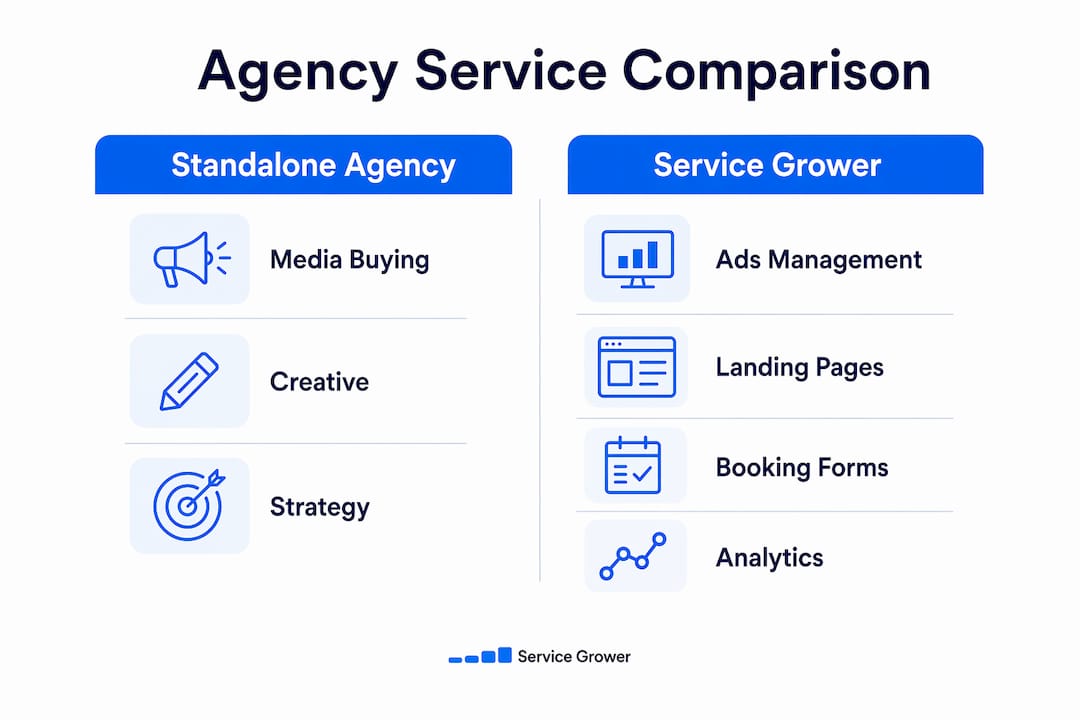
Standalone agencies solve one problem: running ads. Service Grower solves the whole chain: visibility, landing pages, bookings, reviews, and ads in a single platform. That integration is what prevents the most common local-business failure mode, where a well-run ad sends traffic to a slow page with no booking option and no follow-up.
| Dimension | Standalone agency | Service Grower |
|---|---|---|
| Services included | Strategy, creative, media buying | All of the above + AnswerReady sites, SmartRequest booking, review management |
| Pricing shape | % of ad spend or flat retainer | SaaS subscription + optional managed ads |
| Onboarding speed | 2–4 weeks, agency-dependent | Platform live quickly; ads layer on top |
| Reporting | Agency-built reports, variable access | GrowthView dashboards, always-on access |
| Creative capability | Varies by agency | Creator-led creative available |
| Platform credentials | Verify per agency | Meta Business Partner expectations met |
SmartRequest booking forms connect directly to ad campaigns, so a click becomes a booked appointment without the visitor needing to navigate your website. GrowthView gives you live visibility into what’s working, not a monthly PDF. And because AnswerReady websites are built for local search and AI visibility, your ad traffic lands on a page that’s already optimized to convert.
What does pricing and onboarding actually look like?
Pricing models for managed Meta ad packages fall into four types:
- Flat monthly fee: Predictable cost, easier to budget; common for local-business packages
- Percentage of ad spend: Scales with budget; typically 10–20% of monthly spend
- Hybrid: Flat base fee plus a smaller percentage; balances predictability and alignment
- Project-based: One-time setup or audit; less common for ongoing management
Market pricing varies widely. Entry-level packages start at modest monthly rates for basic management; full-service retainers for local businesses vary widely depending on creative scope and ad spend. Always ask for a line-item breakdown separating the agency fee from the ad spend pass-through.
Onboarding milestones:
- Week 0–1: Discovery call, account audit, competitor review, goals and KPIs set
- Weeks 1–4: Creative brief development, tracking setup (Conversions API, pixel), landing-page audit
- Weeks 4–8: First test campaigns live, A/B creative testing, initial data collection
- After week 8: Optimization toward stable CPA, budget scaling decisions
Billing transparency checklist:
- Is ad spend billed separately or pooled with the management fee?
- What triggers a change-of-scope fee?
- How often are invoices issued, and what’s the payment window?
- Is there a minimum ad spend requirement?
What should your first 90 days look like?
A clear milestone plan protects you from the most common disappointment: canceling too early and interrupting the algorithm’s learning phase. Owners who cancel inside the first 4–8 weeks almost always do so right before campaigns stabilize.
Days 1–30:
- Platform onboarding: AnswerReady site live, SmartRequest booking forms connected
- Tracking verified: Conversions API firing, GrowthView baseline established
- Creative assets gathered: photos, video clips, customer review content for UGC ads
- First campaign brief approved and ads submitted for review
Days 31–60:
- First ad flights live with two to three creative variants per audience
- Weekly GrowthView check-ins: click-to-book rate, cost per click, early CPA signals
- Landing-page iteration based on heatmap or session data if available
- Creative rotation if any variant shows clear underperformance
Days 61–90:
- Winning creative scaled; losing variants paused
- CPA direction clear; budget scaling decision made
- Reporting cadence locked in: weekly dashboard review, monthly strategy call
- Shift from testing mode to optimization and growth
Internally, you need to own two things: supplying fresh photo and video assets when the creative team requests them, and responding to SmartRequest booking inquiries promptly. Ad performance and booking conversion are both hurt by slow follow-up.
Key Takeaways
An integrated SaaS platform combining managed Meta ads with built-in landing pages, booking forms, and analytics gives local businesses a faster, lower-friction path to paid social results than any standalone agency.
| Point | Details |
|---|---|
| Integrated conversion path | Connect ads directly to booking forms; don’t send paid traffic to a generic homepage. |
| Landing-page audit first | Poor landing-page performance kills well-targeted campaigns; audit before spending. |
| Expect a 4–8 week runway | Campaigns need time to stabilize; canceling early interrupts the algorithm’s learning phase. |
| Verify Meta credentials | Confirm Meta Business Partner status and ask about certified creative or measurement staff. |
| Service Grower | Combines AnswerReady sites, GrowthView reporting, and SmartRequest booking with optional managed Meta ads in one platform. |
The part most local businesses get wrong about Meta ads
The conventional wisdom says hire the agency with the most case studies. That’s not wrong, but it misses the real problem: most local-business Meta campaigns fail at the destination, not the targeting. An agency can build a technically perfect audience and write compelling copy, and the campaign still underperforms because the landing page loads slowly, has no clear booking option, or doesn’t match the ad’s promise.
The agencies worth hiring know this and say it out loud on the first call. A good partner will challenge your channel assumptions too. If your customers aren’t on Facebook, a great agency tells you that instead of taking your budget. That kind of honesty is rarer than it should be.
For local businesses specifically, the integrated approach wins because it closes the gap between visibility and conversion. Ads drive traffic; AnswerReady pages convert it; SmartRequest captures the booking; GrowthView shows you what worked. That loop is what a standalone agency can’t replicate without also owning your website, your booking system, and your reporting stack.
Book a 15-minute call with Service Grower
Most local businesses spend more time picking a contractor than vetting their ad partner. Service Grower makes that easier.
A 15-minute diagnostic call covers three things: a quick audit of your current online presence and conversion path, a suggested first 90-day plan tailored to your business type, and a transparent walkthrough of pricing ranges for the SaaS subscription and any managed ad package. No obligation, no hard sell. If Service Grower isn’t the right fit, you’ll leave with a clearer picture of what to look for elsewhere. Local businesses looking to understand how local listings and visibility feed into paid ad performance will find that context useful on the call too.
Book your 15-minute call here.
Useful sources
The recommendations in this article draw on the following industry sources. When reviewing any agency’s case studies, look for before/after metrics in your vertical and budget range. Broad ROAS figures from eCommerce brands don’t translate directly to local service businesses.
- Meta Business Partner program guidance — explains what the designation requires and why it matters for vetting
- Creative-first Meta ad case examples — documents engagement lift data and UGC/creator integration approaches
- Boutique agency fit for local businesses — covers pricing ranges, onboarding timelines, and why agency size isn’t the primary quality signal
- Measurement best practices: MER and incrementality — explains why platform ROAS alone understates or overstates campaign impact
- Alternative agency models for smaller businesses — useful context for evaluating boutique and integrated-platform options against traditional agency structures
When reading any agency’s case studies, verify that the client’s industry, budget, and business model are comparable to yours. A +300% ROAS result for a national eCommerce brand tells you almost nothing about what to expect for a local HVAC company or barber shop.