
 GROWTH GUIDE
AI Website Content: 3–5 FAQs to Help Local Pages Earn AI Citations
AI website content means pages built to be cited in AI-generated answers, not pages written by AI. The single best first move is to add a short, direct lead answer and a brief FAQ to your most important service and location pages. We treat tools like Bing Webmaster Tools and IndexNow as the baseline for measuring and speeding up that citation process.
TL;DR:
- Start with your three busiest service and location pages; lead with a one or two sentence answer and add three to five FAQs with schema.
- Audit your business name, address, and phone number across page copy, schema, Google Business Profile, and Bing Places; remove duplicate location pages.
- Use Bing Webmaster Tools grounding queries and citation counts per URL to target edits, then compare citation gains with GA4 leads and bookings.
- Notify search engines with IndexNow after edits, then review citation trends over several weeks; Search Console exclusions may take days to propagate.
- Keep hours, service areas, pricing, and review profiles consistent across your site and business listings, and reply to every customer review.
Table of Contents
- 1. Quick checklist: fixes to make today
- 2. How to write pages so AI systems can extract clean answers
- 3. Technical controls that decide whether your pages can be cited
- 4. Measure what’s working and prioritize your next edits
- 5. What an integrated approach adds to the checklist
- 6. Integrating AI-optimized content with SEO and paid campaigns
- 7. Using customer interaction and review systems inside your content
- 8. Writing content for AI assistants like ChatGPT in local service contexts
- 9. The part of this guide most owners get wrong
- How Service Grower puts this checklist on autopilot
- FAQ
- Sources
- Useful resources to follow up
1. Quick checklist: fixes to make today
Most local business sites lose citation eligibility over small, fixable gaps, not a lack of content. Work through these in order, starting with the pages that already drive the most traffic.
- Add a one to two sentence direct answer at the top of each priority service and location page.
- Add three to five short FAQs to those same pages and mark them up with FAQ schema.
- Check that your on-page name, address, phone number, and hours match your Google Business Profile and Bing Places exactly.
- Replace vague intro paragraphs with clear, descriptive H2 and H3 headings that match how customers actually ask questions.
- Publish small, factual updates (new hours, a new service area, an updated price) and notify search engines through IndexNow when you do.
- Ask customers for reviews consistently, reply to every review, and keep your review profile details consistent across platforms.
- Remove duplicate or outdated location pages that split your NAP signals across multiple versions of the same address.
Pro Tip: Fix your three highest-traffic pages first. A clean answer-first rewrite on a page that already ranks tends to move faster than a brand-new page on an unfamiliar topic.
2. How to write pages so AI systems can extract clean answers
AI systems reward pages that make the answer obvious. The pattern is simple: state the direct answer in one or two sentences, then follow with short bullets or a single paragraph of supporting detail. Search expert guidance on query fan-out shows that systems favor pages leading with a clear answer followed by structured, question-focused support, because that structure maps cleanly to how AI tools break a question into sub-queries.
To put that into practice on a service page:
- Turn your most common customer question into the page’s H2, phrased exactly how a customer would ask it.
- Answer that question in the first one or two sentences under the heading.
- Follow with three or four bullets covering specifics like pricing range, timeline, or service area.
- Use the same name for your service, product, or location everywhere on the page so entity references stay consistent.
Use a small table when the content is genuinely tabular, like pricing tiers or a service timeline. Use bullets for everything else. One useful signal to track is your grounding query data in Bing Webmaster Tools, which shows the exact phrases AI answers pulled from your site, turning guesswork about what to write into a checklist of phrases to support.
None of this requires exotic formatting. Google’s own guidance pushes back on chasing special AI-only tactics, recommending unique, genuinely helpful content as the dependable strategy. Clear writing for a human reader is also what reads cleanest to an AI system scanning for an answer.
3. Technical controls that decide whether your pages can be cited
Content quality gets you most of the way, but a handful of technical settings decide whether AI systems are even allowed to cite what you publish.
- IndexNow: a protocol that lets you ping participating search engines the moment you publish or edit a page, instead of waiting for a routine crawl to notice the change.
- Search generative AI control: a setting inside Search Console that lets you include or exclude your content from generative AI features; excluding a page removes it from those features, and changes typically take a few days to propagate, sometimes longer for cached content.
- Schema markup: LocalBusiness, Service, and FAQ schema give AI systems a structured, unambiguous version of facts that are otherwise scattered across your page’s prose. Structured data for local businesses is foundational for entity resolution, meaning the system correctly matches your website to your actual business.
- NAP consistency: your on-page name, address, and phone number need to match your structured data, which needs to match your Google Business Profile and Bing Places listing. A mismatch anywhere in that chain is one of the fastest ways to lose eligibility for local rich results and AI citations.
- Data-nosnippet or robots controls: useful when a page contains ambiguous or outdated information you don’t want pulled into a snippet or AI answer out of context.
We cover the schema side of this in more depth in our guide to fixing entity identity for AI answers.
4. Measure what’s working and prioritize your next edits
Guessing which pages need work wastes time. AI Performance in Bing Webmaster Tools gives you grounding queries, per-URL citation counts, and a timeline, which together show exactly which pages are already being cited and what phrases triggered the citation.
- Export your grounding queries from AI Performance and group them by topic or customer intent.
- Map each cluster back to the page it should live on, including pages that don’t exist yet.
- Prioritize edits on pages that already show some citation activity. Small clarity fixes there tend to beat brand-new pages on untested topics.
- Cross-check citation gains against GA4 traffic and on-site conversions so you know citation share is translating into actual calls or bookings, not just visibility.
- Re-publish, ping IndexNow, and recheck citation share on a multi-week cadence rather than reacting to single-day swings.
| Signal | Where to find it | What it tells you |
|---|---|---|
| Grounding queries | Bing AI Performance | Exact phrases that triggered a citation |
| Citation count per URL | Bing AI Performance | Which pages are already AI-visible |
| Conversion lift | GA4 | Whether citations lead to real business outcomes |
This workflow is also laid out as a step-by-step timeline in our eight-week playbook for getting cited in AI answers.
5. What an integrated approach adds to the checklist
Every step above is doable on your own, but most local business owners are running the business, not auditing schema on a Tuesday night. Our AnswerReady™ Websites build the answer-first structure and FAQ schema into the page from the start, our AI Presence tooling tracks citation eligibility across AI search surfaces, and our review and customer interaction management keep the trust signals that AI systems and customers both rely on consistent over time.
Businesses that consolidate their website, review management, and AI visibility work into one managed system often see measurable increases in bookings and reviews compared with running the pieces separately.
Pro Tip: A business with limited time to manage reviews, schema, and content updates tends to benefit most from a managed system; a business with in-house marketing staff and the hours to spare can run the same checklist independently.
Service businesses with high call or booking volume, such as HVAC, auto repair, or fitness studios, see the most from having this handled continuously rather than revisited quarterly.

6. Integrating AI-optimized content with SEO and paid campaigns
AI-optimized content and traditional SEO are not separate workstreams. The same answer-first pages that earn AI citations also tend to rank better in standard search results, because both systems reward clarity, structured headings, and consistent entity signals.
Paid campaigns benefit from the same groundwork. Landing pages built for Google Ads or Meta Ads perform better when they carry the same direct-answer structure and schema as your organic pages, since ad platforms also reward relevance and page experience. Keeping your ad landing pages and organic service pages aligned on messaging and facts, like pricing ranges or service areas, avoids sending mixed signals to both search engines and customers.
The most efficient sequence is to fix your core service and location pages first, confirm they’re citation-eligible and ranking, then extend the same structure to any paid landing pages. That order prevents you from running ads to a page that doesn’t yet answer the question clearly, which wastes ad spend regardless of how well-targeted the campaign is.

7. Using customer interaction and review systems inside your content
Reviews and customer messaging are content, not just reputation management. AI systems and search engines both treat review volume, recency, and reply activity as trust signals tied to your business entity, which means a stale review profile can undercut an otherwise well-built page.
A few practices make a measurable difference. Reply to every review, not just negative ones, since reply activity itself is a signal. Keep review request timing consistent, right after a completed job or appointment, so volume stays steady rather than spiking around slow periods. Surface a handful of recent, specific reviews directly on relevant service pages instead of only linking out to a third-party profile.
Customer interaction tools that log inquiries and requests also give you raw material for FAQs. The questions customers actually ask through a booking form or chat widget are a more reliable source of real FAQ content than guessing what might be useful.
8. Writing content for AI assistants like ChatGPT in local service contexts
AI assistants answering a local service question pull from whatever source states the answer most clearly and consistently across the web. That means your website, your Google Business Profile, and your review profiles all need to agree on the same core facts: service area, hours, pricing range, and what you actually do.
For a local plumbing, landscaping, or salon business, the practical move is writing pages that answer the exact question a customer would type into a chat assistant: “Does this company serve my neighborhood,” “What does this cost,” “Are they open now.” Short, direct answers to those questions, placed where a crawler or AI retrieval system can find them easily, matter more than general descriptions of your brand or history.
This is also where structured data for local businesses does real work: it gives an AI assistant an unambiguous version of your service area and offerings instead of a sentence it has to interpret.
9. The part of this guide most owners get wrong
Most advice on AI website content overcorrects toward technical tricks: special markup, keyword stuffing for AI, or chasing every new feature a platform ships. The research behind this guide points the other way. The pages that get cited most consistently are simply the clearest ones, answer-first, structurally honest about what they offer, and backed by consistent facts across the web.
The overrated piece is treating AI citation as a separate discipline from the content work you should be doing anyway. The underrated piece is measurement. Most owners never look at grounding query data, so they’re optimizing blind. Pulling that data even once a month turns “write better content” into a specific list of phrases to support.
If you do one thing after reading this, make it the NAP and schema audit. Content fixes compound slowly; a mismatched address or phone number can quietly block citation eligibility no matter how well the page is written.
— Service Grower
How Service Grower puts this checklist on autopilot
Running this checklist well takes ongoing attention: rewriting pages, tracking grounding queries, keeping review profiles current, and re-checking schema every time a business detail changes. Our Service Grower plan builds the answer-first structure into AnswerReady™ Websites from day one, tracks citation activity through our AI Presence tooling, and reports the results in GrowthView analytics, so you see what’s working without pulling your own exports.
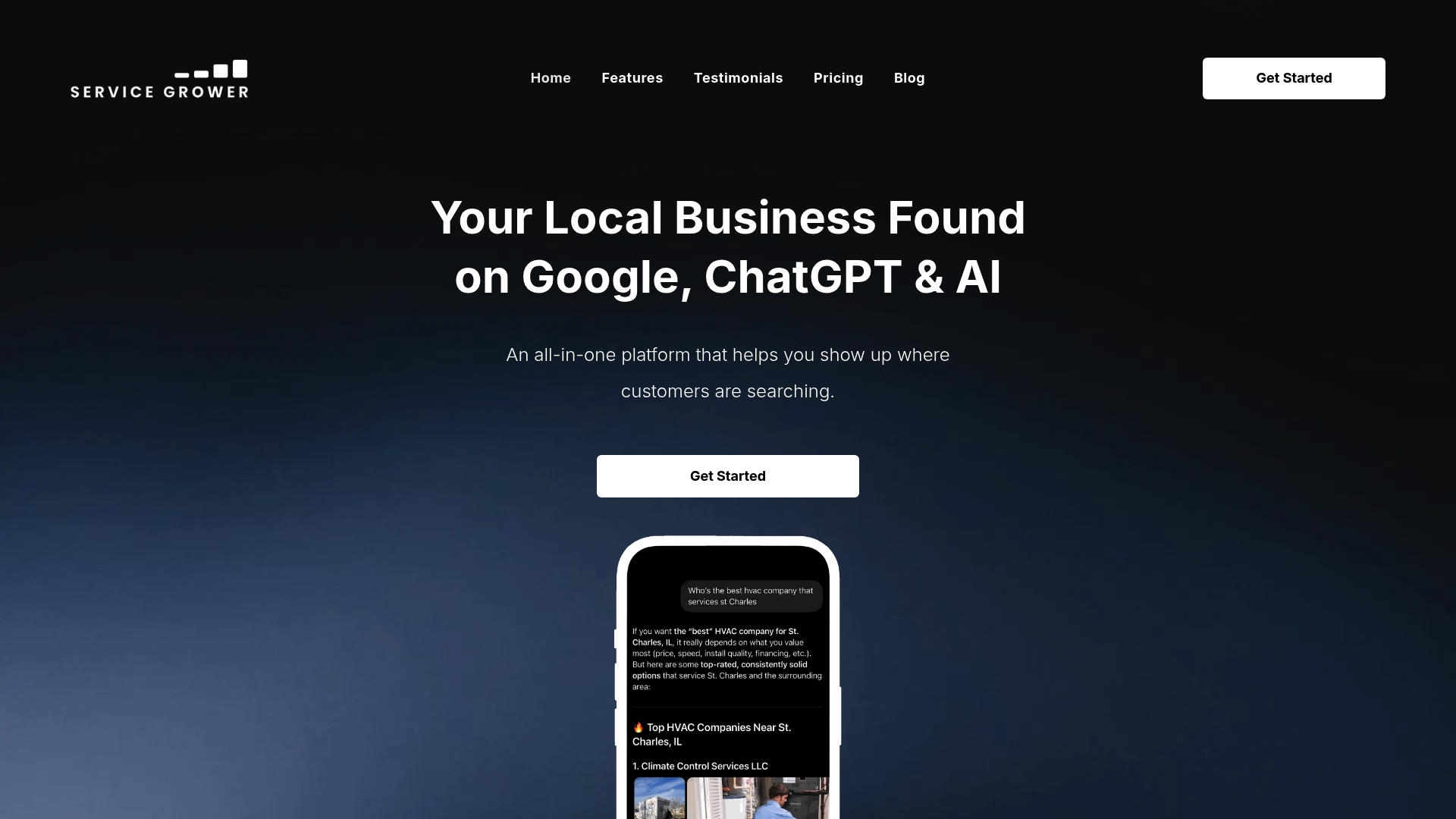
What that looks like in practice:
- AnswerReady™ Websites ship with answer-first pages, FAQ schema, and consistent NAP built in.
- AI presence tracking tools show where a business is already appearing in AI-generated answers.
- Analytics tools tie citation activity back to actual bookings and leads.
Start with a free AI visibility check to see where your current pages stand, then review pricing for the full plan.
FAQ
What does “AI website content” actually mean?
It means content structured and written to be cited in AI-generated answers, such as direct question-and-answer formatting, consistent facts, and clear schema, not content that was written by an AI tool. The goal is extractability: making your answer easy for an AI system to lift accurately.
How long does it take to see AI citations improve?
There’s no fixed timeline, since it depends on how quickly search engines recrawl your pages and how competitive your local market is. Using IndexNow to notify engines after edits and checking AI Performance on a multi-week cadence gives the most reliable read on progress.
Do I need to hire a developer to add schema markup?
Not necessarily. Structured data guidance walks through LocalBusiness and FAQ schema for anyone comfortable editing a page’s code, and a managed platform like the Service Grower plan can build it in automatically.
Can I exclude certain pages from AI features?
Yes. Search generative AI control in Search Console lets you include or exclude content from generative AI features, and excluded content won’t appear in those features, though the change can take a few days to propagate.
Does managing reviews actually affect AI citations?
Review recency, volume, and reply activity are part of the trust signals tied to your business entity, and Google’s own guidance on local ranking recommends complete profile data and consistent review replies as part of local relevance.
Sources
- Introducing AI Performance in Bing Webmaster Tools (Public preview)
- Rank in Google AI overviews: local business guidance
- Google: stop chasing special AI optimizations — focus on helpful content
Useful resources to follow up
- AI Performance in Bing Webmaster Tools
- Search generative AI control
- Google Business Profile local ranking tips
- Structured data for local businesses
- How to optimize content for AI search