
 GROWTH GUIDE
AI Search Visibility: A Practical Guide for Marketing Teams
Run an AI visibility audit this week and trial a dedicated tracking tool. That’s the short answer. Brands that skip this step are invisible in ChatGPT, Gemini, and Perplexity recommendations, and only a small fraction of local businesses are ever surfaced in unbranded AI queries. The gap between appearing in a generative answer and being absent from one is increasingly a revenue gap, not just a ranking gap.
Your two-step start:
- Run a manual sampling audit across ChatGPT, Gemini, and Perplexity using 10–15 queries your customers actually type
- Start a free check or platform trial to get a baseline visibility score before you invest in fixes
Key Takeaways
AI visibility in unbranded queries is where new customer acquisition happens, and review volume combined with NAP accuracy are the two fastest levers to move it.
| Point | Details |
|---|---|
| Audit before you optimize | Run cross-engine sampling across ChatGPT, Gemini, Perplexity, and Google AI Overviews before making any changes. |
| Review volume drives recommendations | Businesses in the top AI-recommended tier had substantially more reviews than those in the lowest tier. |
| NAP accuracy is non-negotiable | Roughly half of AI results contain incorrect contact details; fix listings before building content. |
| Track recommendation rate, not just mentions | Unbranded recommendation rate is the metric that reflects real new-customer acquisition potential. |
| Service Grower covers the full workflow | AnswerReady™ sites, review management, and GrowthView reporting support audit, optimization, and monitoring in one platform. |
Table of Contents
- What is AI search visibility and why should your brand care?
- What do AI visibility tools actually measure, and which engines matter?
- How to run an AI visibility audit for your brand
- How to evaluate and choose an AI visibility tool
- Concrete tactics to improve your AI search visibility
- How Service Grower maps to the AI visibility workflow
- What timeline and KPIs should you set for AI visibility work?
- How pricing models and trial options typically work
- How to interpret AI visibility metrics for strategic decisions
- How AI visibility data fits into your broader marketing and SEO strategy
- What AI visibility improvements look like in practice
- Common pitfalls in measuring AI search visibility and how to avoid them
- Service Grower’s take on what actually moves the needle
- Primary sources and further reading
- Sources
What is AI search visibility and why should your brand care?
AI search visibility is how consistently and favorably your brand appears inside AI-generated answers, recommendations, and summaries across platforms like ChatGPT, Google AI Overviews, Gemini, and Perplexity. It’s distinct from traditional ranking: instead of a blue link at position three, you’re either named in the generated answer or you’re not.
The mechanism behind this is retrieval-augmented generation (RAG). Google’s own guidance confirms that generative features ground their answers in traditional search indexes, then corroborate claims across multiple sources before surfacing a recommendation. That means a single well-optimized page is rarely enough. The AI needs to find your brand mentioned consistently across your website, your Google Business Profile, third-party directories, and review platforms before it treats you as a trustworthy entity worth recommending.
For marketing teams, the business case is straightforward. Awareness and recommendation are not the same thing. A user who asks ChatGPT “best HVAC company near me” and gets three names isn’t browsing. They’re deciding. Being absent from that answer means losing a high-intent prospect before they ever reach your site.
What do AI visibility tools actually measure, and which engines matter?
Core metrics you’ll track
| Metric | What it measures |
|---|---|
| Visibility score | Percentage of tracked prompts where your brand appears in the AI-generated answer |
| Brand mentions | Raw count of times your brand name surfaces across monitored queries |
| Linked mentions (citations) | Mentions where the AI cites a specific source URL pointing to your content or listings |
| Prompt hits | Number of distinct query prompts that triggered a brand appearance |
| Source attribution | Which URLs the AI cited when mentioning your brand |
| Recommendation rate | Share of prompts where your brand is actively recommended, not just mentioned |
Sentiment and recommendation rate are worth separating. A brand can be mentioned frequently in a neutral or cautionary context (“some customers report long wait times”) without being recommended. Tools that conflate the two will mislead your reporting.
Engines to track, in priority order:
- ChatGPT (OpenAI): the highest-traffic generative search product in the U.S.; critical for consumer and B2B queries alike
- Google AI Overviews / AI Mode: integrated into the world’s dominant search engine; Google’s Search Console now includes a Generative AI performance report, which gives you partial first-party data
- Gemini: Google’s standalone AI assistant, increasingly used for research and local discovery
- Perplexity: growing fast among research-oriented users and early adopters; cites sources explicitly, making attribution tracking easier
Search Console’s generative reports cover Google’s own AI features but leave a significant gap across third-party engines. Third-party tools fill that gap, though expect some variance in prompt datasets and refresh frequency between vendors.
How to run an AI visibility audit for your brand
Pre-audit setup
Before you query a single engine, build your foundation:
- Compile a query list. Pull 10–20 unbranded queries your customers use (“best [service] in [city]”, “who does [service] near me”) plus 5–10 branded queries. Include question-format prompts, since AI engines favor conversational inputs.
- Choose your platforms. At minimum: ChatGPT, Google AI Overviews, Gemini, and Perplexity. Log into each with a clean session or incognito window to avoid personalization bias.
- Set up a tracking template. A simple spreadsheet works: columns for query, engine, brand mentioned (Y/N), recommendation (Y/N), source URL cited, and any contact detail errors.
Step-by-step audit actions
- Run each query across all four engines. Copy the full AI-generated response into your log.
- Flag every mention of your brand and every competitor mention. Note whether the mention is a recommendation or a neutral reference.
- Record every source URL the AI cites. These are your corroboration gaps: sources the AI trusts that you either appear on or don’t.
- Check your Google Business Profile and top directory listings for NAP (name, address, phone) consistency. A large-sample audit found roughly half of ChatGPT and Perplexity results contained incorrect contact information, which means inaccurate listings actively hurt your AI visibility.
- Run a free visibility check through a dedicated tool to get a scored baseline.
Deliverables to produce
- Baseline visibility scorecard: your brand’s appearance rate across engines and query types
- Top missing prompts: queries where competitors appear but you don’t
- Prioritized source gaps: directories, review platforms, or content pages the AI cites for competitors that you’re absent from
Pro Tip: Cross-reference the sources the AI cites for your top competitors against your own citation profile. The delta is your fastest path to improvement, because you’re targeting sources the AI already trusts.
How to evaluate and choose an AI visibility tool
Vendor-evaluation guidance consistently points to three factors that separate useful tools from expensive dashboards: model and source coverage, accuracy of source attribution, and integration with your existing analytics stack.
Feature checklist for evaluating any tool:
- Engine coverage: does it monitor ChatGPT, Gemini, Perplexity, and Google AI Overviews? Tools that cover only one or two engines give you a partial picture.
- Prompt dataset: how many prompts does it track, and are they relevant to your category and geography? A large prompt set with poor category fit is less useful than a smaller, targeted one.
- Source attribution accuracy: can it tell you which URL the AI cited, not just that your brand appeared? This is what turns a visibility score into an actionable fix list.
- Dashboards and alerts: does it surface changes in visibility score automatically, or do you have to log in and dig? Alerting on drops is as important as tracking gains.
- Integrations: Search Console, Google Business Profile, and your analytics platform. Tools that pull all three into one view save significant reporting time.
- Multi-location support: if you manage more than one location, confirm the tool can segment visibility by location and aggregate across the portfolio.
On pricing: most credible tools offer a free brand check or a short trial. Use that window to validate source attribution accuracy before committing.
Concrete tactics to improve your AI search visibility
0–30 days: fix the foundation
- Audit and correct your GBP listing. Name, address, phone, hours, and category must be exact and consistent with your website. NAP consistency and GBP completeness carry disproportionate weight in AI discovery relative to the effort required.
- Fix NAP across top directories. Yelp, Apple Maps, Bing Places, and industry-specific directories should all match your GBP exactly.
- Launch or accelerate your review program. The 10,000-business benchmark from Insites found that businesses in the top AI-recommended tier averaged 304 reviews versus 117 for the lowest tier. Volume matters, and so does recency.
- Respond to existing reviews. Response rate signals active management to AI systems that weight engagement.
30–90 days: build content and citation depth
- Add FAQ schema to your service pages. Schema.org’s FAQ and LocalBusiness markup in JSON-LD format helps AI systems parse your content and extract structured answers. This directly improves prompt hit rates for question-format queries.
- Publish service-specific content pages. One authoritative page per core service, written to answer the exact questions your customers ask AI engines.
- Expand your citation footprint. Submit to 10–20 additional directories relevant to your category. Prioritize sources the AI already cites for competitors in your audit.
90+ days: scale and monitor
- Set up product or service feeds if you run e-commerce or bookable services. Structured merchant data increases the likelihood of appearing in AI product discovery responses.
- Run monthly cross-engine audits using your original query set. Log which sources each engine cites for each mention and track drift over time.
- Build a review response template library so your team can respond consistently at scale without sounding robotic.
Pro Tip: Don’t treat reviews as a one-time push. A steady cadence of 5–10 new reviews per month outperforms a burst of 50 followed by silence, because AI systems weight recency alongside volume.
How Service Grower maps to the AI visibility workflow
Service Grower covers the full audit-to-monitor loop in a single platform, which matters because fragmented tools create reporting gaps that slow down decision-making.
| Workflow stage | Service Grower capability |
|---|---|
| Audit | AI visibility check across engines; baseline visibility score and source gap report |
| Content readiness | AnswerReady™ websites built with structured data and FAQ schema for AI parsing |
| Review management | Automated review requests, response tools, and volume tracking |
| Source and listing management | NAP consistency monitoring and directory sync |
| Reporting | GrowthView analytics dashboard with visibility trends and citation tracking |
A typical pilot runs 30 days: week one covers the audit and GBP/NAP fixes; weeks two and three focus on review generation and content page setup; week four produces a progress report with updated visibility scores. The business outcome to expect at 30 days is a corrected data foundation and a prioritized list of the next 90-day actions, not a dramatic jump in recommendation rate. That comes later, and the timeline section below explains why.
What timeline and KPIs should you set for AI visibility work?
Realistic expectations prevent wasted budget and stakeholder frustration. Here’s what the evidence supports:
- Days 1–30: data corrections and GBP fixes take effect; AI engines begin picking up updated NAP data as they re-crawl sources
- Days 30–90: first signals of improved visibility score; citation count grows as new directory listings are indexed; review volume starts climbing if the program is active
- Months 3–6: material improvement in recommendation rate for unbranded queries; measurable referral traffic from AI platforms if attribution tracking is in place
KPIs to track and report:
- Visibility score (week-over-week change, not just absolute)
- Citation count and source diversity
- Recommendation rate by query type (branded vs. unbranded)
- Review volume and average rating
- Referral traffic from AI platforms (track in GA4 with source/medium segmentation)
For stakeholder reporting, a monthly cadence works well for the first six months. Present visibility score trend, top-performing prompts, and the three sources driving the most citations. Avoid reporting raw mention counts without context; a spike in mentions that includes negative sentiment is not a win.
How pricing models and trial options typically work
Most AI visibility tools fall into one of three pricing structures:
- Freemium checks: a free one-time brand scan with limited prompt coverage; useful for a quick baseline but not for ongoing monitoring
- Per-location subscriptions: monthly fee per business location; scales predictably for multi-location operators and is the most common model for local business tools
- Seats plus data volume: enterprise pricing where cost scales with the number of users and the size of the prompt dataset monitored
What to validate during any trial:
- Does the engine coverage match your priority platforms?
- Are source attributions accurate when you manually verify them against the actual AI outputs?
- Can you export data in a format your analytics team can use?
- Does the integration with Search Console and GBP work without manual data entry?
For a single-location business, a per-location subscription with a free trial period is the lowest-risk entry point. For a multi-location brand managing 10 or more locations, confirm that the tool offers portfolio-level dashboards and bulk NAP management before signing. The per-location cost can compound quickly without those features.
How to interpret AI visibility metrics for strategic decisions
A visibility score going up is not automatically a signal to maintain course. The metric that matters strategically is recommendation rate on unbranded queries, because that’s where new customer acquisition happens. A brand can have a high visibility score driven entirely by branded queries (people searching for the brand by name) while being invisible to the high-intent unbranded traffic that actually grows revenue.
When you see a gap between overall visibility score and unbranded recommendation rate, the fix is almost always content and citation depth, not technical adjustments. The AI needs more independent corroboration of what your business does and where it operates before it will recommend you to someone who hasn’t heard of you.
Track source diversity alongside citation count. Twenty citations from the same three domains is weaker than fifteen citations from fifteen different authoritative sources. AI systems weight corroboration across independent sources, so a narrow citation profile is a vulnerability even when the total count looks healthy.
How AI visibility data fits into your broader marketing and SEO strategy
AI visibility metrics don’t replace traditional SEO reporting; they extend it. Organic rank, click-through rate, and conversion data still matter. What AI visibility data adds is a layer of pre-click discovery measurement that traditional tools miss entirely.
The practical integration: feed your visibility score and citation growth data into the same reporting dashboard as your organic traffic and paid acquisition metrics. When visibility score rises but organic traffic doesn’t follow, the gap usually points to a content quality or conversion issue on the pages the AI is citing. When organic traffic rises but AI visibility stays flat, you likely have strong content but weak corroboration across external sources.
For brands running Google Ads alongside organic efforts, AI visibility data also helps prioritize which service categories deserve paid support. If a category has low AI visibility and high commercial intent, paid coverage fills the gap while organic and AI presence builds.
What AI visibility improvements look like in practice
A local HVAC operator with inconsistent NAP data across 14 directories and 43 Google reviews ran a baseline audit and found zero appearances in unbranded ChatGPT queries for their metro area. After correcting NAP across all directories, responding to existing reviews, and launching a post-service review request program, their review count reached 180 over four months. By month five, they appeared in ChatGPT responses for two of their five target query types.

The pattern holds across categories: the businesses that move fastest are the ones that fix data accuracy first, then build review volume, then add content depth. Businesses that lead with content changes while leaving NAP errors in place see slower movement because the AI can’t reliably corroborate the entity across sources.
A fitness studio that added LocalBusiness and FAQ schema to its website and published five service-specific content pages saw its prompt hit rate double within 90 days for question-format queries. The schema gave AI systems a structured way to extract and cite specific service details, which increased the likelihood of appearing in answers to specific questions rather than only broad category queries.
Common pitfalls in measuring AI search visibility and how to avoid them
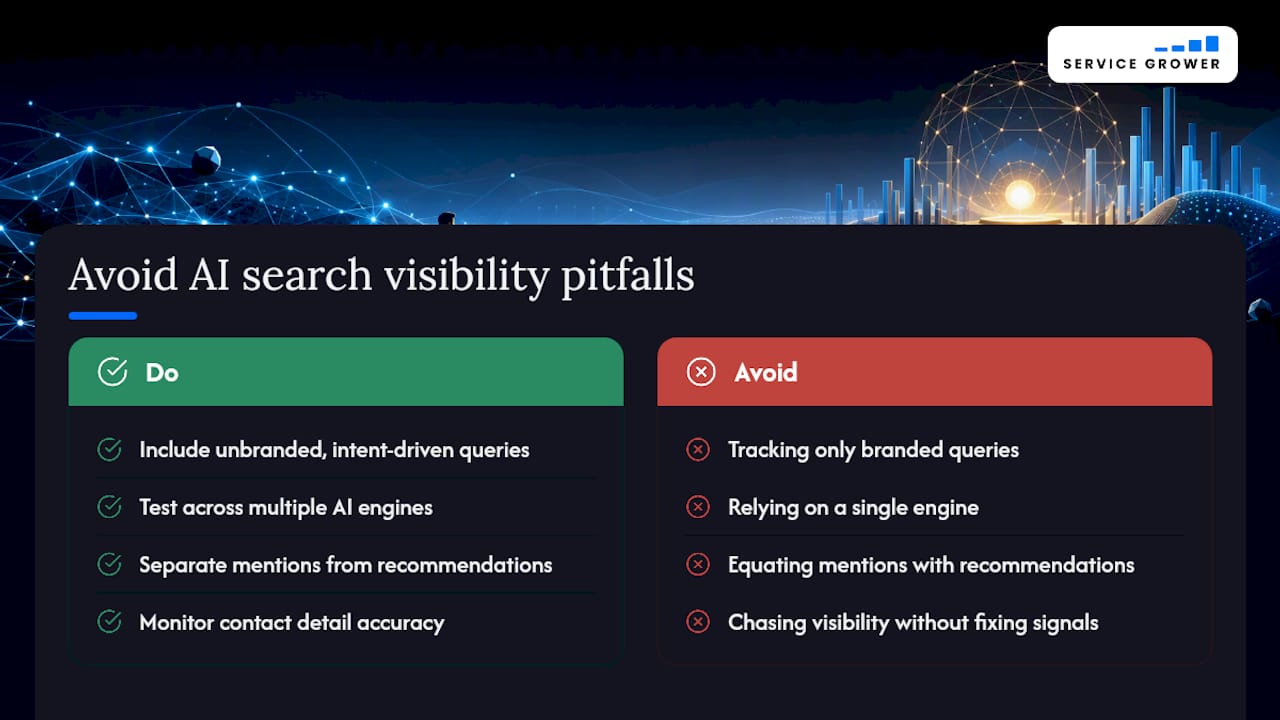
Tracking only branded queries. Branded visibility is easy to achieve and tells you almost nothing about new customer acquisition. Always include unbranded, intent-driven queries in your prompt set.
Treating a single engine as representative. ChatGPT and Google AI Overviews have meaningfully different selection behaviors. A brand that appears consistently in one may be absent from the other. Cross-engine testing is the only way to get an accurate picture.
Confusing mention volume with recommendation rate. Being mentioned in a list of options is not the same as being the recommended choice. Tools that don’t separate these two metrics will overstate your actual visibility impact.
Ignoring contact detail accuracy. The Insites benchmark found that AI outputs frequently contain incorrect contact information, which means a customer who finds you in an AI answer may call a wrong number or visit a closed location. Accuracy monitoring is not optional.
Chasing visibility score without fixing the underlying signals. A high visibility score built on a thin citation profile and low review volume is fragile. The next algorithm update or competitor review push can erase it. Build the foundation first.
Service Grower’s take on what actually moves the needle
The conventional wisdom in AI search optimization leans heavily on technical fixes: schema markup, structured data, content optimization. Those things matter, but they’re the second chapter, not the first. The brands that see the fastest improvement in AI recommendation rates are the ones that treat data accuracy and review volume as infrastructure, not marketing tactics.
AI systems are designed to surface entities that multiple independent sources agree are trustworthy and relevant. A technically perfect website with 40 reviews and inconsistent directory listings will lose to a simpler site with 300 reviews and clean NAP data almost every time.
The other thing most guides understate: AI visibility is a team sport internally. The marketing manager can’t fix NAP errors without operations. The review program won’t scale without buy-in from the service team. Governance matters. Assign one owner for listing accuracy, one for review generation, and one for content, then meet monthly to review the visibility scorecard together. That structure outlasts any single tactic.
Ready to see where your brand stands in AI search?
Service Grower gives local businesses and multi-location brands a clear picture of their AI search visibility, from baseline audit to ongoing monitoring, without stitching together five separate tools.
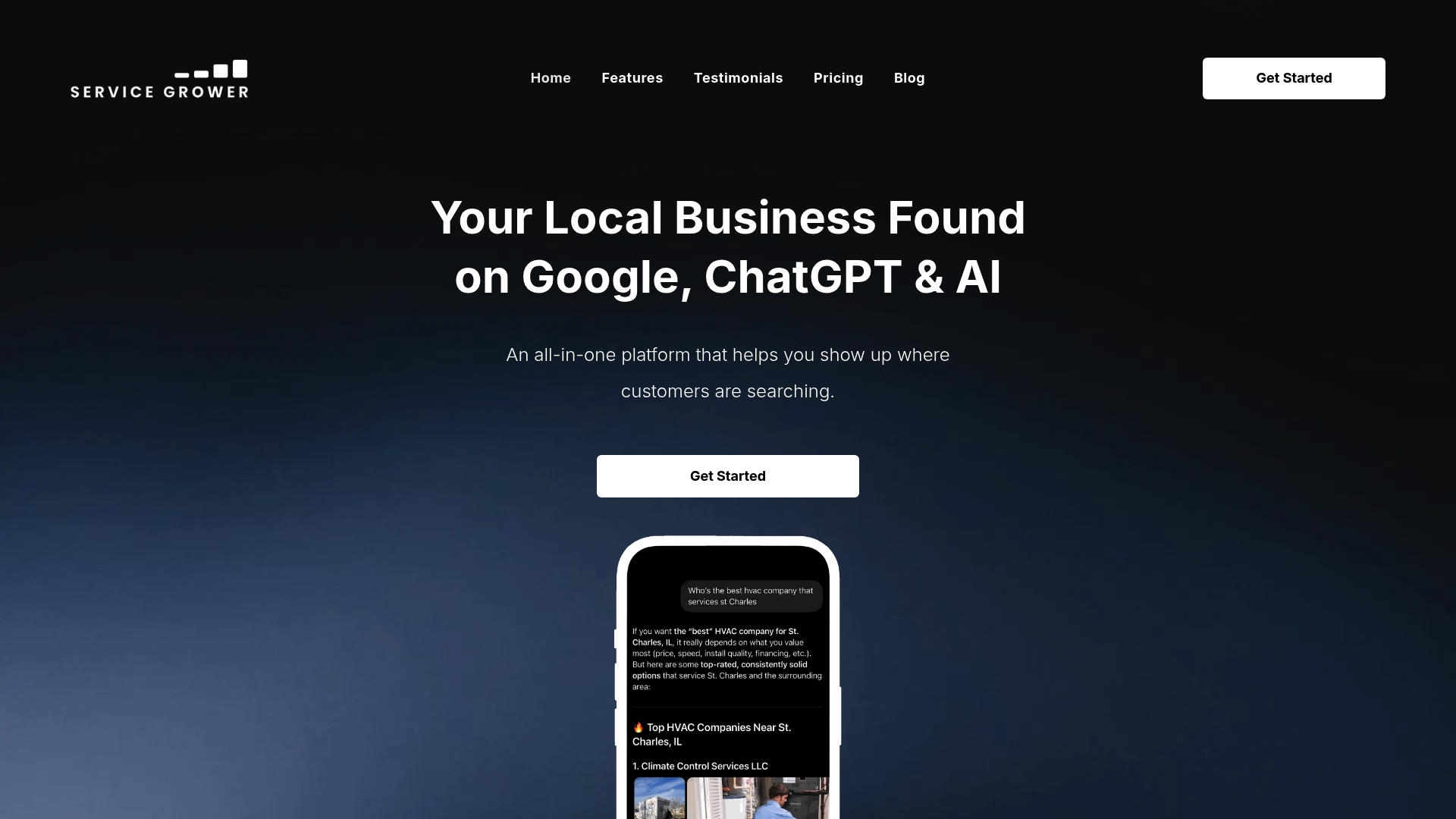
The platform’s AnswerReady™ websites are built with the structured data and content architecture AI engines need to parse and cite your business. Review management, NAP monitoring, and GrowthView reporting all run from the same dashboard, so your team spends time acting on insights rather than compiling them. For teams ready to move from audit to improvement, a 15-minute discovery call is the fastest way to scope a pilot and see what a 30-day improvement plan looks like for your specific locations. You can also explore the full platform to see how each feature maps to the workflow covered in this guide.
Primary sources and further reading
- Google’s guide to optimizing for generative AI features — official RAG guidance and Search Console generative reports
- Insites AI visibility benchmark (10,000 businesses) — review volume correlations and contact accuracy data
- AI SEO for local businesses (SEOProfy) — NAP, GBP, and cross-platform consistency guidance
- Local business AI search guide (EvolveAmz) — audit routine and cross-engine testing workflow
- AI search visibility tool evaluation (Capterra) — vendor selection criteria and trial checklist
- Schema — canonical structured data types for LocalBusiness, FAQ, and Product markup
- Service Grower platform overview — AnswerReady™ websites, review management, and GrowthView analytics
- Service Grower blog — implementation guides and case studies
Sources
- Google’s Guide to Optimizing for Generative AI Features on Google Search | Google Search Central | Documentation | Google for Developers
- Local Business AI Search Guide 2026: Get Cited in ChatGPT
- AI Search Visibility Tools: How to Choose the Right One
- Schema