
 GROWTH GUIDE
Stop Guessing: Track AI Overviews With a Three Tool Stack
Combine Search Console’s generative AI impressions report with a citation tracker like AIClicks or Authoritas, then add a GA4/GTM fragment proxy for click evidence. That trio is the only combination that gives a defensible picture of your AI Overviews tracking right now. Start today by opening the Generative AI performance view in Search Console, then trial one citation tool against your top 10 keywords.
TL;DR:
- Combining Search Console’s AI impressions report with a citation tracker and a GA4/GTM fragment proxy is essential for a full understanding of AI Overviews performance.
- Most tools only flag AI Overviews or show limited citation data, so testing a tool with your actual keywords for content expansion and export capabilities is critical before purchasing.
- The measurement stack includes four data sources: Google’s impressions report, regex filters for search intent, GTM-GA4 fragments for clicks, and citation expansion, which must be analyzed together.
- Regular, ongoing checks—daily citation scans, weekly impressions and fragment review, and monthly citation trend analysis—are necessary to keep tracking accurate amid citation volatility.
- Many teams fail at AI Overviews tracking because they stop after initial detection; automation and continuous monitoring are crucial due to the fast movement of citations.
Table of Contents
- What Does AI Overviews Tracking Actually Mean?
- Which AI Overview Trackers Should You Actually Test?
- How Does the Four-Layer Measurement Stack Work?
- What Should Your Daily, Weekly, and Monthly Checks Look Like?
- How Do You Pick the Right Tracker Without Wasting a Quarter?
- How Service Grower Approaches AI Overview Visibility
- The Gap Between Tracking Tools and Tracking Discipline
- Get a Free Diagnostic Before You Buy Anything
- Sources
- FAQ
What Does AI Overviews Tracking Actually Mean?
AI Overviews tracking means measuring three separate things that Google bundles into one confusing experience: whether your page got an impression inside an AI Overview, whether your specific URL got cited as a source, and whether any human actually clicked through. Most marketers conflate these, then wonder why their numbers don’t match a client’s expectations.
Google’s own Generative AI performance report inside Search Console now shows impressions, pages, countries, devices, and dates for AI Overviews and AI Mode. That’s a real upgrade. But it stops short of showing clicks, click-through rate, or the query that triggered the impression. You get the “was I shown” signal, not the “was I cited” or “did anyone click” signal. Closing that gap requires the other two layers: a citation tracker that expands the AI Overview and records which URLs got quoted, and a GA4/GTM setup that catches a partial slice of click activity through URL fragments.

This matters for a second reason. Google has said publicly that AI Overviews run on the same ranking and E-E-A-T systems as standard search results. There’s no separate AI-specific schema or hack that gets you cited. If your rankings are weak, your AI Overview presence will be weak too, so tracking has to connect back to the same technical and content fundamentals you’d audit for regular organic visibility.
Which AI Overview Trackers Should You Actually Test?
Seven tools show up repeatedly when marketers compare AI Overview tracking options, and they split into two camps: SEO suites with an AI Overview module bolted on, and dedicated trackers built specifically for citation capture.

SE Ranking’s AI Overviews Tracker flags when an AI Overview appears for a tracked keyword and whether your URL got cited, inside the same dashboard as your regular rank tracking. If you already run SE Ranking for keyword positions, this is the path of least resistance. MorningScore takes a similar approach, adding an AIO visibility column to its existing SEO toolkit rather than building a standalone product. Neither tool is trying to be a specialist; they’re trying to be one more column in a report you already check daily.
AIClicks, by contrast, runs daily automated scans against your keyword list, records whether an AI Overview appeared, and exports the list of cited URLs. That daily cadence matters more than it sounds, because citation volatility is high — a citation you hold on Monday can vanish by Wednesday. Authoritas goes further on depth: it’s built for enterprise workloads and fully expands AI Overview content so you can see the complete cited-source list rather than a summary. PromptMonitor covers multiple AI models at once, useful if you’re also watching ChatGPT or Perplexity citations alongside Google’s AI Overviews. Airefs is the budget entry, with low-cost plans that include basic AI Overview checks for teams that don’t need enterprise depth.
| Tool | Tracks | Collection method | Trial | Best for |
|---|---|---|---|---|
| SE Ranking AI Overviews Tracker | Impressions + citation flag | Active querying, integrated with rank tracking | Yes | Teams wanting AI visibility inside existing SEO reports |
| AIClicks | Impressions + citation list | Daily active querying | Short free trial | Mid-size teams needing daily automated scans |
| MorningScore | AIO visibility column | Active querying within SEO suite | Yes | SEO-focused teams wanting AIO signals bundled in |
| Authoritas | Full citation expansion | Deep content expansion | Demo-based | Enterprises needing granular citation analysis |
| PromptMonitor | Multi-model citations | Active querying across models | Yes | Teams tracking AI Overviews plus chatbot visibility |
| Airefs | Basic AIO checks | Active querying | Low-cost entry plans | Small teams and solo operators on a budget |
Before committing to any of these, run a small test. Pick 10 keywords that mix informational and commercial intent, feed them into whichever tool you’re evaluating, and check two things after a week: did it show you the full expanded AI Overview text, and could you export the citation data. A 7 to 14 day trial with real keywords tells you more than any vendor demo.
- Confirm the tool expands AI Overview content rather than just flagging its presence.
- Check whether exports include the full citation list, not a summary count.
- Verify the tool distinguishes AI Overviews from AI Mode, since they behave differently.
How Does the Four-Layer Measurement Stack Work?
Four separate data sources answer four separate questions, and none of them alone gives you the full picture. Treating them as a stacked system rather than picking just one is the difference between a defensible report and a guess.
- Google Search Console’s generative AI report answers “was I shown.” It breaks impressions down by page, device, country, and date, straight from Google’s own logs. The catch: no clicks, no CTR, no query-level detail. You know you appeared; you don’t know how often anyone acted on it.
- A regex proxy on your standard GSC queries approximates which searches are AI-Overview-shaped, usually long, conversational, question-based phrasing. It’s a rough filter, not a precise one, but it helps you spot patterns Google’s own report won’t split out.
- GTM plus GA4 fragment detection catches a portion of actual clicks. AI Overview links often carry a
#:~:text=fragment pointing to the exact quoted sentence on your page. GA4 can’t read that fragment natively, so you need a custom JavaScript variable in GTM that decodesdocument.location.hash, fires an event when the fragment is present, and passes the text as an event parameter. It works, but coverage is partial and can overlap with Featured Snippet clicks that use the same mechanism. - Third-party citation tracking fills the gap none of the above can touch: which specific URLs got cited inside a given AI Overview. GSC tells you a page appeared; it never tells you which URLs made the cut. Only a tool that expands the overview’s content shows that.
Citation windows matter here too. Because visibility shifts fast, a single snapshot is nearly worthless. Run citation checks weekly at minimum for anything you’re reporting on monthly.
Pro Tip: Set up the GTM fragment variable once and register it as a GA4 custom dimension immediately. Retrofitting historical sessions later is impossible, so every week you delay is a week of data you’ll never get back.
What Should Your Daily, Weekly, and Monthly Checks Look Like?
Turning this into a habit beats running it as a one-off audit, since AI Overview citations shift constantly.
Daily, run quick citation checks on your highest-priority keyword set, the ones tied to revenue or a client contract. This is a five-minute scan, not a deep dive.
Weekly, pull the Search Console generative AI impressions report broken out by page and device, review fragment-tagged event counts in GA4, and spot-check for misattribution. That last step matters more than it sounds: one tracked dataset found roughly 22% of AI Overview sessions got misattributed to Direct traffic in GA4, because the fragment click looked like a bare URL visit rather than a referred session. If you’re not checking for that weekly, your channel attribution is quietly wrong.
Monthly, review citation-share trends across your priority pages, audit which competitors are picking up citations you’re losing, and schedule content refreshes for pages that are bleeding citation share.
Build your dashboard around five numbers:
- Generative AI impressions by page and device (from Search Console)
- Citation share for your priority keyword set (from your tracker)
- Fragment-tagged event count in GA4
- Misattribution rate between fragment events and Direct traffic
- Month-over-month citation volatility for your top 10 pages
Google itself has noted that clicks from AI Overviews tend to be higher intent, so weight your KPIs toward engagement and conversion, not raw click count. A smaller number of AI Overview visitors converting at a higher rate is a better story than a bigger number that bounces immediately.
How Do You Pick the Right Tracker Without Wasting a Quarter?
Run a real demo before you sign anything. Ask the vendor to load your actual keyword list, not a canned example, and check whether the tool expands the full AI Overview text or just reports a yes/no flag.
- Request a sample export using 15 to 20 of your own keywords, and confirm the citation log includes every cited URL, not a truncated top three.
- Ask directly whether the tool separates AI Mode from AI Overviews. These are different surfaces with different behavior, and a vendor that treats them as one thing is giving you blended, less useful data.
- Confirm refresh cadence in writing. Daily and weekly scans produce very different pictures given how fast citations churn.
- Push on data ownership and export rights before signing, especially retention windows and whether historical data leaves with you if you cancel.
Red flags show up fast in a demo. No export option, vague language about “proprietary sampling” with no explanation of methodology, or a sales pitch promising guaranteed clicks from AI Overviews. Google has been explicit that AI Overviews run on standard ranking systems with no separate hack for inclusion, so any vendor implying otherwise is overselling.
Pro Tip: If a vendor can’t show you a live expansion of an actual AI Overview during the demo, in real time, on a keyword you picked, that’s the clearest signal their “citation tracking” is closer to guesswork than measurement.
How Service Grower Approaches AI Overview Visibility
Service Grower’s AI Presence tools pair AnswerReady™ website structure with GrowthView analytics, so citation gaps get flagged alongside review and booking data in one dashboard. Instead of stitching together four separate tools, local businesses get one system tracking whether they’re showing up where customers actually search.
The Gap Between Tracking Tools and Tracking Discipline
Most teams don’t fail at AI Overview tracking because they picked the wrong tool. They fail because they check once, see a citation, and stop. Given how fast citation share moves, a single win tells you almost nothing about next week. DIY tracking with Search Console and a spreadsheet is genuinely fine below 25 keywords. Past that, or once you need citation-share reporting for a client, automation earns its cost.
— Service Grower
Get a Free Diagnostic Before You Buy Anything
There are real tools worth trialing here, AIClicks for daily scans, Authoritas for enterprise depth, PromptMonitor for multi-model coverage. But most local businesses don’t need another dashboard to stare at; they need someone to read the dashboard and fix what it finds. Service Grower runs a Free AI Visibility Check that audits your current AI and search presence, then pairs it with GrowthView analytics so you can see citation gaps next to your actual booking and review numbers instead of in isolation.
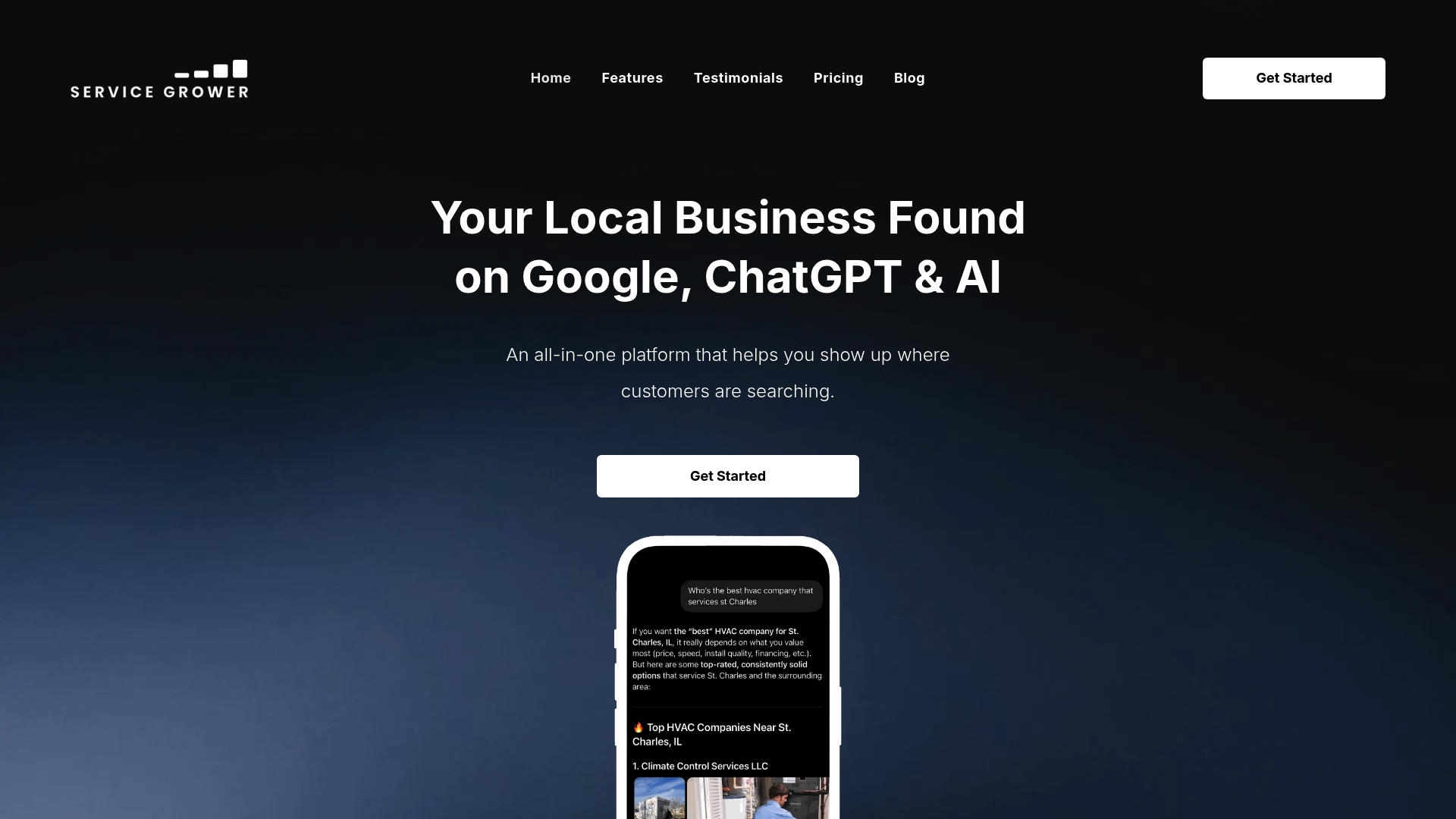
The pilot covers a keyword set built around your actual services, a citation audit against competitors in your market, and specific GTM fragment recommendations if your site needs them. From there, the Service Grower plan runs $249 per month and folds AnswerReady™ website management, reputation tracking, and AI presence monitoring into one system instead of five separate subscriptions. If you’d rather see how it stacks up against building this yourself, compare your options before deciding. Start with the free check, then decide if you want the full system running behind it.
Sources
- Introducing Search Generative AI performance reports in Search Console | Google Search Central Blog
- What 9 months of AI Overview data and 51,000+ tracked events reveal | Search Engine Land
- How to Track AI Overviews in 2026: 4-Layer Stack
FAQ
Why Am I Getting AI Overviews for My Searches?
Google triggers an AI Overview when its systems determine a summarized answer, pulled from multiple ranked sources, better serves the query than standard links alone. This tends to happen most on informational and comparison-style searches rather than highly transactional ones.
Is AI Tracking My Searches When I Use AI Overviews?
Google logs search activity the same way it does for standard results, tied to your account and device settings, not through some separate AI-specific tracking layer. Your search history settings in your Google account control this the same way they control regular search history.
How Do I Stop AI Overviews From Showing Up in My Results?
There’s no dedicated toggle to disable AI Overviews specifically, though some regions and account settings affect how often they appear. Managing your broader search personalization and history settings in your Google account is the closest available control.
Should You Trust AI Overviews as a Source?
Treat them the way you’d treat any summarized answer: useful for a quick orientation, worth verifying against the original cited sources for anything consequential. Since AI Overviews pull from pages ranked through standard E-E-A-T signals, their reliability tracks the quality of the sources they cite, not some separate AI-specific vetting process.