
 GROWTH GUIDE
2026 Roofer Marketing Playbook That Actually Books Jobs
The highest-leverage system for roofer marketing right now pairs Google Local Services Ads, targeted Search campaigns, and Meta ads with a conversion-ready website and instant follow-up automation. None of those channels work well in isolation. A roofer running LSAs without a fast CRM response, or Search Ads pointed at a generic homepage, is paying for leads that never turn into booked jobs. Client work confirms the pattern: fix the system, not just the ad spend.
TL;DR:
- Focusing on local services ads and Google Business Profile optimization provides the lowest-cost, validated leads, especially for new roofing businesses.
- Building a fast CRM and responding to leads within five minutes significantly improves close rates, making response speed more impactful than ad creative.
- Combining paid channels like LSAs, Search Ads, and Meta retargeting reduces cost per booked job and creates a more reliable, scalable marketing system.
- A well-optimized, conversion-focused website, with mobile speed and clear calls-to-action, can boost booking rates from 2-3% to over 12%.
- Implementing automated review collection and timely reputation management enhances local SEO and consumer trust, which directly increases lead quality and ranking.
Table of Contents
- What Roofer Marketing Channels Should You Run First?
- Paid Ads That Actually Scale: LSA, Search, and Meta Playbooks
- How Do You Rank in the Local Map Pack?
- What Makes a Roofing Website Actually Convert?
- Reputation Management: The System Behind the Reviews
- How Fast Should You Respond to a New Roofing Lead?
- Storm-Response Marketing: Ready Before the Wind Picks Up
- What Should You Actually Budget for Roofing Marketing?
- A Phased Roadmap for Growing Your Roofing Marketing
- How Service Grower Fits the Roofing Marketing Playbook
- The One Fix Most Roofers Skip
- Get a System, Not Just a Website
- Sources
What Roofer Marketing Channels Should You Run First?
Not every channel deserves the same dollar at every stage. LSAs earn the first budget dollar because Google verifies your license and insurance, then charges you only for leads that actually call. Search Ads pick up the homeowners already typing “roof leak repair near me,” while Meta builds demand before someone even knows they need a roof. Organic local SEO compounds slowly but eventually gets nearly free. Referrals close at the highest rate of any channel, but they take longest to scale.
- Local Services Ads (LSAs): fastest path to validated, pay-per-lead volume for a roofer just starting to invest in ads.
- Search Ads: captures high-intent searches that LSAs miss, especially for insurance-claim and commercial roofing terms.
- Meta/Facebook ads: builds brand awareness and works for storm-response surges and before/after visual proof.
- Local SEO: the compounding channel. Slow to build, cheap to maintain, hard for a rival to displace once you rank.
- Referrals: close rates beat every paid channel, but volume depends on job quality and how systematically you ask.
A shop running $1,000 to $3,000 a month should lean almost entirely on LSAs and Google Business Profile work. Once monthly spend clears $5,000, Search Ads and Meta retargeting start pulling their weight alongside LSAs.
Paid Ads That Actually Scale: LSA, Search, and Meta Playbooks
Roofing contractor advertising fails most often not because the channel is wrong, but because the setup underneath it is thin. Each paid channel needs its own structure to perform.
- Local Services Ads. Get verified (license, insurance, background check) and track answer speed obsessively. Google’s own book-rate data rewards businesses that answer calls quickly and respond to messages within minutes. LSA costs for roofing typically run $45 to $130 per lead, and because you pay only for leads Google validates, book-rate is the metric that determines whether that price is a bargain or a waste.
- Search Ads. Build campaigns around intent, not services. Split “emergency repair” from “new roof replacement” from “insurance claim help,” each with its own ad group, and maintain a negative keyword list that blocks “how to,” “DIY,” and “jobs” searches from burning budget. Every campaign should point to a dedicated landing page for that specific job type, not your homepage.
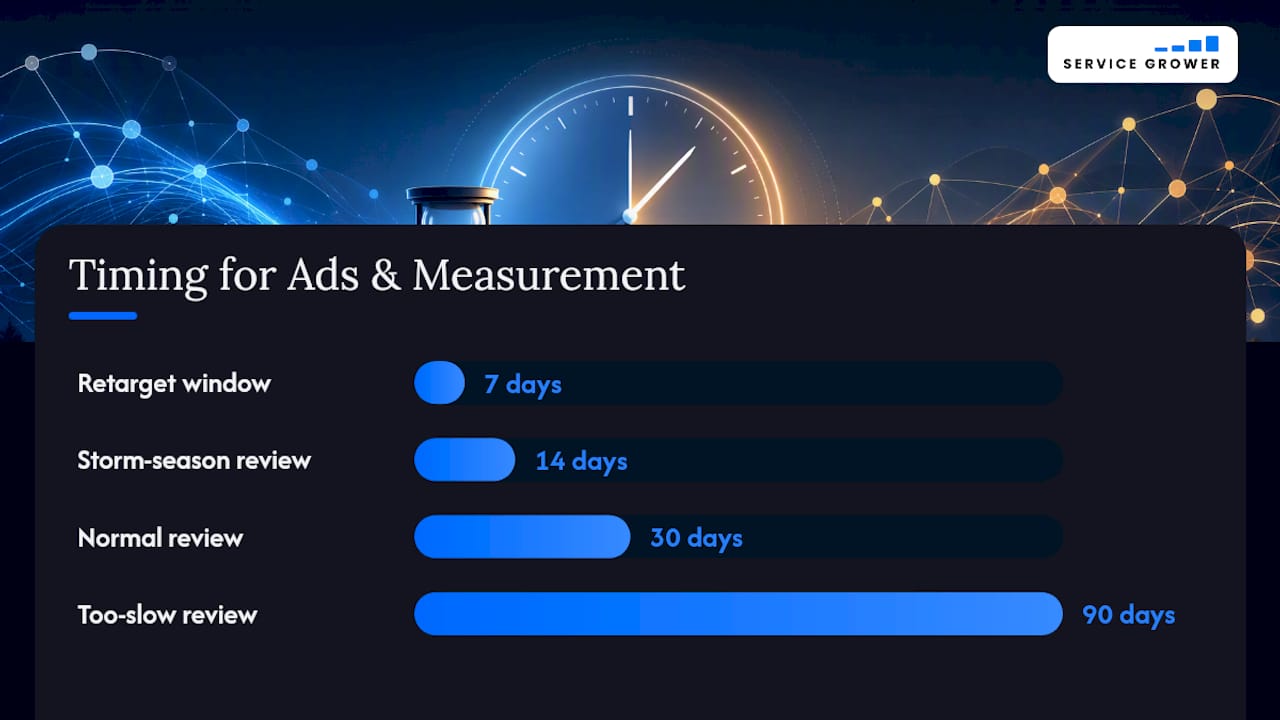
- Meta ads. Before/after photo carousels and drone footage of completed roofs outperform stock imagery by a wide margin. Layer in zip-code and house-age targeting so your digital ads reach the same streets your door-knock crews are covering, then retarget anyone who visited a landing page but didn’t call within seven days.
Measurement ties it together. Calculate Cost Per Booked Job (CPBJ), not just cost per lead, and confirm your Meta Pixel is paired with the Conversion API. Skipping CAPI causes real attribution loss that makes profitable campaigns look like losers.
Pro Tip: Review CPBJ by channel every two weeks during storm season and monthly otherwise. Weekly is too noisy; quarterly is too slow to catch a campaign that’s quietly burning cash.
How Do You Rank in the Local Map Pack?
Digital marketing for roofers still starts with a complete Google Business Profile. That means every service category filled in (roof replacement, storm damage repair, gutter installation), a real street address if you have one, current photos of actual jobs, and schema markup on your website that matches your GBP data exactly. Consistent name, address, and phone number across every directory and citation site matters more than most owners assume. Google penalizes contradictory listings by simply trusting them less.
- Fill every applicable service category in GBP, not just “roofing contractor.”
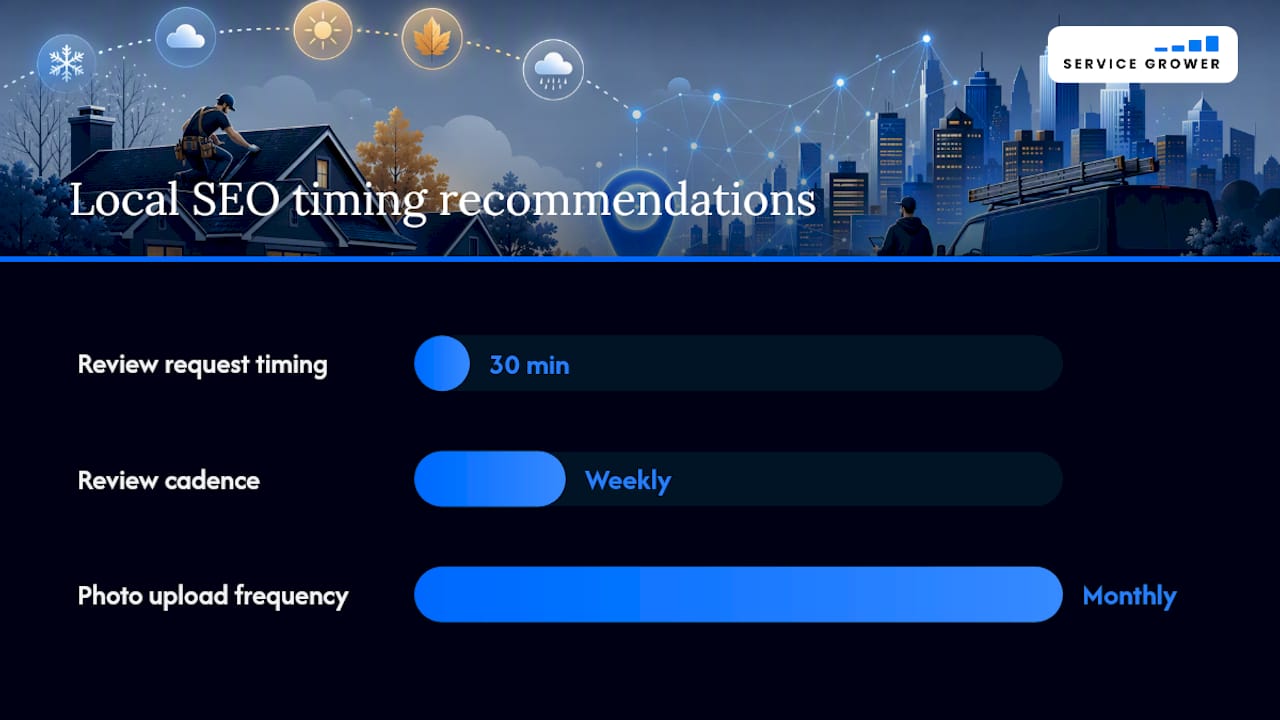
- Upload fresh job photos monthly. Stale profiles read as inactive businesses.
- Match your website’s schema markup to your GBP listing exactly.
- Keep your name, address, and phone number identical across all directories.
Reviews carry as much weight as the profile itself. Automate review requests to fire within 30 minutes of job completion, when the homeowner’s satisfaction is freshest, and aim for a steady weekly cadence rather than a burst-and-drought pattern.
City-specific landing pages round out local SEO for roofing businesses. A page titled “Roof Replacement in [City]” needs unique content: local weather patterns, permit requirements, and neighborhood examples, not a template paragraph with the city name swapped in. Google’s local ranking factors weigh prominence and review recency heavily, so a profile with reviews from last week beats one with reviews from eight months ago even if the older profile has more total reviews.
What Makes a Roofing Website Actually Convert?
Most roofing websites are digital brochures. They load slowly, bury the phone number, and give visitors six different things to click instead of one. Conversion-engineered roofing sites convert at 12% to 18%, compared to the 2% to 3% typical of an unoptimized site. That gap alone can multiply your booked jobs four to seven times without spending another dollar on ads.
The elements that make the difference are simple, not clever:
- Mobile-first design with a page load under three seconds.
- A single, unmissable call-to-action above the fold. Click-to-call on mobile, always.
- Trust badges: manufacturer certifications, insurance proof, years in business.
- Before/after photo galleries and short video walkthroughs of past jobs.
- A dedicated page per service and per city, each with a clear price range and financing options.
A service contractor website built specifically for this kind of conversion flow removes the guesswork of trying to retrofit an old template. Test one variable at a time, headline, CTA button color, form length, and give each test enough traffic to reach statistical confidence before calling a winner.
Fix the page first. It’s usually cheaper than the next month of ad spend.*
Reputation Management: The System Behind the Reviews
Homeowners choose a roofer the way they choose a surgeon: by checking what other people said afterward. A five-star average with three reviews reads as less trustworthy than a 4.7 average with 200. Volume, recency, and response quality all factor into both your map-pack ranking and a homeowner’s gut decision to call you instead of the next name on the list.
- Trigger an automated SMS review request within 30 minutes of job completion, while the crew’s work is still fresh in the homeowner’s mind.
- Target a steady flow of new reviews weekly, scaling toward 15 to 20 per week during active storm season.
- Route negative feedback to a private channel first, so an unhappy customer can be addressed before it becomes a public one-star post.
- Respond publicly to every review, positive or negative, within 24 hours.
- Keep every review request and published response compliant with FTC disclosure guidance on endorsements and testimonials.
A tool built for generating more Google reviews automatically handles the timing and routing so this doesn’t depend on a crew member remembering to text a link. Reputation management for roofing businesses is a rare case where the version with automation outperforms the manual version.
How Fast Should You Respond to a New Roofing Lead?
Speed-to-lead is the least glamorous fix in roofing lead generation, and it’s also the one most owners skip in favor of a shinier tactic. A slow response doesn’t just lose the lead. It hands the lead to the competitor who called first.
- Build the CRM first. Look for SMS automation, local caller ID (so your call doesn’t get flagged as spam), and native integration with your landing pages and call tracking.
- Fire an SMS within 60 seconds of form submission, confirming the request and setting an expectation for a callback.
- Call within five minutes. Every additional minute of delay measurably reduces the odds of reaching the homeowner at all.
- Layer in reminder sequences for anyone who doesn’t answer the first call, spaced over the next 48 hours.
A single missed call or a sluggish CRM response drops close rates in ways no bid adjustment can fix. Track three numbers weekly: response time, contact rate, and lead-to-booked-job rate. If response time creeps past five minutes, every dollar spent upstream on LSAs and Search Ads is quietly losing value regardless of how good the ad copy was.
Storm-Response Marketing: Ready Before the Wind Picks Up
Storm season rewards the roofer who prepared weeks in advance and punishes the one scrambling to build a landing page while the phone is already ringing. The playbook has to exist before the storm does.
- Prebuild storm assets: a dedicated storm-damage landing page, ad creative featuring drone shots of typical hail and wind damage, and an SMS list segmented by past customers and warm leads.
- Activate within 2 to 4 hours of a confirmed storm event, before competitors even finish assessing the damage.
- Pair digital retargeting with door-knock crews, using the same zip-code data to hit both channels at once for maximum recall.
- Pause storm campaigns after 4 to 6 weeks, once claim volume in that market normalizes, so budget doesn’t keep burning on a surge that’s already over.
- Publish homeowner education content warning against storm-chasing scammers. It protects your brand and often earns a share of the trust competitors lose.
Storm demand is real, but it has to sit on top of always-on SEO and referral systems, not replace them. A roofer who only markets during storms lives in a feast-or-famine cycle that makes hiring and cash flow unpredictable the other ten months of the year.
What Should You Actually Budget for Roofing Marketing?
Every channel has a real cost-per-lead range, and pretending otherwise is how owners overspend on the wrong mix. LSAs run roughly $45 to $130 per lead, with book-rates that make them a strong starting point. Search Ads tend to cost more per click but bring higher intent. Meta costs less per lead but converts at a lower rate unless retargeting is dialed in. Shared lead aggregators look cheap upfront but close at only 5% to 15%, which often makes their true cost per booked job worse than an exclusive channel that costs more per lead.
- $1,000 to $3,000/month: LSAs plus GBP optimization. Skip Meta and Search until the foundation converts well.
- $3,000 to $7,000/month: Add Search Ads for high-intent terms and start city-specific landing pages.
- $7,000 to $15,000/month: Layer in Meta for demand generation and retargeting, with dedicated storm-response reserves.
Cost Per Booked Job is the number that actually matters, since it accounts for both lead cost and close rate in one figure. A multi-channel mix using LSAs, Search, Meta, SEO, and referrals together consistently produces a lower CPBJ than any single channel run alone.
A Phased Roadmap for Growing Your Roofing Marketing
Trying to run every tactic at once is how a $2,000 monthly budget gets spread so thin that nothing works. Sequence the work by revenue stage instead.
- Foundation phase. Complete your Google Business Profile, launch automated review requests, build one conversion-ready landing page per core service, turn on LSAs, and set up basic CRM automation for speed-to-lead.
- Scaling phase. Expand into city-specific landing pages for each market you serve, layer in Search Ads and Meta on top of LSAs, formalize a referral program with tracked incentives, and build a repeatable sales process for estimates and follow-up.
- Brand phase. Pursue manufacturer certifications and co-marketing partnerships, optimize marketing separately for each additional location, and build out sales operations that support a team of estimators rather than one owner doing every call.
Sequence matters more than most owners expect.
How Service Grower Fits the Roofing Marketing Playbook
Every system described above, review automation, conversion-ready pages, fast follow-up, works better when it runs on one platform instead of five disconnected tools. Service Grower brings those pieces together specifically for local service businesses, roofing included.
- AnswerReady™ Websites built to answer the questions AI search engines and homeowners actually ask, not generic service copy.
- Review management that automates request timing and routes negative feedback privately before it becomes public.
- SmartRequest booking forms that capture leads directly into a tracked pipeline instead of an email inbox someone checks twice a day.
- GrowthView analytics that show which channels are producing booked jobs, not just clicks.
- Optional managed Google and Meta ad packages for roofers who want the paid-channel playbook run for them.
Stitching together five separate vendors for a website, review tool, CRM, and ad management usually means five separate logins, five support lines, and data that never quite matches across platforms. An integrated approach cuts that friction and shortens the time between signing up and seeing booked jobs on the calendar.
The One Fix Most Roofers Skip
Roofers obsess over ad targeting and creative, and both matter. But the single biggest lever we see get ignored is what happens in the first five minutes after a lead comes in. A roofer with mediocre ads and a five-minute call-back beats a roofer with brilliant ads and a same-day call-back, every time. Fix your follow-up speed and your landing pages before you touch your ad budget again. Clients who tighten those two things first consistently see their existing ad spend produce more booked jobs without a single dollar of new spend.
— Service Grower
Get a System, Not Just a Website
There are other routes to solving this: hiring a specialized roofing ad agency, buying shared leads from an aggregator, or piecing together a website builder, a separate review tool, and a standalone CRM yourself. Each works to a degree, but each also means separate bills, separate logins, and data that doesn’t talk to each other.
Service Grower gives roofers one platform instead of five: an AnswerReady™ website built to convert, automated review requests, a booking and lead-tracking system, and reporting that shows which channel is actually producing booked jobs, with managed Google and Meta ad options if you want that piece handled too. It’s built for local businesses that need visibility across both traditional search and AI-driven search results, not just a pretty homepage. If your roofing company isn’t showing up when homeowners search nearby, start with a Free AI Visibility Check to see exactly where you’re losing leads before you spend another dollar on ads.
Sources
Figures on LSA costs and book-rates come from PipelineOn’s 2026 roofing marketing benchmarks. Conversion-rate ranges and storm-response guidance draw from Digital Footprint Solutions’ complete roofing marketing guide. Multi-channel CPBJ benchmarks come from Elev8 Operations’ 12-channel playbook. Review and endorsement compliance follows FTC disclosure guidance and this breakdown of the FTC’s fake reviews rule.
- Roofing Digital Marketing in 2026
- The Complete Guide to Roofing Marketing in 2026 | DFS
- How to Get More Roofing Leads in 2026 (12-Channel Playbook) — Elev8 Operations
- FTC revises online-advertising disclosure guidelines